Mirror Life: Why Scientists Want to Stop This Discovery
Creating a life form that no organism in nature could recognize has led to one of the strangest scientific decisions humanity has ever made.
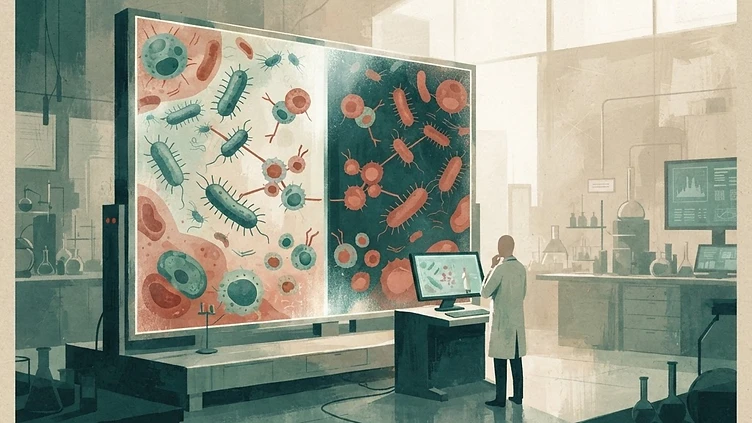
Sometimes, science's most striking moment is not when it discovers something, but when it chooses to forgo what it could potentially find. Last year, in the quiet corners of laboratories, a strange decision was made regarding a life form no one had yet created: it was decided not to create it. This was not a retreat stemming from technical impossibility; on the contrary, it was a braking action born from the proximity of possibility. Mirror life refers to organisms built with a molecular symmetry that nature has never encountered. This is precisely where the crux of the matter lies: humanity stood on the brink of something it could build with its own hands but could never recall, and perhaps signed one of the strangest precautionary decisions in the history of science. So, what was the fear that convinced so many researchers simultaneously, and what invisible rule drew such a precise line? ## Life's Secret Preference for Handedness In the chemical world, some molecules are like our right and left hands; they are made of the same parts, are mirror images of each other, but never overlap perfectly when placed on top. This property is called chirality, and life chose only one of these two possibilities billions of years ago. Almost all amino acids used by living cells are in the left-hand form, while almost all sugars are in the right-hand form. This choice is so deeply rooted that no organism living on Earth today deviates from this rule; from bacteria to humans, every cell functions with the same molecular preference. It is as if nature has an unwritten agreement that every living thing silently obeys. Understanding that this consistency is a necessity rather than a coincidence requires looking at how proteins fold. To recognize its substrate, an enzyme requires precise geometry, much like a lock needs its key; a molecule from the wrong hand, even if it consists of the same atoms, will not fit the lock. Imagine trying to wear a right-hand glove on your left hand; the material is the same, the stitching is the same, but the fingers simply do not fit. Life has tuned this harmony so finely over billions of years that even the DNA helix always rotates in the same direction. This small but universal rule forms the invisible skeleton of biology, and precisely for this reason, an experiment that reverses this skeleton transforms from mere scientific curiosity into an existential question. ## The Danger Created from the Mirror In recent years, the advancement of biotechnology has brought scientists closer to an increasingly daring question: what if we were to re-engineer all the molecular components of an organism, from its DNA to its cell membrane, with the opposite of this universal preference? This scenario, which seems theoretically possible, could reveal a being called mirror bacteria; a living thing that possesses all the rules of life but is written in total reverse. What is truly frightening here is not that this bacterium might be toxic or aggressive; on the contrary, it is that our immune system would never even notice it. Immunity works by recognizing the shape of molecules through antibodies and enzymes; if that shape is reflected from a mirror, the system cannot even see the enemy. It is like an alarm system failing to notice someone entering through the door because it does not recognize their shape; the danger remains, but it stays invisible. This invisibility poses a risk not only for the human body but for the entire ecosystem. Viruses, bacteriophages, and even single-celled organisms that keep natural bacteria in balance have been programmed throughout billions of years of evolution to recognize the same chiral form. A mirror bacterium would fall completely outside this prey-predator chain; it could neither be infected by a virus nor consumed by a predator. This means that if it were released, it could multiply uncontrollably, and no natural balancing mechanism could stop it. The issue here is not toxicity, but the risk of creating a kind of biological ghost; an entity that nature cannot see and therefore cannot resist. ## Science Applying Its Own Brakes In 2024, hundreds of researchers signed a joint call against this scenario, which has not yet been fully realized technically, and requested that mirror life research be halted. The extraordinary aspect of this call was that it reversed science's habit of implementing regulations only after damage has occurred; here, a stance was taken based solely on the weight of a possible scenario before any harm existed. Moreover, this was not a ban from the outside, but a consensus reached among scientists themselves; they drew the boundaries of their own curiosity and skills with their own hands. Reading this decision merely as a safety precaution would mean missing the true depth of the matter. There is a rare kind of scientific maturity here; the drive to know is balanced by the capacity to weigh the cost of that knowledge. Of course, there are those who object: they argue that such an early brake might overlook the potential benefits mirror molecules offer in medicine, such as drug molecules that could remain intact in the body for longer periods. This objection is partially valid, as mirror molecules are already used safely in drug development. But the subject here is not a single molecule, but an entire self-replicating organism that cannot be recalled once it goes out of control; and this difference completely changes the scale of the risk. The story of mirror life is actually less about bacteria and more about what it means to recognize a boundary before crossing it. Perhaps for the first time, humanity has chosen to postpone something it could do, not because it could, but because it could envision the consequences in its mind. This seems like a small but meaningful victory of science against its own pace; a rare moment where responsibility, rather than curiosity, takes the lead. Perhaps the question that should be asked is not whether mirror bacteria will one day be created, but how often humanity can say stop at such thresholds.
İlgili Denemeler
Can the Human Brain Detect Magnetic Fields?
Geophysicist Joseph Kirschvink's experiment at Caltech indicates that the human brain responds to magnetic fields, raising questions about a potential sixth sense.
Jan Hendrik Schön: The Physicist Who Fooled Science
The scandal of Jan Hendrik Schön's fabricated data at Bell Labs highlights the critical vulnerabilities in the scientific peer-review system.
Barry Marshall Drank Bacteria to Prove Stomach Ulcer Theory
Barry Marshall made medical history by consuming harmful bacteria to prove that stomach ulcers are caused by an infection rather than stress alone.
Tartışma (0)
Henüz yorum yok. İlk yorumu siz yapın.
Join the Newsletter
New essays, once a week, delivered to your inbox.