Michael Gazzaniga: Two Distinct Minds in One Brain
A severed brain connection intended to stop epileptic seizures raised the unsettling question of whether two separate minds can exist within a single body.
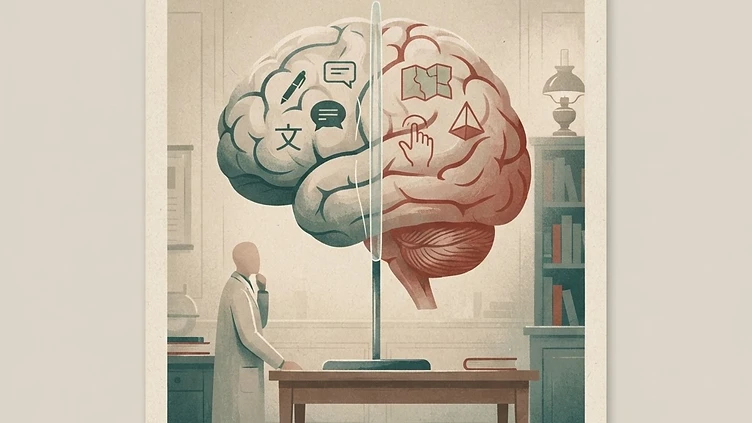
We harbor an almost unquestioned belief that our minds are governed by a single center, and that the 'self' is an indivisible whole. Whether we are drinking a cup of coffee or making a life-altering decision, we assume a single voice speaks from within. Yet, this intuition was shaken to its core by one of neuroscience's most peculiar and unsettling experiments. On the operating table, a thin strip of tissue, severed to halt severe epileptic seizures, revealed that two distinct minds could exist side-by-side within our skulls, unaware of each other. Michael Gazzaniga’s name was written into the history of neuroscience with this very discovery; by revealing that the brain’s two hemispheres could function independently, he forced us to re-evaluate the nature of consciousness. ## What Happens When the Corpus Callosum Is Severed? The left and right hemispheres of our brain are connected by a dense bundle of nerve fibers known as the corpus callosum. Through this link, the two sides constantly exchange information, share memories, and act as if seeing the same world. However, in some epileptic patients, seizures utilized this bridge to leap from one hemisphere to the other, seizing the entire brain. By the mid-twentieth century, surgeons turned to a desperate solution: severing the corpus callosum to completely isolate the two hemispheres. Seizures decreased, and patients returned to daily life. Yet, in the short time that followed, inexplicable and unforeseen oddities began to emerge in these individuals' behaviors. Externally, the patients appeared perfectly healthy; they spoke, walked, and went about their daily routines. But under laboratory conditions, using specially designed visual tests, something strange appeared. Sometimes, a patient could not name an object seen with their left eye; at other times, they could not recognize a movement performed by one hand with the other. Gazzaniga observed these patients patiently for years, documenting that the two hemispheres could process information independently, or even generate conflicting reactions simultaneously. It was as if two separate operating systems were running in parallel within the same skull, but the cable connecting them was gone. ## The Left Hand Does Not Know What the Right Hand Is Doing One of the experiments that most strikingly demonstrated this contradiction relied on splitting the visual field. A screen was placed before a patient; an image was shown on the left side, and a different image on the right. Due to the brain's anatomy, information from the left visual field went to the right hemisphere, while information from the right went to the left. Since the speech center is typically located in the left hemisphere, the patient could easily name the object seen on the right, but struggled to name the object on the left. Conversely, the same patient could correctly identify and retrieve the object seen on the left with their left hand. The body knew through touch what language could not articulate. This signaled something far deeper than a simple sensory deficit. In some experiments, the two hands exhibited contradictory behaviors; one hand would button a shirt while the other tried to unbutton it, or one hand would reach for an object while the other reached for a different one. This was not merely a loss of motor control; it demonstrated that two hemispheres could simultaneously generate different preferences, intentions, and minor decisions. Gazzaniga's observations also showed that the left hemisphere was constantly weaving a narrative, creating a story to explain what was happening; the body would act, and the language center would try to link that action to a logical reason. But was the storyteller narrating the truth, or merely inventing an explanation to maintain its own consistency? ## How Many 'Selves' Are in One Body? Facing these findings, one cannot help but ask: is the 'self' truly singular? Gazzaniga’s patients behaved as undivided, integrated individuals in daily life; no one felt split in two, nor did they feel that way themselves. Yet, experiments showed that underneath that wholeness, two relatively independent processes worked simultaneously. This strengthened the idea that consciousness arises not from a central command room, but from many small systems constantly negotiating with one another. Perhaps a similar multiplicity exists in normal brains as well, only the corpus callosum masks it so effectively that we remain unaware. A skeptic might argue that split-brain patients are an exceptional case, the result of a surgical intervention, and that in a healthy brain, consciousness remains singular and whole. This objection has merit, as the two hemispheres in healthy individuals are in constant communication. But Gazzaniga’s true contribution was using this exceptional case to show that the normal brain, too, might not be a single voice, but a consensus of many voices constantly balancing one another. The crack that appeared without the corpus callosum merely made an existing structure visible; it did not invent a division out of nothing. To visualize this, imagine a scene: a split-brain patient is shown a winter landscape in their left visual field and a chicken in their right. When asked to choose a matching picture, their left hand picks a snow shovel because the right hemisphere saw the winter scene. However, when the patient attempts to explain why their hand picked the shovel using their left hemisphere’s speaking voice, they provide a completely fabricated but internally consistent reason, such as 'to clean the chicken coop.' Here, two separate systems possess two different pieces of information, but only one has the power of speech, and it rewrites events to suit its own logic. This small scene illuminates the negotiation that goes on within us all, albeit more quietly. Gazzaniga’s legacy lies not in providing a definitive answer, but in reopening a question with which we were comfortable. Seeing that two separate consciousnesses can exist in one brain forces us to reconsider how solid and singular our 'self' really is. Perhaps the self was never a fixed entity governed by a single center; perhaps each of us lives through a temporary and fragile consensus of the many voices within. The story of split-brain patients remains not just a peculiar corner of medicine, but one of the most chilling and enlightening moments in the human effort to understand the self.
İlgili Denemeler
Can the Human Brain Detect Magnetic Fields?
Geophysicist Joseph Kirschvink's experiment at Caltech indicates that the human brain responds to magnetic fields, raising questions about a potential sixth sense.
Jan Hendrik Schön: The Physicist Who Fooled Science
The scandal of Jan Hendrik Schön's fabricated data at Bell Labs highlights the critical vulnerabilities in the scientific peer-review system.
Barry Marshall Drank Bacteria to Prove Stomach Ulcer Theory
Barry Marshall made medical history by consuming harmful bacteria to prove that stomach ulcers are caused by an infection rather than stress alone.
Tartışma (0)
Henüz yorum yok. İlk yorumu siz yapın.
Join the Newsletter
New essays, once a week, delivered to your inbox.