The Long Now Clock: A 10,000-Year Engineering Riddle
Funded by Jeff Bezos and buried deep within a mountain, how does this clock force humanity to consider the distant future?
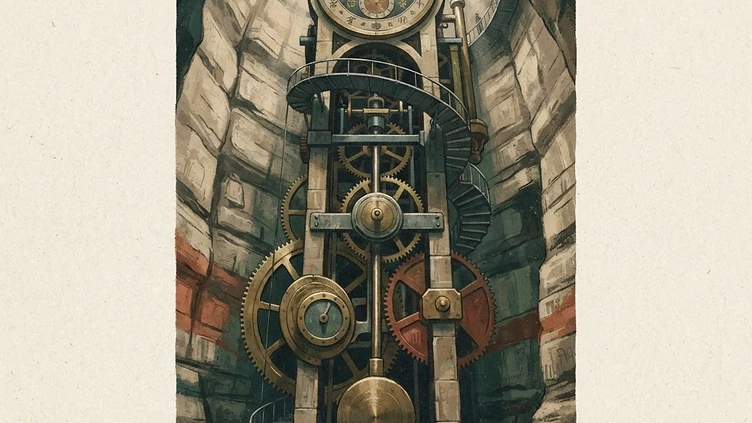
When we ask how humanity relates to time, we typically think of calendars, alarms, and deadlines—tools we use to break time into manageable segments. Yet, in the belly of an arid mountain in Texas, there exists a clock that does the exact opposite. Designed to function for ten thousand years, this machine teaches us to count not in minutes, but in generations. Funded by Jeff Bezos and born from the vision of Danny Hillis, this project stands less as a timepiece and more as a patient letter written to the future. Why, then, would one build a machine for people we will never meet, and how does this question hold a mirror up to science itself? ## Danny Hillis' Dream: A Machine Resistant to Time Danny Hillis is a computer engineer, meaning his career exists in the fastest-decaying corner of technology. Processors become obsolete every two years, software becomes unusable without updates, and hardware turns into junk. Hillis' peculiar idea was born from this very speed; he asked himself if it were possible to design something durable in a world that ages so quickly. This question grew beyond mere curiosity into a manifesto. Hillis was not just seeking a long-lasting tool, but offering a rebuttal to the human mind's habit of short-term thinking. What is fascinating here is that the project proceeds more from a philosophical stance than a technical curiosity. As the community gathered around Hillis designed the gears of the clock, they were effectively designing humanity's sense of responsibility toward the future. For an engineer, ten thousand years is not merely an equation to solve; it is a paradox of working without knowing who you are working for. Since those who see the clock will be our descendants—people we will never know—the project gains a peculiar humility, where engineering becomes not an ego trip, but a cross-generational promise. ## Lasting 10,000 Years: Can the Problem of Material and Maintenance Be Solved? Making a machine last ten years is one thing; making it last ten thousand is another. The clock's parts are forged from stainless materials, as oxidation is time's most patient enemy. Yet, the material is only the surface; the real challenge is creating a self-verifying system that requires no maintenance. By synchronizing itself with the sun's position at noon, the mechanism can determine the correct time without human intervention. This shifts the fundamental question: engineering must now serve not the user of today, but someone in a future whose existence we cannot even conceive. One might immediately object that no structure or technology in human history has functioned continuously for thousands of years. While pyramids stand, they are no longer used as tombs; ancient aqueducts remain, but no one drinks from them. Perhaps the clock's success lies not in its continued operation, but in keeping the possibility of that operation alive. The project does not promise an indestructible object; it asks us to interrogate what it means to resist decay in every generation. Perhaps the true engineering achievement lies not in the clock itself, but in the minds of those who continue to think about it. ## The Thought of the Long Now: Where Does Science Stand Regarding Short-Term Intellect? The very name of the Long Now Foundation is a form of objection; it suggests viewing the present not as trapped within the narrow boundaries of today, but as a broad time span between past and future. In the world of science and technology, this perspective is unconventional, as the pressure for academic publishing, the speed expectations of venture capital, and the market's quest for instant profit trap us in short cycles. A laboratory must produce results in three years, and a company is judged by its quarterly reports. The existence of this clock reminds us that something outside this cycle is possible—that science can prepare for questions that do not yet exist, rather than merely responding to current crises. Certainly, some may call this a luxury gesture; one might argue that while the world has urgent problems, burying a clock in a mountain looks like an expensive toy for a rich entrepreneur. But this objection misses a point: the capacity for long-term thinking does not conflict with our ability to solve short-term crises; rather, it nourishes it. Issues like climate change or the societal impacts of artificial intelligence are difficult precisely because their consequences emerge decades later, and our minds are not accustomed to looking that far ahead. The clock acts as a tool that exercises this ability to see; it is as practical a reminder as it is symbolic. I do not know what time that silent mechanism inside the mountain is showing right now, but I do not believe that is what matters. What is important is not that someone goes there to find the clock and sees it still ticking; it is the small mental shift that comes from knowing it exists. Perhaps science draws its greatest strength not from the problems it solves, but from the scale of time it forces us to consider. And perhaps, with a chime we may never hear, this clock whispers to the hurried mind of today that patience, too, can be an engineering material.
İlgili Denemeler
Can the Human Brain Detect Magnetic Fields?
Geophysicist Joseph Kirschvink's experiment at Caltech indicates that the human brain responds to magnetic fields, raising questions about a potential sixth sense.
Jan Hendrik Schön: The Physicist Who Fooled Science
The scandal of Jan Hendrik Schön's fabricated data at Bell Labs highlights the critical vulnerabilities in the scientific peer-review system.
Barry Marshall Drank Bacteria to Prove Stomach Ulcer Theory
Barry Marshall made medical history by consuming harmful bacteria to prove that stomach ulcers are caused by an infection rather than stress alone.
Tartışma (0)
Henüz yorum yok. İlk yorumu siz yapın.
Join the Newsletter
New essays, once a week, delivered to your inbox.