Hacı Bekir: The Legendary Journey of Turkish Delight
How did a small candy shop in Bahçekapı leave a sweet mark on the world that remains vibrant two centuries later?
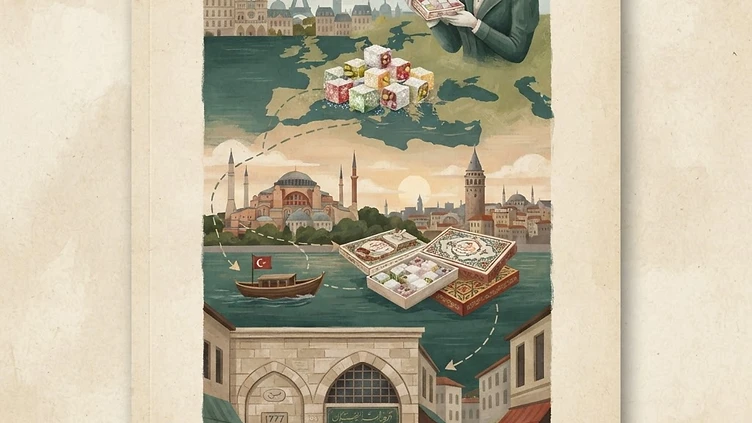
Have you ever wondered how many centuries a piece of candy can survive? Most sweets remain trapped within the walls of the kitchen where they were born; one generation loves them, the next forgets, and the recipe yellows in a notebook. Yet, Turkish Delight did not. It moved from the narrow streets of Bahçekapı to every neighborhood in Istanbul, then to the salons of Europe, and finally to supermarket shelves in almost every countryy on earth. Is it not astounding that something so simple, made of flour, sugar, and starch, could embark on such an enduring journey? When I ask myself this, I realize the answer lies not in the recipe itself, but in the hands that carried it and the sense of loyalty that guided those hands. ## The Silent Beginning of an Apprenticeship The small shop opened in 1777 in Bahçekapı showed no signs of grandeur by today’s standards. It had neither a wide display window nor an ambitious sign. What Hacı Bekir did was simply to bring a pleasure hidden in the palace kitchens out into the streets. Until then, Turkish Delight was a rarity seen mostly at the tables of the elite; for an ordinary Istanbullu to encounter it, one had to attend an invitation or enter through a familiar door. Hacı Bekir dismantled this barrier and transformed luxury into a street delicacy. Today, we call this democratization, but for the people of that time, the word never crossed their minds; they only knew that with a few coins in their pockets, they were accessing a taste they had once only imagined. What is interesting here is that this shift occurred not through revolutionary rhetoric, but through a discipline of quiet craftsmanship. Hacı Bekir wrote no manifesto and shouted no slogans; he simply boiled sugar with the same precision every day, molded it with the same care, and waited with the same patience. Perhaps most great changes begin this way, in the hands of a master who is quiet and focused on his work. One might ask: why do we care so much about the opening of a candy shop? Because this small story shows us how a society’s taste evolves and how something leaks from the palace walls to the street. The democratization of Turkish Delight was, in fact, a quiet revolution a city performed upon itself. ## The Same Name, The Same Recipe, A New Century When a business founder dies, the spirit of the enterprise usually fades away as well. Yet, the Hacı Bekir family did the exact opposite: they did not change the name, they did not alter the recipe, and they kept the shop’s identity in the same mold for generations. This is an example of what modern marketing calls brand continuity, which emerged spontaneously within Ottoman craft culture. Think about it: carrying a name given by a family a century ago also means carrying the expectations behind that name. Each new generation has felt compelled not to betray the trust left by the previous one; this is a kind of silent contract, an unwritten agreement reaffirmed every single day. A counter-question might arise here: is staying with the same name and recipe not a sign of stagnation? One might think that surviving without innovation or change is merely clinging to nostalgia. I do not agree. Because continuity itself creates value over time; the longer a name is repeated with the same quality, the more reliable it becomes. When we see the Hacı Bekir name on a box of delight today, it offers us not just a promise of flavor, but a promise of two centuries of loyalty. The entire effort of modern branding is essentially an attempt to manufacture this trust artificially; the Hacı Bekir family built it organically over time. Perhaps true brand consciousness lies not in logo design, but in carrying a name across generations. ## The East’s Sweet, The World’s Commodity The arrival of Turkish Delight in Europe is a story in itself, and Western travelers and merchants passing through Istanbul played a major role. Foreigners visiting the city took this soft, powdered treat back to their own countries and gave it a name: Turkish Delight. This naming was the beginning of a process of acquiring an identity. When a delicacy leaves the language of its native soil and is renamed in another, it ceases to be just food and becomes a representative of a country and a culture. When they hear Turkish Delight, Western ears hear not just a sweet, but the image of an oriental world and an exotic geography. At this point, one might ask: is the transformation of a local delicacy into an international symbol always a gain, or does it also contain a loss? Because when the name changes, the meaning sometimes shifts; on European shelves, Turkish Delight often became a much simpler, more standardized product than the one Hacı Bekir carefully boiled. Yet, I believe the gain outweighs this loss. Because the worldwide recognition of a flavor also feeds curiosity about its origins; today, many people still head to Istanbul, even directly to that shop in Bahçekapı, to learn about the original, true version of Turkish Delight. The transformation of the local into a global symbol sometimes makes us forget its origin, but sometimes it refreshes the curiosity about it; the story of Turkish Delight resembles this second possibility. Looking at this entire journey, I see that the conquest of Turkish Delight was never achieved by an army or politics. A master’s patience, a family’s loyalty, and the inherent appeal of a flavor took it out of a candy shop and into the mouths of the world. Perhaps this reminds us that greatness does not always arrive with a loud move; sometimes, it waits quietly inside a small mold. The aroma that emerged from that shop door in Bahçekapı two centuries ago may still be leaving the same sweet mark somewhere, on the palate of a stranger; this shows me that the patience of craftsmanship is sometimes more enduring than the speed of history.
İlgili Denemeler
The Mechanical Turk: History's Chess-Playing Mystery
The chess-playing automaton known as the Mechanical Turk deceived figures like Napoleon and Benjamin Franklin, masking a hidden human operator as a machine.
Bournville: The Utopian Town Built by Chocolate
The streets, gardens, and teetotal order of Bournville reveal how the Quaker faith imprinted a distinct form of morality upon the foundations of industry.
Levi's: The Story of Riveted Jeans Born from Gold Rush
In 1873, a tailor's discovery of a riveted solution for torn pockets redirected the true fortune of the gold rush toward the enduring garment industry.
Tartışma (0)
Henüz yorum yok. İlk yorumu siz yapın.
Join the Newsletter
New essays, once a week, delivered to your inbox.