From Tire Guide to Culinary Icon: The Michelin Story
A tire factory once taught people where to go and what to eat to get them on the road.
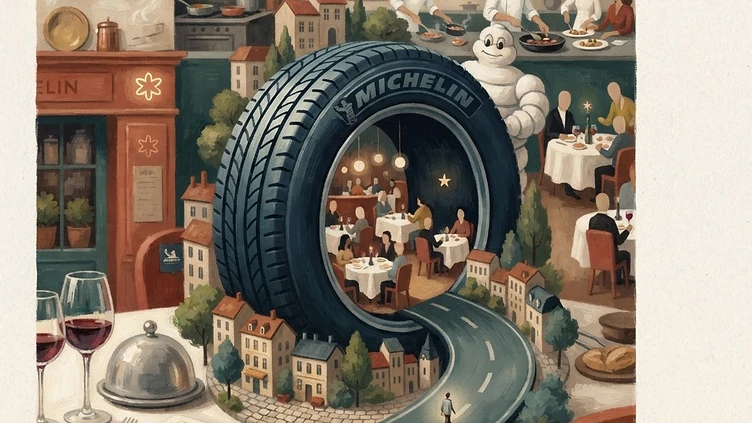
Who could have predicted that a tire factory would one day turn into the world's most respected culinary authority? Moreover, this transformation was not a conscious strategy, but the result of a commercial maneuver that began almost by accident. The story of Michelin comes from a time when a company, which today gifts us one of the most serious benchmarks in the gastronomy world, was actually trying to convince people not to eat, but to hit the road. Understanding this strange journey is a good opportunity to see how brands can exceed their own intentions, and sometimes, break free from their own control to assume a completely different identity. ## A Guide Created to Wear Down Tires Let us go back to 1900. In France, the automobile was still an object of curiosity, a luxury toy. The number of vehicles on the road was so low that it was quite difficult for a tire manufacturer to make money from this market. At this point, the Michelin brothers clung to a simple but clever idea: to encourage people to drive more and go to more distant places. Because the more kilometers traveled, the more tires would wear out, and the more tires would be sold. The logic was extremely simple; it had nothing to do with gastronomy or tourism. The guide they printed for this purpose was, in the eyes of today, an almost humble document. It contained road maps, addresses of car mechanics, locations of gas stations, and places to stay. It was distributed for free because the goal was not to make a profit, but to get people on the road. No one at that time thought this small booklet would one day turn into a worldwide symbol of authority, of course. The Michelin brothers just wanted to sell tires, but in doing so, they were unwittingly creating a habit: a habit that led people to think not only about where they could go, but also about what they would find once they arrived. ## Authority Built by Secret Inspectors As time went on, the guide changed. The star system added to the guide in 1926 is the real turning point of the story. Because by then, the issue was no longer just about giving directions; it had entered a completely different field, such as evaluating restaurants and eateries based on food quality. But how can a tire company be a reliable authority on food? This question comes to mind immediately, and the answer is right here: through independent, anonymous inspectors. These inspectors visited restaurants like ordinary customers no one knew, ate meals, evaluated the service, and never revealed their identities. This secrecy was the system's most powerful weapon, as it was impossible for a restaurant owner to recognize the person inspecting them and give them special treatment. The evaluation criteria were kept strictly in place, and the process of awarding stars was based on a consistent metric rather than arbitrary taste. This meticulousness, over time, allowed the guide to evolve from a commercial marketing tool into something else entirely. People now trusted the Michelin star as if it were the seal of a government institution. This trust, backed by a tire company, was not based on any official authority, but strangely, it was respected more than an official one. There is an interesting paradox here: the question of how a company driven by commercial interests became a symbol of impartiality. Normally, a brand creating an evaluation system that serves its own interests would fill people with suspicion. Yet, in Michelin's case, the exact opposite happened because the company chose not to hide its interests, but rather to build a transparent methodology. Perhaps this choice shows us that the real source of trust is not secrecy, but consistency. ## The Legacy Left by the Tire Today, if you say Michelin to someone on the street, it is highly likely that tires will not be the first thing that comes to their mind. What will come to mind is that small star symbol that changes a chef's life, forces a restaurant to close its doors, or suddenly boost a restaurant's reputation.rings world-wide fame.rings fame to a restaurant.rings global fame. The company's main line of business, tire production, is of course still ongoing, but it has been relegated to the background in cultural memory. This is a kind of ironic reversal: the by-product created to sell a product has eclipsed the product itself. At this point, one must ask: how fair is it that a chef's years of hard work are weighed so sharply by the winning or losing of a single star? Some chefs speak of the pressure of this system, while others, conversely, say that this star was the most important turning point of their careers. Perhaps there is no balance here, but this lack of balance is proof of how powerful a cultural authority the system has become. Because nothing is considered real power if it cannot influence human life so deeply. That is exactly why the Michelin star continues to be the most discussed, most debated metric in the world of gastronomy. This story also reminds us of the gap between a company's intention and the impact it creates. The Michelin brothers probably just wanted to sell more tires; they had no goal of establishing a cultural authority. But time took their small marketing move and turned it into something else entirely. This shows us that sometimes the greatness of an idea is measured not by the intention of the one who started it, but by how that idea evolves over time. Today, while the news of a restaurant winning a Michelin star hits headlines around the world, few remember that the origins of this star are based on the marketing strategy of a tire factory. Perhaps this oblivion is the most beautiful part of the story. Because the more something turns into an institutional authority, the more it makes people forget the ordinary, even slightly ridiculous, intention at its core. The fact that a guide released to sell tires now has the power to change a chef's life shows us that brands do not hold their destinies in their own hands; sometimes, time and the meaning given by people change everything.
İlgili Denemeler
The Mechanical Turk: History's Chess-Playing Mystery
The chess-playing automaton known as the Mechanical Turk deceived figures like Napoleon and Benjamin Franklin, masking a hidden human operator as a machine.
Bournville: The Utopian Town Built by Chocolate
The streets, gardens, and teetotal order of Bournville reveal how the Quaker faith imprinted a distinct form of morality upon the foundations of industry.
Levi's: The Story of Riveted Jeans Born from Gold Rush
In 1873, a tailor's discovery of a riveted solution for torn pockets redirected the true fortune of the gold rush toward the enduring garment industry.
Tartışma (0)
Henüz yorum yok. İlk yorumu siz yapın.
Join the Newsletter
New essays, once a week, delivered to your inbox.