Kuru Disease: From Cannibalism to Prion Science
How did a mourning ritual of a tribe in Papua New Guinea introduce modern medicine to a completely different type of pathogen?
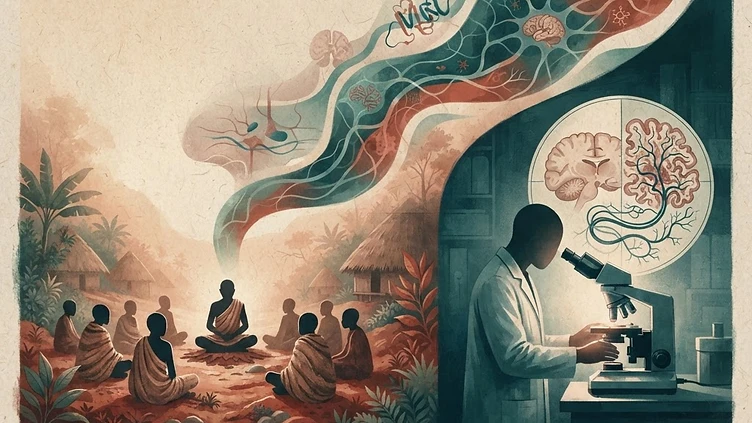
When you hear the story of a disease, you sometimes feel as if you are listening to a mythology rather than medical history. This is exactly what happened to the Fore tribe living in the mountainous highlands of Papua New Guinea. These people, who mourned by eating the bodies—especially the brains—of their loved ones, were unknowingly inviting death into a ritual they nurtured with love. Today, this practice sounds horrific, but for them, it was not an act of revenge or cruelty; rather, it was a form of continuity: ensuring the spirit and strength of the deceased remained within the family. However, hidden within this compassionate gesture was a deadly mechanism that no scientist at the time could fully identify. This article explains how a mourning ritual paved the way for one of modern medicine’s most peculiar discoveries: prions. ## A Tribal Funeral Ritual In the Fore tribe, death did not mean the individual was completely separated from their family. During funeral rites, women carefully prepared the bodies of deceased relatives and consumed various organs, including the brain. There was no hunger or malice behind this behavior; on the contrary, it was the most intense expression of respect, devotion, and love. It was believed that the wisdom, strength, and identity of the deceased needed to be passed on to the living, and this transition occurred through the sharing of the body. Consider this: a society tied its way of mourning to such a ritual, which appeared to have continued seamlessly for generations. But there was something invisible within the ritual. If the deceased had died specifically from kuru, they carried an agent in their brain that no one could even name at the time. This agent was resistant even to cooking temperatures and entered the bodies of the women through open wounds on their hands while preparing food, or via ingestion. This was why women and children were far more susceptible to the disease than men; they were the ones who typically prepared and shared the brain. An act performed with love transforming into a transmission chain without notice shows how silently human behavior and biology can intertwine. A society had, without realizing it, produced the tool of its own destruction with the purest of intentions. ## The Laughing Death The symptoms of kuru carried an oddity that almost contradicted its name. In the Fore language, kuru meant to tremble, and as the disease progressed, one would first see loss of balance, then involuntary muscle tremors, and eventually, outbursts of strange laughter. The patient would laugh uncontrollably, as if their body were reacting to its own collapse. For this reason, the disease was initially referred to by Western researchers as the laughing death. Yet, behind this laughter was a terrifying progression: speech would slur, swallowing would become difficult, and within a few months, the person would lose the ability to walk and ultimately perish. For scientists, the main impasse was understanding the source of the disease. Was it genetic or infectious? The appearance of multiple cases in the same families strengthened a genetic explanation; after all, people of the same lineage were falling ill. But if it were genetic, why was the disease decreasing in certain regions over time? Why were some close relatives not getting sick? It was necessary to look at the social structure of the tribe, for the real clue lay not in the genes, but in the funeral rituals. Researcher Carleton Gajdusek's years of observation within the tribe linked the disease's spread pattern to ritualistic cannibalism. The decline in kuru cases following the state-enforced reduction of the ritual after the 1950s became the most striking evidence strengthening this link. Thus, the disease was neither purely genetic nor infectious in the classic sense; it stood in a place between the two categories, a place that had yet to be named. ## The Prion Revolution Research on kuru forced the scientific community to move beyond the traditional binary of thinking. Until then, disease-causing agents fell into the categories of bacteria, viruses, fungi, or parasites; the common denominator for all was that they carried genetic material, i.e., DNA or RNA, to replicate. The agent of kuru showed an incredible resistance to heat, radiation, and processes that destroy genetic material. This led to a single question: if it has no genetic material, how does this thing replicate, and how does it spread? Stanley Prusiner's answer to this question became a turning point in medical history. He proposed that the agent causing the disease was a protein, which forced healthy proteins around it into the same faulty shape by changing its own configuration, and he named this structure a prion. When this idea was first heard, it was met with great skepticism in the scientific world, because a protein producing its own copy contradicted the rules of biology known at the time. However, as evidence accumulated, the concept of prions not only explained kuru but also framed bovine spongiform encephalopathy, known as mad cow disease, and Creutzfeldt-Jakob disease in humans within the same context. Common to all these diseases was a tissue deterioration in the brain resembling a porous sponge, and at the root of them all were misfolded proteins that spread silently without triggering the immune system. The question that started at a funeral rite of the Fore tribe resulted in the definition of a completely different category of pathogen in laboratories; this shows that sometimes, the smallest social practice in the most remote geography can rewrite the fundamental concepts of science. Today, kuru is almost never seen in the Fore tribe because ritualistic cannibalism has long been abandoned. But the legacy left by the disease is far more permanent than death: the discovery of prions has raised the idea that neurodegenerative diseases, and according to some researchers, even more common conditions like Alzheimer's, might progress through similar mechanisms. A mourning ritual established with love by a tribe led humanity to redefine the concept of disease; this reminds us that perhaps the most peculiar and seemingly distant human practices may actually hold the deepest clues about the functioning of the universe.
İlgili Denemeler
Can the Human Brain Detect Magnetic Fields?
Geophysicist Joseph Kirschvink's experiment at Caltech indicates that the human brain responds to magnetic fields, raising questions about a potential sixth sense.
Jan Hendrik Schön: The Physicist Who Fooled Science
The scandal of Jan Hendrik Schön's fabricated data at Bell Labs highlights the critical vulnerabilities in the scientific peer-review system.
Barry Marshall Drank Bacteria to Prove Stomach Ulcer Theory
Barry Marshall made medical history by consuming harmful bacteria to prove that stomach ulcers are caused by an infection rather than stress alone.
Tartışma (0)
Henüz yorum yok. İlk yorumu siz yapın.
Join the Newsletter
New essays, once a week, delivered to your inbox.