Redefining the Kilogram: Shift to Universal Constants
For a century, all the world's measurements of weight relied on a single piece of metal kept in a Paris vault.
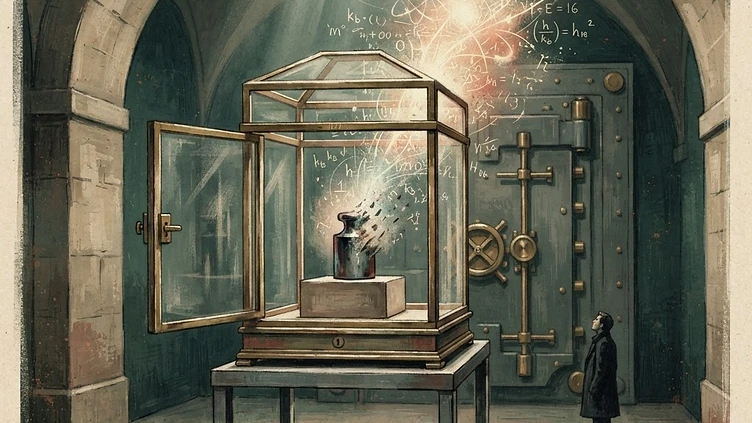
It sounds like a strange tale that the world's entire system of measurement once depended on a single piece of metal resting quietly in the corner of a vault. Yet, for much of the twentieth century, this was reality. Near Sevres, France, inside a triple-locked safe, sat a small cylinder made of a platinum-iridium alloy; every scale, every marketplace, and every spacecraft on Earth indirectly calibrated its accuracy by referencing that cylinder. While science assures us that it offers objective, immutable, and universal truths, it is unsettling to learn that our most fundamental unit of measurement was, in fact, entrusted to a single object in a single room. How certain, then, is what we call certainty?
A World Tied to a Single Object
Consider that to understand what a kilogram is, you had to look directly at an object, not a mathematical formula or a law of nature. This was the case from 1889 onwards. Replicas distributed around the globe were stored as reference points in their respective countries, like siblings cast from the same mold. But none of those copies were the absolute truth; they were merely representations. The true authority was that single cylinder in Paris. This demonstrates that even when humanity established the measurement system it considered the most objective, it still relied on a form of faith. We trusted that an object existed somewhere, that it remained unchanged, and that it could serve as a universal reference.
This trust carried a fragility that contradicted science's claim to absolute precision. For matter, no matter how carefully preserved, is never immune to time and physics. Even a piece of metal kept in a vacuum-sealed, climate-controlled vault can lose atoms or experience microscopic changes on its surface. The striking part is not that science ignored this vulnerability for years, but the crisis it faced upon realizing it. If your reference point shifts, everything measured against it is implicitly altered. This is not merely a problem of metrology, but a philosophical one: is what we call constant truly constant, or do we behave as if it is simply because we have agreed to accept it as such?
The Fading Grammar of the Cylinder
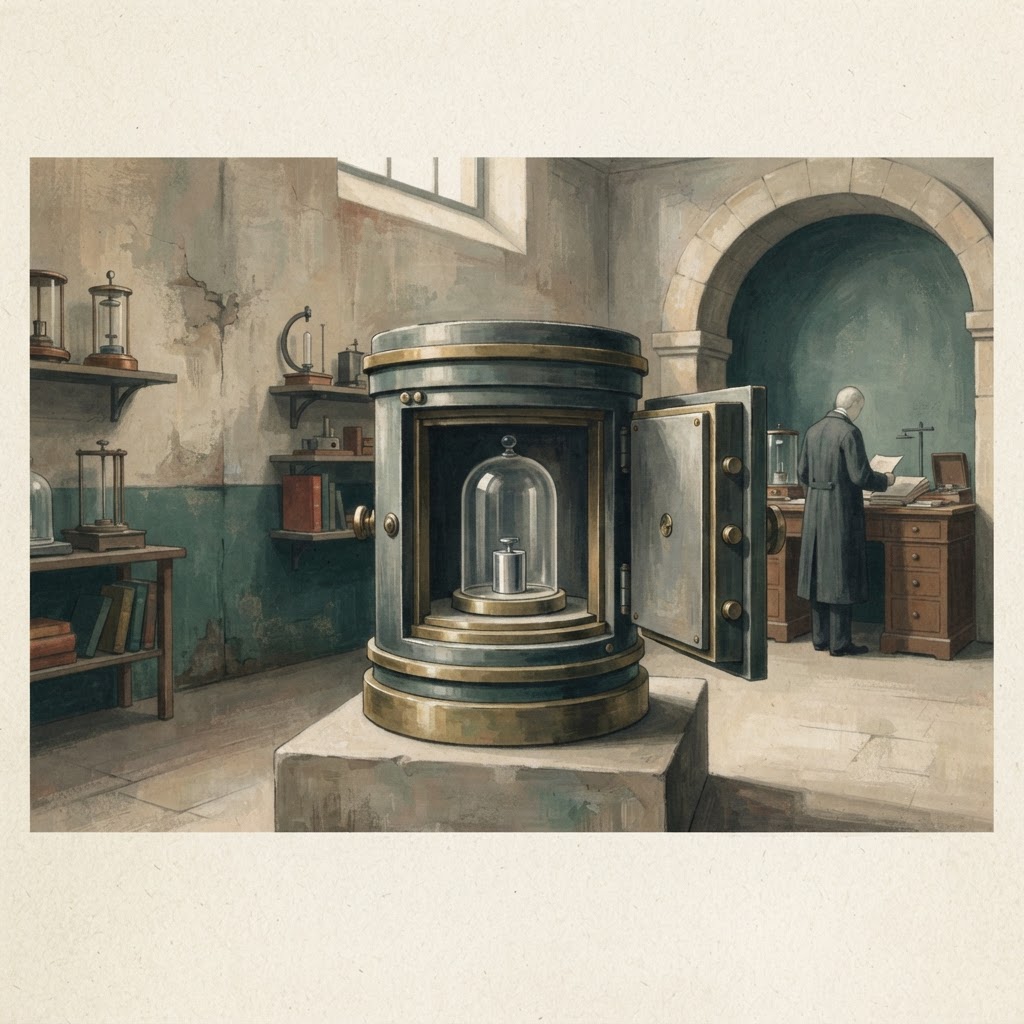
As scientists compared the replicas to the original in Paris over the years, they began to find small but significant discrepancies. These differences were far too minute to be noticed in daily life, but in a field like metrology, where precision is paramount, even such trivial variations triggered a tectonic shift. If the original object was losing mass, then the definition of a kilogram everywhere in the world was shifting. The question that emerged was simple yet profound: which was the true kilogram? The one losing mass, or the constant it was meant to represent?
This point brings us to one of the most uncomfortable questions science asks itself. The definition of a unit must remain independent of the thing it measures; otherwise, the unit becomes a victim of its own definition. The loss of mass in a cylinder was not just a physical event; it was a crisis of confidence. For a century, people had trusted that cylinder because they had no other choice. However, because science is a discipline that does not shy away from admitting its own errors, it began to seek an exit from this fragility rather than hiding it. What is fascinating here is not the crisis itself, but the direction of the response: they chose to trust nature rather than an object.
From Object to Constant
In 2019, the definition of the kilogram changed. We no longer look at a piece of metal; we use an equation linked to the Planck constant, one of the most fundamental laws of the universe. This is not just a technical update, but a radical transformation in our understanding of measurement. You no longer need to travel to Paris or unlock a vault to define a kilogram.ilogram.ilogram.ilogram.ilogram.ilogram.ilogram.ilogram; with the right equipment, you can reproduce a kilogram anywhere on Earth by referencing the laws of the universe. This is one of the most concrete examples of science striving to become independent of the material world.
Of course, a counter-argument arises: is relying on an abstract constant truly more reliable than relying on a tangible object? After all, the Planck constant is also a construction of the human mind—a value measured and calculated. But the difference lies here: a metal object can be affected by environmental conditions, time, and handling, whereas the fundamental constants of nature remain the same in every corner of the universe and for all time. This represents a shift in trust from human-made objects to an order that existed before us and will persist after us. Perhaps this is part of the maturation story of science: first, we trust what we can touch, then we trust what we cannot touch but which holds true everywhere.
Today, the process of redefining the kilogram is not just a technical issue for physicists. It reminds us that what we call certainty is actually a process, one that changes over time and, indeed, needs to change. Perhaps the ultimate lesson is this: as long as humanity remains willing to question even its most trusted standards, science will continue to progress. The vault in Paris may now be empty, but the question left behind by that small cylinder still lingers in our minds: what can we trust, and how much, and can the very basis of that trust change one day?
İlgili Denemeler
Can the Human Brain Detect Magnetic Fields?
Geophysicist Joseph Kirschvink's experiment at Caltech indicates that the human brain responds to magnetic fields, raising questions about a potential sixth sense.
Jan Hendrik Schön: The Physicist Who Fooled Science
The scandal of Jan Hendrik Schön's fabricated data at Bell Labs highlights the critical vulnerabilities in the scientific peer-review system.
Barry Marshall Drank Bacteria to Prove Stomach Ulcer Theory
Barry Marshall made medical history by consuming harmful bacteria to prove that stomach ulcers are caused by an infection rather than stress alone.
Tartışma (0)
Henüz yorum yok. İlk yorumu siz yapın.
Join the Newsletter
New essays, once a week, delivered to your inbox.