Ant Mill: Why Do Ants Enter a Death Spiral?
A single ant never loses its way, yet a collective sometimes prepares its own demise by obsessively following its own tracks.
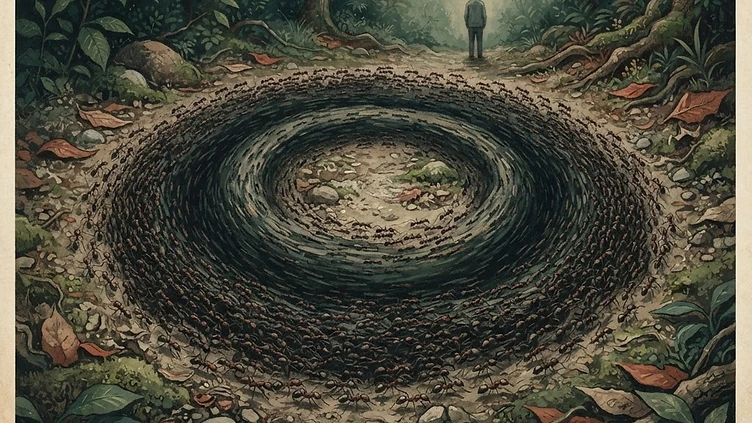
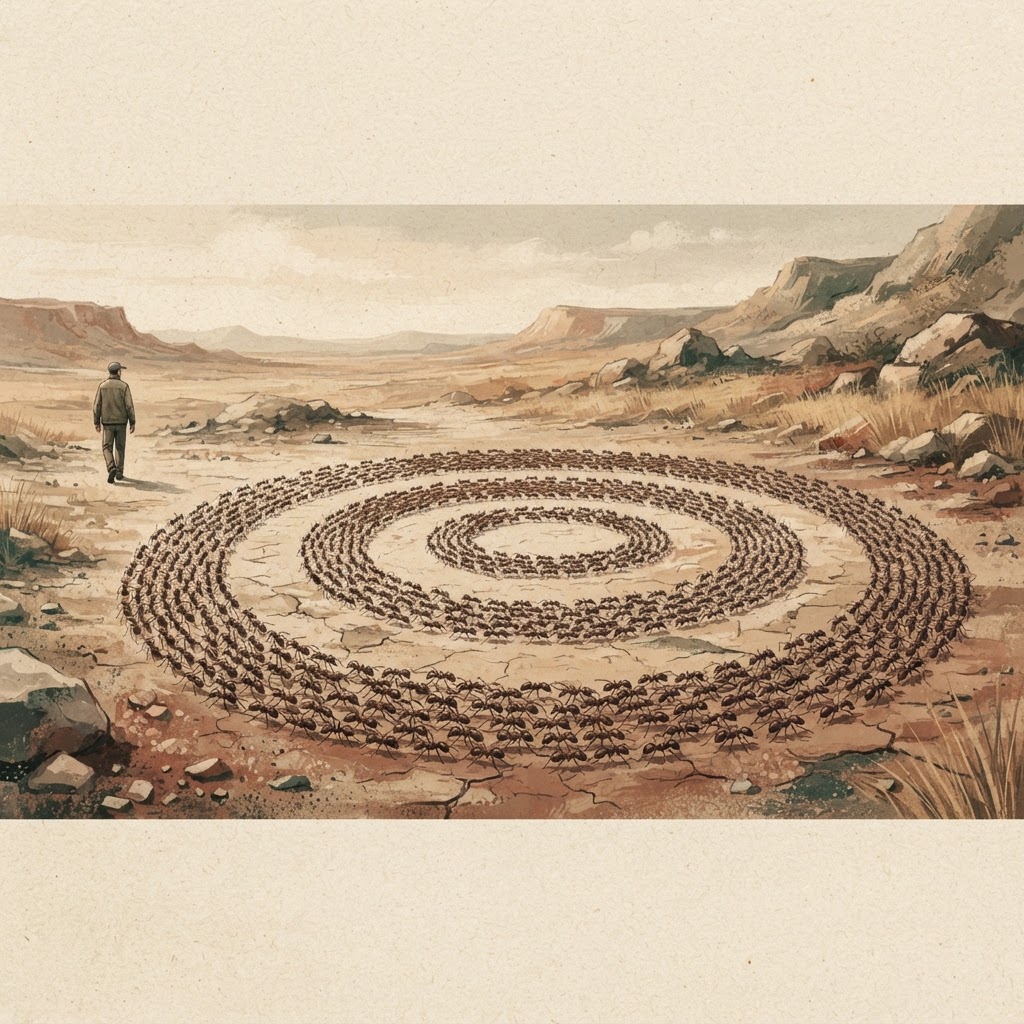
Imagine a forest ant colony beginning to follow its own trail in circles for hours, or even days, resulting in a bizarre scene where thousands of individuals die of exhaustion. Known in nature documentaries as the death mill, this phenomenon is one of the most striking examples of how a simple mistake can escalate into a massive catastrophe. When a single ant gets lost, the colony searches for it, finds it, and continues on its way; but when thousands of ants begin chasing their own tails simultaneously, no one can call a halt. This is because there is no guiding mind present that knows how to stop or that can see the whole. This image always leads me to wonder: is what we call intelligence truly hidden within the individual, or is it embedded in the relationships between individuals? ## The Trap of the Pheromone Trail These army ants are creatures with limited vision; they read the world largely through scent. The leading ant leaves a pheromone trail, and those following track this scent, adding their own to it. Under normal conditions, this simple rule works perfectly: the colony finds food, returns to the nest, and establishes a massive organization without any central command. The problem begins the moment this trail loops back onto itself. The leading ant notices the trail left by the one behind it, mistakes it for a reliable path, and begins to follow it; the colony then transforms into a trapped river that, from the outside, forms a perfect circle. The most striking point here is that no ant has made a wrong decision. Each is following the single rule it was taught: follow the trail in front of you. Yet, the reliability of this rule depends on new information from the outside; the moment the loop closes, there is nothing from the outside, only the scent of their own past. The colony reads its own footprints like a compass, but that compass no longer points anywhere—it only points to itself. What is strange is that the strength of this trail increases over time; each pass adds new pheromones, the trail strengthens, and as it strengthens, it becomes harder to abandon. This is precisely why once a death mill is formed, it is almost impossible for it to dissipate on its own; it requires outside intervention or a few deserters breaking away from exhaustion. ## A System Collapsing Without Mind One must stop here and ask: is what we call a colony a single intelligence, or the sum of thousands of little automata? Ant colonies are generally cited as examples of swarm intelligence because creatures with very simple individual rules can produce surprising results when they come together, such as building bridges, constructing nests, or solving complex logistical problems. But the death mill also shows the limits of this intelligence: the system produces intelligent behavior only under specific conditions; when those conditions break down, the same rules, with the same obedience, can lead to the opposite outcome—a mass suicide. Intelligence here is not a fixed attribute, but a probability; it shines in the right context and fades in the wrong one. Some might look at this example and say that ants are not intelligent anyway, which is why this happens. Yet that is not the point. The issue is not a lack of intelligence, but the lack of a central eye, a perspective capable of viewing the whole from above. Human societies, too, may be composed of highly intelligent individuals, but if each of those individuals follows only the trail in front of them—the nearest signal—the resulting aggregate behavior can take a shape that no one intended. The ant mill reminds us of the possibility that intelligent parts can produce an unintelligent whole; this possibility is as true for human-made systems as it is for nature. ## Today's Digital Mills Looking at sudden crashes in financial markets, we see a similar pattern. Algorithmic trading systems read price movements based on signals given by one another; when one system sells, others that see this also begin to sell, these sales produce new signals, and the cycle grows. Here, too, no one is making a wrong decision; each algorithm stays true to its own rule. The problem is that the data fueling that rule no longer comes from real external demand, but is derived from the system's own movements. The market turns into a colony seeking its own pheromone trail on its own tail; prices fluctuate not due to a real cause, but due to reactions that imitate one another. It is possible to recognize the same architecture in the feedback loops of social media. The moment a piece of content receives its first interaction, the algorithm shows it to more people; more views bring more interactions, which strengthens this important signal for the algorithm. Here, too, there is no central editor, no mind that sees the whole; each user only follows the trail in front of them—that which is already popular—which further amplifies that popularity. The result is sometimes an agenda cycle detached from real value, growing only through its own momentum; the debate is fueled not by the actual topic, but by the existence of the debate itself. The difference between a human and an ant is the capacity to step outside this cycle and ask: are we just following our own tracks right now? But using this capacity often operates slower than the cycle itself; by the time we realize it, the circle has usually turned several times and energy has been exhausted. Perhaps the most dangerous aspect of digital systems is that their speed leaves no opportunity for this awareness; while an ant dies within hours, a market crash can catch its own tail in minutes, and an agenda distortion in mere seconds. Perhaps the core issue is that these three examples show a common weakness with the same nakedness: the repetition of simple rules eventually produces its own trap, and what is needed to escape that trap is not more rules, but a perspective that can step outside the loop. The ant mill does not offer us a hopeless lesson; it merely whispers a warning: we must not forget to occasionally look at our own trail and where the steps we take are coming from, lest we get lost in the crowd. Because sometimes the path that seems most secure is merely the scent of our own past, consuming us by expanding the same circle without ever taking us to a new place.
İlgili Denemeler
Can the Human Brain Detect Magnetic Fields?
Geophysicist Joseph Kirschvink's experiment at Caltech indicates that the human brain responds to magnetic fields, raising questions about a potential sixth sense.
Jan Hendrik Schön: The Physicist Who Fooled Science
The scandal of Jan Hendrik Schön's fabricated data at Bell Labs highlights the critical vulnerabilities in the scientific peer-review system.
Barry Marshall Drank Bacteria to Prove Stomach Ulcer Theory
Barry Marshall made medical history by consuming harmful bacteria to prove that stomach ulcers are caused by an infection rather than stress alone.
Tartışma (0)
Henüz yorum yok. İlk yorumu siz yapın.
Join the Newsletter
New essays, once a week, delivered to your inbox.