Jane Jacobs: Do Eyes on the Street Still Ensure Safety?
How does the insight of a thinker who realized that cities are made safe by ordinary eyes rather than police resonate in today’s surveillance-heavy neighborhoods?
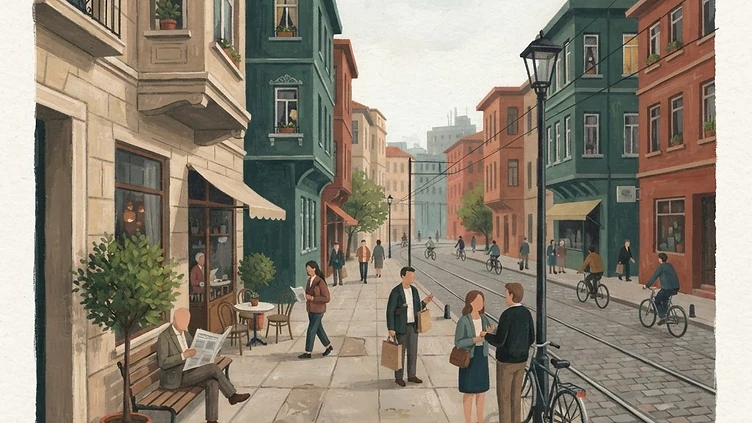
Have you ever wondered if we are being watched by countless eyes while walking through a city? Could this state of being watched be an invisible network that keeps us safe, rather than a source of unease? Half a century ago, while observing the streets of New York, Jane Jacobs posed this very question: what makes a neighborhood safe—uniformed authority or the spontaneous, voluntary attention of a homeowner looking out a window, a shopkeeper sitting on the sidewalk, or a pedestrian passing by? In an age where cameras monitor every corner and security firms stand guard at every apartment building, does Jacobs's simple yet profound observation still speak to us, or has it become a nostalgic memory?
The Patrol of Eyes
Jacobs's core discovery was that safety originates not from an official institution, but from the social fabric itself. On a street, a shopkeeper watches the sidewalk while arranging their display; a woman in an apartment across the way looks out while sipping her tea; a neighbor returning home in the evening notices faces they do not know but see at the same time every day. None of these glances are limited by a job description or done for a paycheck; they are natural consequences of being present and using the street. According to Jacobs, this scattered, continuous attention is a more effective deterrent than any patrol vehicle, because it is constant and ubiquitous.
The power of this idea stems from a simple observation: humans behave differently in environments where they feel they might be watched, even if they do not know who is watching. On a crowded sidewalk, dozens of people see a child crying, and one of them will approach out of a simple human reflex, without any sense of duty. Yet on an empty street, at a moment recorded by a camera but seen by no one, that same child might receive no help at all. The distinction Jacobs emphasized is clear: security is not the existence of a recording, but the vitality of a gaze.

The Deceptive Security of the Camera
Modern cities have increasingly outsourced safety to technology and specialized personnel. A camera is placed on every corner, a security guard at every gate, and a code system at every apartment door. This shift is not irrational; cameras do not tire, do not forget, and they bear witness. But there is an irony at play: a camera records an incident; it does not prevent it. It only allows us to watch the moment after the fact. The street eye Jacobs spoke of reacts instantly because it is alive and embedded in the moment.
More importantly, this transition has a side effect: people have stopped looking at one another. The moment we believe security belongs to a camera or a guard, we lose the need to know who our neighbors are. Noticing a stranger at the apartment entrance is no longer our job, but the camera's; when we witness an argument, it feels more natural to take out a phone and record it than to intervene. This is not a shift where security has increased, but one where responsibility has been displaced. As the number of cameras rises, the concern people feel for one another diminishes; the street has become a space that is watched, but no longer a space that is truly inhabited or claimed.
A valid objection might arise here: there is a widespread belief that crime rates drop thanks to cameras, so why criticize this technological shift? But Jacobs's primary concern was not crime statistics, but the spirit of a neighborhood. A street should not merely be a place where crimes do not occur, but a place where people live by trusting one another. A camera does not produce this trust; it only records. The living eyes Jacobs described, however, rebuild trust every day.
The Silent Contract with the Stranger
Jacobs's most striking suggestion is that urban safety is born not from familiarity, but from a recurring, unspoken respect between people who do not know each other at all. Even if you do not know your neighbor's name, you recognize the face you encounter every morning at the same hour while buying a bagel. This recognition is not a friendship, but it creates a sense of belonging. We make way for each other on the sidewalk, return a dropped item to a stranger, or share a slight nod when we catch the eye of someone walking alone late at night. These small gestures are not mandated by any law, which is exactly why they are meaningful.
What is missing in today's isolated neighborhoods is this silent contract. When residential complexes are surrounded by walls and guarded by security gates, people learn to protect themselves not from each other, but from an ill-defined danger outside. But this protection is also a form of isolation; those inside the walls remain strangers to one another, and those outside are never known at all. Perhaps the way to revitalize a neighborhood today is not to add more cameras, but to create small reasons for people to spend time on the street: a bench, a tea house, a marketplace—anything that encourages people to look at one another and notice each other's presence.
Jacobs's concept of the street eye reminds us that security is a relational issue, not a technical one. No matter how much cameras record, what makes a neighborhood livable is the presence of people who look at one another and care about each other's existence. Re-establishing this gaze in today's cities is not a return to obsolete nostalgia, but perhaps the most modern solution of all: because no technology can provide a response as quick, as human, or as vibrant as a person sitting on the street observing their surroundings. The challenge lies in recalling the silent guardians of the sidewalk and inviting them back—to the street, to the window, and to the front of the local shop.
İlgili Denemeler
Doorman Culture: The Loss of Community in Cities
This essay explores how the erosion of the apartment caretaker profession has transformed urban neighborliness, trust, and the collective memory of the neighborhood.
Hostile Architecture: Excluding Bodies in Public Spaces
In modern cities, a simple metal fixture added to benches silently exposes who public spaces are intended for and whose presence is systematically excluded.
The Third Place: Where Did Our Sense of Belonging Go?
Drawing on Ray Oldenburg's concept of the third place, this piece explores the societal cost of the vanishing communal spaces that once defined our daily lives.
Tartışma (0)
Henüz yorum yok. İlk yorumu siz yapın.
Join the Newsletter
New essays, once a week, delivered to your inbox.