The Hawthorne Effect: How Being Observed Changes Behavior
How did engineers testing lighting in a factory realize that what they were measuring was not the light, but the person being watched?
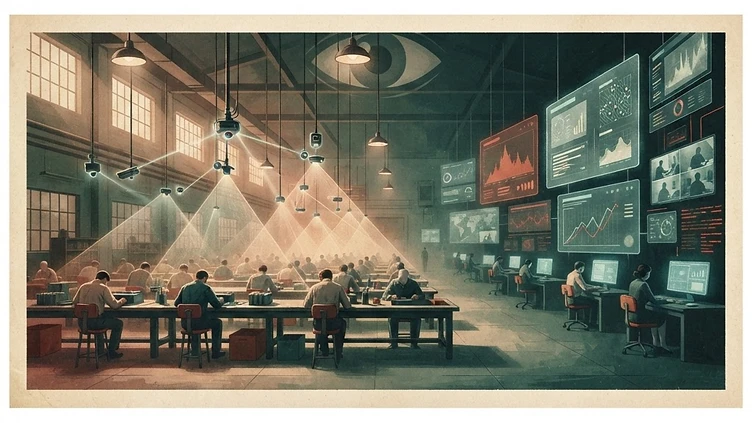
When you enter a room and find a camera quietly running in the corner, does your posture change? Perhaps you straighten your back a little more, lower your voice, or convince yourself that nothing has changed. A long time ago, in a factory, there were engineers trying to measure the effect of lighting on human efficiency. What they were looking for was quite simple: stronger lamps, brighter workshops, and higher production. What they found, however, was far more complex and distinctly human; they realized that what they were measuring was not the light, but themselves.
They Increased the Light, Productivity Rose
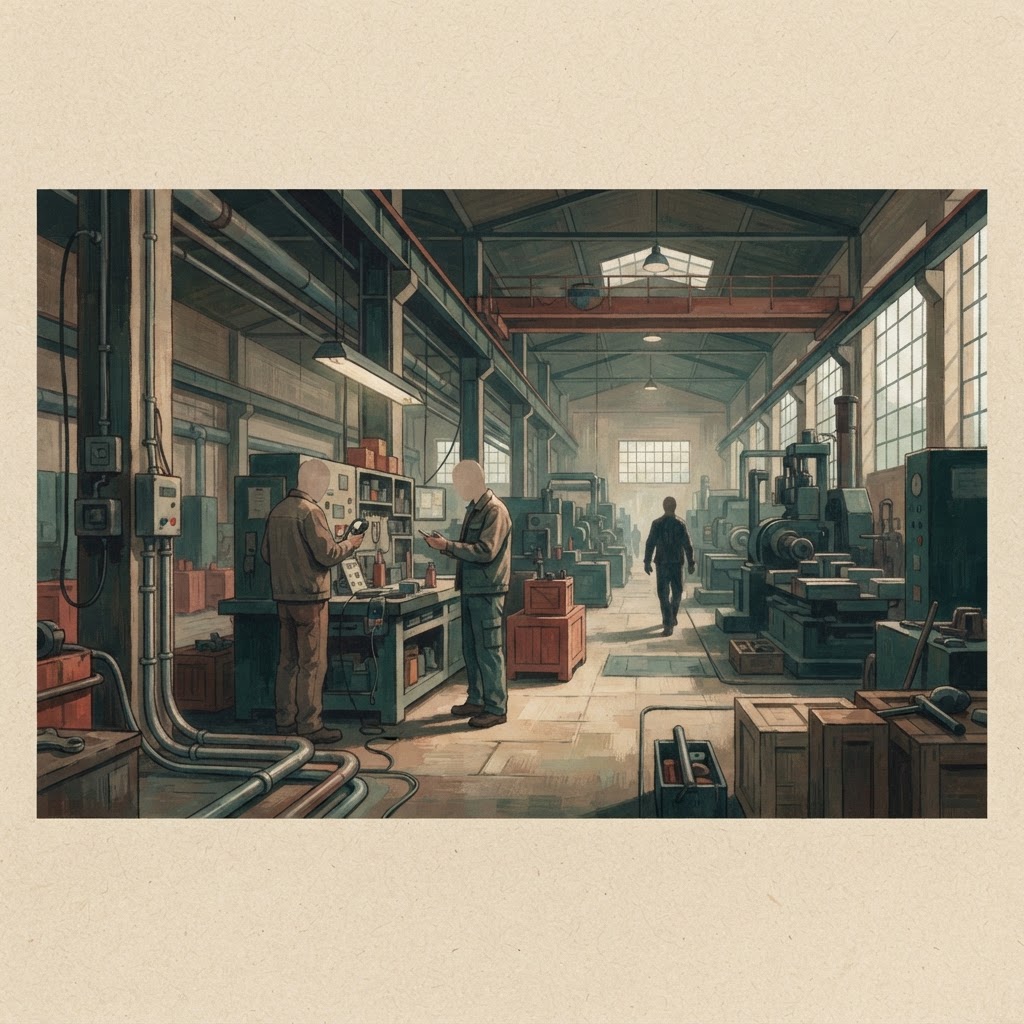
At the Western Electric Hawthorne factory, things actually began with a very technical question. Engineers replaced the bulbs in the workshop, gradually increasing the intensity of the light, and recorded the production speed of the workers. They encountered the expected result: as the light increased, productivity increased. But the truly surprising part appeared in the second phase of the experiment. This time, the engineers gradually dimmed the light, bringing the workshop close to twilight, expecting production to fall. It did not fall; instead, it continued to rise. It was as if darkness, not light, was fueling efficiency; yet, the issue was never about the light at all.
At that point, the engineers had to admit that the variable they were measuring was not light intensity, but the very fact that the workers in the workshop knew they were part of an experiment. When people realize that there are eyes upon them, that someone is taking notes, and that their performance is being recorded, they work more carefully, behave more disciplined, and perhaps try to be the protagonist of a slightly better story. The power of the lamps was a variable, but the real variable was the observation itself. This small detail pointed to the most fragile point of scientific measurement: the fact that the observer can change what is being observed.
The Observed Body Behaves Differently
What we call the Hawthorne effect is, in essence, nothing more than taking an ancient intuition into a scientific dictionary: a human becomes someone else the moment they know they are being watched. You might find this exaggerated; perhaps you think you can remain yourself even in front of a camera. But compare the moments when an invigilator walks around the room during an exam with the moments you study alone; or the minutes when your manager stands behind you in a meeting with the minutes you work at your desk by yourself. The body is the same body, but the attitude is different, the posture is different, even the tone of voice changes. Observation spreads like a thin polish over behavior, and the true texture beneath becomes invisible.
There is an objection that could be raised here: isn't all of social life a stage anyway, don't people play a role while watching each other every moment? This objection is partially true, but what the Hawthorne effect emphasizes stands somewhere slightly different. The issue is not just that social life is performative, but that what is measured is mistaken for a scientific reality when it is actually a product of the observation. That is to say, when you design an experiment to capture human behavior in its pure form, the very experiment you design changes the behavior. This leads to the question: is there any human behavior that is never observed, or is every measurement a hand that slightly distorts what is being measured?
Everyone Has Their Own Hawthorne Factory
The workers at the Hawthorne factory could return to their old selves when the experiment ended; the light measurements stopped, the engineers left, and the workshop became an ordinary workshop again. For today's person, there is no such return. Our phone screens, our pedometers, the like counters beneath our social media accounts, and workplace productivity software have all set up small Hawthorne factories around us, and the lights of these factories never go out.ocial media accounts, all have built a small Hawthorne factory around us, and the lights of this factory never turn off.ocial media accounts, the productivity software at work—all have built small Hawthorne factories around us, and the lights of this factory never go out. Even when writing a message, we edit our sentences repeatedly because we know the other party sees the 'typing' indicator; before sharing a photo, we look at that frame through the eyes of an invisible audience, even though no one told us to.
Perhaps the most striking point is that this observation now comes from within, not from outside. The workers at Hawthorne knew of the engineers' presence; there was a clear eye looking from the outside. Ours is mostly an imaginary eye; even when the camera is off and no one is watching us, we act by assuming an audience exists. Someone might come out and say, 'This was always the case, humans have always lived in the eyes of others,' and this might be partially true. But the scale has changed: observation used to be limited to certain moments, but now it is a background noise that continues constantly, everywhere, on every screen. As our step count turns into a number, our sleep pattern into a graph, and our attention into an advertising algorithm, it is now difficult to predict which data shows our true self and which only shows the performance produced by being watched.
Furthermore, it must be added that this constant feeling of observation reshapes not only our behavior but our perception of self. The worker at Hawthorne could return to their own state when the experiment ended because there was still a difference, a point of comparison between the observed and unobserved states. For our generation, this point of comparison is gradually fading; because finding a moment where we are not being watched now requires special effort. Putting the phone aside, turning off the screen, staying away from social media is, in a sense, like trying to turn off the lights of our own factory with our own hands. But we can no longer say with confidence whether what remains when the lights go out is still our purest self.
While the engineers at Hawthorne were trying to measure the light, they found themselves; and we cannot help but ask what we are actually measuring beneath every screen, every counter, and every like. Perhaps the question that needs to be asked is not how we can live without being observed, but how we can remain true to ourselves even while being watched. Because light was never the issue; the issue was always how much the body that knows it is being looked at can resemble its state when it thinks it is not.
İlgili Denemeler
Doorman Culture: The Loss of Community in Cities
This essay explores how the erosion of the apartment caretaker profession has transformed urban neighborliness, trust, and the collective memory of the neighborhood.
Hostile Architecture: Excluding Bodies in Public Spaces
In modern cities, a simple metal fixture added to benches silently exposes who public spaces are intended for and whose presence is systematically excluded.
The Third Place: Where Did Our Sense of Belonging Go?
Drawing on Ray Oldenburg's concept of the third place, this piece explores the societal cost of the vanishing communal spaces that once defined our daily lives.
Tartışma (0)
Henüz yorum yok. İlk yorumu siz yapın.
Join the Newsletter
New essays, once a week, delivered to your inbox.