Hwang Woo-suk: The Fall of a Science Hero
The story of a researcher who, after filling a nation with pride, became the architect of one of the greatest scientific frauds in history.
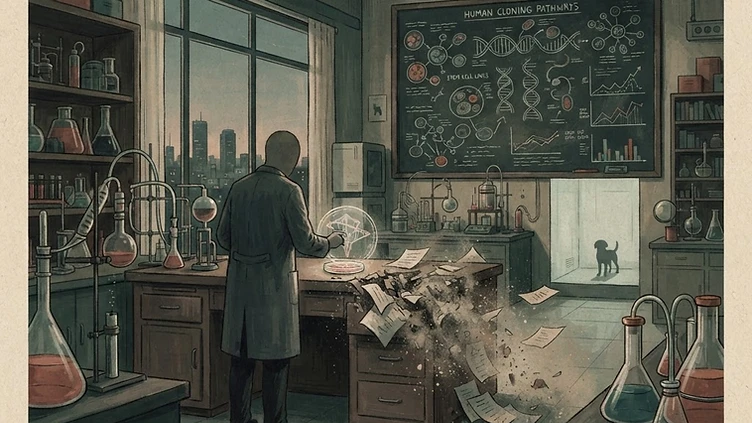
To understand how a society views science, one of the most effective methods is to observe how it canonizes a scientist. In the early 2000s, South Korea became the stage for such a canonization. A veterinarian named Hwang Woo-suk claimed to have touched one of humanity's oldest dreams: patient-specific stem cells, the herald of an era that would allow the paralyzed to walk and halt diseases. Then everything collapsed. This downfall not only ended one man's career but also raised unsettling questions about how science regulates itself. ## A Nation's Scientific Hero To grasp the rise of Hwang Woo-suk, one must first look at what South Korea needed at the time. The country had emerged from economic crises and aspired to be a global leader in technology, seeking to transition from a follower to a pioneer. Hwang embodied this desire with his humble rural background and ambitious claims of cloning human embryonic stem cells. Even the announcement of a cloned dog made global headlines; when his human stem cell claims emerged, he became a national symbol. The state provided extraordinary support, ranging from special research funding to security details and massive crowds at airports. One must ask: does turning a scientist into a source of national pride serve science, or merely the need for such pride? Hwang's story shows how easily these two become entangled. Science is powerful because it is verifiable, whereas nationalist pride does not wait for verification; it simply wishes to believe. While some argue that all great breakthroughs are fueled by national excitement, the difference here was that Hwang's work was celebrated without ethical oversight or independent verification. Science journalism lost its critical distance, turning laboratory updates into reports of triumph, which explains why the cracks remained hidden for so long. ## Cracks in Science Magazine Hwang's most striking claims were published in Science, one of the world's most prestigious journals. Peer review usually acts as a safeguard, but Hwang's papers inverted this assurance. Data were fabricated, photos duplicated, and datasets repurposed. The question remains: how did peer review miss this? Reviewers evaluate the consistency of the author's interpreted results rather than raw data, relying on the author's integrity. Even journal editors later admitted that the review process assessed presentation rather than the data itself. The scandal surfaced not through official oversight, but through young researchers and journalists who uncovered ethical violations regarding egg donations. Once this door opened, the scientific fraud became visible. The ensuing investigation at Seoul National University confirmed that nearly all claims were groundless. Hwang was stripped of his titles and faced legal repercussions. Such a rapid fall is both surprising and inevitable; no matter how brilliant a fabrication may be, it is destined to crumble upon contact with reality. ## The Crisis of Scientific Trust To view the Hwang case merely as an individual moral failure is to miss the point. The core issue lies in the limits of science's self-regulation. Science is a cumulative system of trust; when one researcher shares findings, others build upon them. When this chain breaks, the damage spreads beyond the individual to the entire field. The ensuing skepticism led to a decline in public support for stem cell research, as people became wary of promises of miracles. This trust crisis is not unique to South Korea, as similar cases have appeared globally in physics, psychology, and medicine. Hwang's story is a striking example of a structural weakness in science. Peer review and replication are safety layers, but none are absolute guarantees. Perhaps the most profound lesson is the incompatibility of the hero narrative with science. Science is slow, skeptical, and self-questioning, whereas the hero narrative demands fast, certain results. Hwang's story exploded where these two narratives clashed. Today, stem cell research continues with more caution, transparency, and a demand for independent verification—a strange legacy of Hwang's actions. The ultimate question is not about the lie itself, but how easily a system can surrender to it. Science is trustworthy not when it is closest to the truth, but when it never abandons the effort to reach it. Hwang's betrayal was in mimicking that effort; his name remains a warning sign in the history of science, reminding us that behind every brilliant promise, there must always be patient skepticism.
İlgili Denemeler
Can the Human Brain Detect Magnetic Fields?
Geophysicist Joseph Kirschvink's experiment at Caltech indicates that the human brain responds to magnetic fields, raising questions about a potential sixth sense.
Jan Hendrik Schön: The Physicist Who Fooled Science
The scandal of Jan Hendrik Schön's fabricated data at Bell Labs highlights the critical vulnerabilities in the scientific peer-review system.
Barry Marshall Drank Bacteria to Prove Stomach Ulcer Theory
Barry Marshall made medical history by consuming harmful bacteria to prove that stomach ulcers are caused by an infection rather than stress alone.
Tartışma (0)
Henüz yorum yok. İlk yorumu siz yapın.
Join the Newsletter
New essays, once a week, delivered to your inbox.