Hubble Tension: Why Is the Universe Expanding at Two Rates?
Two independent methods for measuring cosmology's most fundamental number yield conflicting results for the same universe.
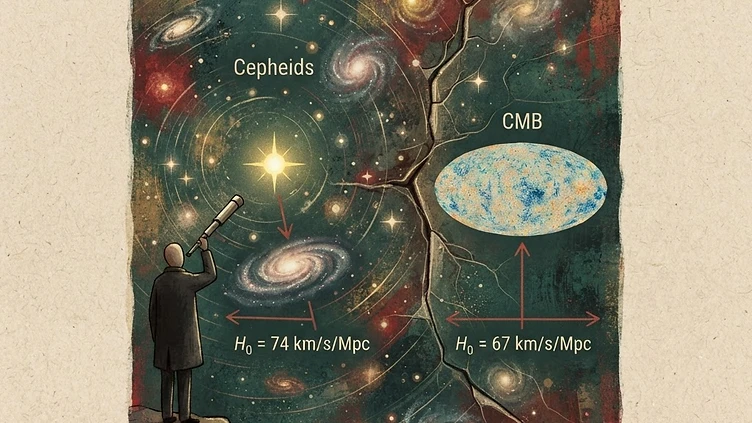
Imagine measuring a table with a ruler at midnight, measuring it again with a different ruler in the morning, and finding the two results do not match. Your first instinct would likely be to suspect one of the rulers is faulty. But if the rulers were produced with the most precise instruments, the measurements repeated countless times, and the margin of error reduced almost to zero, you might have to stop questioning the rulers and start questioning the table itself. Cosmology currently stands at just such a moment. Two independent methods for determining the expansion rate of the universe yield significantly different values for the same cosmos, and this discrepancy persists with a stubbornness that cannot be dismissed as observational error. This small yet fundamental disagreement, known as the Hubble tension, may be unsettling the very cornerstone of cosmology that we thought was most secure. ## Two Rulers, Two Universes There are two primary ways to measure the expansion rate of the universe, or the Hubble constant. The first looks at the early universe: the cosmic microwave background is like a fossil light left over from just a few hundred thousand years after the Big Bang. Satellites that map the patterns of this radiation with great precision calculate the expansion rate by fitting the standard cosmological model to these patterns. The second method, conversely, looks at the much closer universe. By using stars of known brightness, such as Cepheids, and subsequently supernovae as distance markers, it directly observes the speed at which galaxies in the local universe are receding from us. Both methods are highly reliable in their respective fields, each the product of years of meticulous study. Yet when the results are placed side by side, the figure from the early universe does not match the figure from the local universe. What is truly striking here is not the magnitude of the difference but its persistence. We are talking about a deviation of a few percent, yet this discrepancy appears repeatedly with statistical confidence too strong to be dismissed as coincidence. It is as if two separate teams drew two separate maps of the same city, but the scale units on the maps do not correspond. The light from the early universe tells us one speed, while the light from stars and supernovae tells us another. Both claim to describe the expansion rate at the same moment in the universe's history, yet the results differ. At this point, one cannot help but wonder: could one of the two rulers we use to measure the universe be unknowingly measuring an entirely different cosmos? ## Error or Discovery? The first instinct, of course, is to assume there is a technical error somewhere. Perhaps there is an overlooked systematic bias in the brightness calibration of Cepheid stars, or perhaps a hidden prejudice in the processing of cosmic microwave background data. This possibility remains on the table, and the vast majority of scientists have been searching for exactly this for years, questioning every link in the chain of measurements. But as years pass and measurement techniques diversify, the error cannot be pinpointed to a single source. Moreover, the different teams performing the measurements use different telescopes and different statistical methods, yet the results always point toward the same direction and the same inconsistency. This strengthens the possibility that the problem lies not in the measurement but in the model we use to interpret it. The standard cosmological model divides the content of the universe into dark energy, dark matter, and ordinary matter, determining these proportions based on cosmic microwave background data. If this model does not fully reflect the actual content of the universe, then the Hubble constant we derive from the early universe might be built on a faulty foundation from the start. Perhaps we need a scenario where dark energy does not remain constant throughout the history of the universe but changes over time. Perhaps in the very early periods of the universe, when light had not yet fully decoupled from matter, an unknown additional energy component was at play. None of this is proven, but each shows that the problem may be rooted much deeper than a simple observational flaw—in our assumptions about the physical structure of the universe. This moves the issue from a report of a technical glitch to a conceptual crisis. ## Crisis is the Fuel of Science Looking at the history of science, it is evident that major transformations rarely come through linear progress. Often, a small anomaly appears first: a number does not sit where it is expected, or an observation does not perfectly align with theory. In the nineteenth century, a small deviation in the orbit of Mercury was first dismissed as an observational error, then led to the search for an invisible planet, and eventually revealed the limits of Newtonian physics, paving the way for the theory of relativity. Similarly, unexplained lines in atomic spectra opened the door to quantum mechanics. Each time, the issue was not to discard the existing theory entirely but to move it into a broader, deeper framework. The Hubble tension may be standing at a similar threshold, a breaking point that starts as a minor mismatch and forces cosmology toward a more comprehensive understanding. Of course, it is also worth remembering that not every anomaly births a revolution. Some inconsistencies quietly disappear over time as measurement techniques become more precise, and no one remembers them. Perhaps the Hubble tension will also disappear in a few years with a subtle correction found in the measurement chain, and today's debates will remain a footnote. But even this possibility does not make the issue unimportant, because the crisis itself pushes scientists to ask new questions about the contents of the universe, the nature of dark energy, and even how time functioned in the early universe. Even without being resolved, the crisis enriches the field with the questions it poses. Just as a crack in a wall makes one wonder what is hidden beneath, this numerical discrepancy whispers that a more complex structure lies beneath the seemingly smooth surface of the universe. Perhaps the most honest approach is not to immediately attribute this tension to one side or the other, but to learn to live with the question it leaves open. The inability to agree on a fundamental number like the expansion rate of the universe reminds us of how fragile the foundation of human knowledge about the cosmos really is. But this fragility is not a weakness; it is one of the moments when science is most alive. If two rulers do not match, and the problem is not with the rulers, then it is time to rethink the shape of the table. The Hubble tension may be remembered in the coming decades as the first serious step we took toward understanding the dark side of the universe.
İlgili Denemeler
Can the Human Brain Detect Magnetic Fields?
Geophysicist Joseph Kirschvink's experiment at Caltech indicates that the human brain responds to magnetic fields, raising questions about a potential sixth sense.
Jan Hendrik Schön: The Physicist Who Fooled Science
The scandal of Jan Hendrik Schön's fabricated data at Bell Labs highlights the critical vulnerabilities in the scientific peer-review system.
Barry Marshall Drank Bacteria to Prove Stomach Ulcer Theory
Barry Marshall made medical history by consuming harmful bacteria to prove that stomach ulcers are caused by an infection rather than stress alone.
Tartışma (0)
Henüz yorum yok. İlk yorumu siz yapın.
Join the Newsletter
New essays, once a week, delivered to your inbox.