Memory Reconsolidation: How Is Our Past Rewritten?
Memory is not a recording device, but a fresh draft rewritten every time it is accessed.
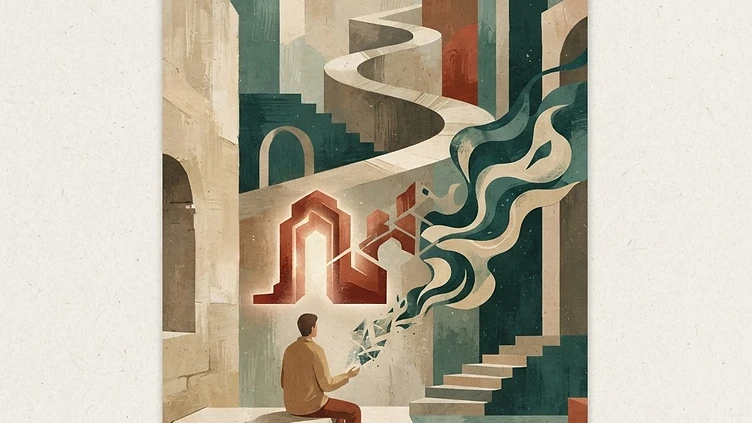
Think of a summer vacation from your childhood. The scent of the sea, apricots forgotten on a table, your mother's voice. When you recall that memory now, are you bringing back the exact same day, or are you constructing a slightly different version each time? Most of us think of memory as a safe; you put something inside, it gathers dust over time, but its essence remains intact, and you pull it out whenever you want. However, the neuroscientific findings of the last thirty years displace this comfortable description and present us with a much more unsettling picture: the past is a draft that is rewritten every time it is remembered. ## Memories Are Not Frozen Photographs The intuition that memory works like a file is useful in daily life. When we say to someone "I remember," we act as if an exact copy of that event sits in a corner of our brain. But the brain is not a computer disk; the connections between neurons are living tissues that are chemically reshaped every time they are used. Recalling a memory is not like opening a closed box; it is like dumping the contents of that box onto a table and repacking them. During this repacking, your current mood, what was said around you at that moment, and even the way the question is asked can seep into the content of the memory. When I first heard this idea, it seemed a bit exaggerated to me; after all, we know people who tell the same story the same way for years. But the subtlety of the matter lies exactly here: as the memory changes, we do not notice that it is changing. The new version always seems as real and certain to us as the old one. In other words, the fragility of memory does not come to us as a feeling of uncertainty; on the contrary, every reconstructed memory stands as solid and convincing as the last. This is what makes the issue so crucial; if we live without realizing that it is being rewritten, how much can we trust our past? ## The Experiment That Erased Fear The most striking evidence for this fragility comes from animal experiments on memory reconsolidation. While studying fear memories in mice brains, researchers noticed something: when a mouse associates a certain sound with fear, this memory is first stored in a stable form. But when the mouse hears that sound again, that is, the moment it recalls the fear memory, the cellular trace in the brain connected to that memory enters a short-term unstable state. When a chemical intervention is made in the brain during this window of instability, the consolidation of the memory is prevented, and the mouse is no longer afraid of that sound. The impact of this finding lies in how it fundamentally shakes the belief that a memory is unchangeable once recorded. If a fear memory returns to a pliable state the moment it is remembered, this may not be a quirk peculiar to mice, but a general principle of how the brain works. Indirect studies on human memory point to a similar pattern: every time we recall a memory, we 'cook' it again, and during this cooking process, there are small additions, subtractions, and colorings. Someone might step up here and say, 'But I remember an event from thirty years ago like it was yesterday'; this objection seems valid, but the real issue is not the degree of clarity, but that the clarity is a result produced anew each time. The sharpness of what you remember is not proof that it has not changed, but proof that the change can hide itself so well. ## Who We Were, Who We Think We Are It is inevitable to jump from here to the issue of identity. We define ourselves largely as the sum of our memories; when we say 'I am this kind of person,' we actually mean a summary of the events we have experienced in the past. But if these events shift slightly every time we remember them, the ground we stand on is actually a shifting one. Your recollection of a fight from five years ago might be creating a version of you that is a bit more justified or a bit more regretful based on your current mood. This does not mean you are lying; it just means that memory is fine-tuning the past according to your current needs. The frightening part of this situation is that our identity is not as rock-solid as we think. But right here, another door opens: if the past is not fixed, the power of the past to imprison us is not so absolute either. A person carrying a trauma, a resentment, or a regret also has the possibility of reconstructing that memory in a slightly different light each time they recall it. This is not about denying the past, but about letting go of the claim that there is a single, unchangeable truth about it. What we think we are can be thought of as a text that we constantly revise and negotiate anew every day. In the end, what we are left with is a more modest but more honest picture of memory. Our past is not an archived and untouched document; it is a draft that is reopened and rearranged every time we remember it. This might leave us feeling insecure at first, because it does not promise a definite reference point for what 'really' happened. But it also has a liberating side: we do not have to be the overseers of our past, because we are not its sole owners anyway. Every act of remembering is a chance for repair; every recollection is a small but real rewrite of who we are. Perhaps the question that should be asked is not 'what happened in the past,' but 'how am I reconstructing that past today?'
İlgili Denemeler
Can the Human Brain Detect Magnetic Fields?
Geophysicist Joseph Kirschvink's experiment at Caltech indicates that the human brain responds to magnetic fields, raising questions about a potential sixth sense.
Jan Hendrik Schön: The Physicist Who Fooled Science
The scandal of Jan Hendrik Schön's fabricated data at Bell Labs highlights the critical vulnerabilities in the scientific peer-review system.
Barry Marshall Drank Bacteria to Prove Stomach Ulcer Theory
Barry Marshall made medical history by consuming harmful bacteria to prove that stomach ulcers are caused by an infection rather than stress alone.
Tartışma (0)
Henüz yorum yok. İlk yorumu siz yapın.
Join the Newsletter
New essays, once a week, delivered to your inbox.