He Jiankui and the Fate of Gene-Edited Babies
When a Chinese scientist secretly modified human embryos with CRISPR, the scientific community realized that a boundary had been crossed.
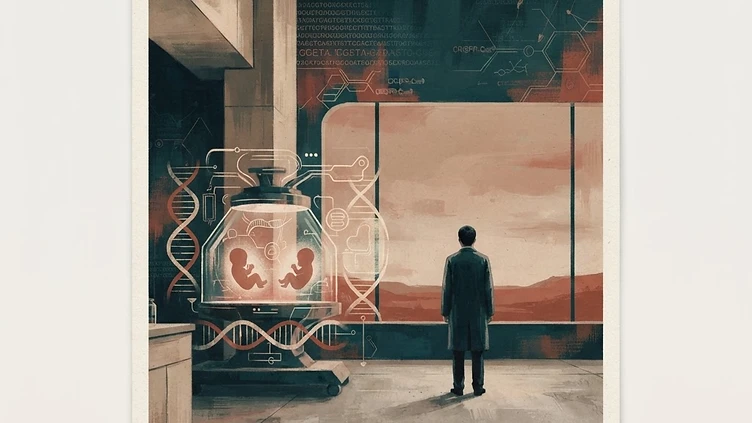
Let a laboratory's doors remain closed and keep the activities inside a secret; this premise sounds like something out of a science fiction novel, yet it became reality in 2018. A researcher in China did something unprecedented in human history and announced it to the world from a conference stage. This scientist, He Jiankui, used gene-editing technology known as CRISPR to modify the genetic code of human embryos, resulting in the birth of two babies. The speed at which the news spread could not keep pace with the ethical weight it carried; the world reacted first with shock, then with outrage. So, what became of this man? The answer to that question encompasses the broader debate over who gets to draw the lines of science and how they do it. ## Twins from a Secret Lab The action taken by He Jiankui can be technically summarized in a simple sentence: the CCR5 gene was modified via CRISPR with the aim of making these babies inherently resistant to the HIV virus. However, behind this sentence lies the reality that for the first time in human history, a scientist dared to permanently alter the germline of an unborn individual. Consider this for a moment; treating a disease is one thing, but modifying the genetic makeup of a human and all their future descendants is entirely different. What He did was the latter. We must stop here and ask: was modifying the CCR5 gene really necessary? Other, far less risky ways of preventing HIV were already available. This question highlights the symbolic weight of the experiment more than its scientific justification. He Jiankui was not developing a treatment; he was crossing a threshold that pushes the biological boundaries of humanity without consulting anyone. This intervention, known as germline editing, was a decision that would affect not just that embryo, but every generation born from it. And this decision was made within the four walls of a lab, without the approval of any international regulatory mechanism. ## The Scientific Community's Shock and the Legal Price When the news broke, the reaction rose like a sudden, surging wave. Most of the scientific community considered this move not only premature but also irresponsible. The issue was not merely the possibility of a technical error; the concern was that the consensus established within science, along with advisory boards and ethics committees, had been completely bypassed. One scientist had placed his own conscience or personal calculations above the collective decision of society. This was a matter of trust as much as laboratory discipline, for science progresses through a process approved by peers, one that is reproducible and accountable, not through the bravado of a single individual. Chinese authorities did not remain indifferent to this backlash. He Jiankui was tried by his country's court and sentenced to prison. This indicates that the matter was viewed not just as a scientific debate but as a legal violation. Interestingly, the punishment was less about questioning the scientific value of the experiment and more about his actions taken without permission and while evading oversight. The primary crime was perhaps not using CRISPR, but doing so without being accountable to anyone. This distinction is significant because it leads us to wonder what would happen to someone who performs a similar experiment in the future with the necessary permits and transparency. At this point, there is also an underlying fear within the scientific community: if one person can modify the human genome so easily, someone else could use the same technology for much more dangerous purposes tomorrow. He Jiankui's story thus ceased to be just about one scientist and became an allegory for the potential for the uncontrolled spread of technology. No one suggested he had malicious intent; the core issue was how even a well-intentioned step can lead to chaos when left unchecked. ## Opening Pandora's Box: The Future of Germline Editing After serving his sentence, He Jiankui returned to the research world. This return in itself is not the story; what matters is what his return reveals to us. The fact that once the box is opened, it cannot be closed. The ability to permanently alter the human genome is no longer a theoretical possibility but a proven case, the results of which stand before our eyes. We cannot take this knowledge back; we can only discuss how to manage it. A counter-argument that comes to mind here might be: perhaps He Jiankui's serving of his sentence is proof that the system corrects itself and that justice prevails. Perhaps that is true. But the real question lies in the void left by his return; because the world has still failed to establish a clear, international framework for germline editing. He's experiment was a breaking point, yes, but the discussion following this rupture did not transform into concrete regulation. In other words, technology has moved forward, while human resolve seems to remain in the same place. The truly unsettling aspect of this situation is that a similar move could be made in the future perhaps more sophisticatedly and with less noise. He Jiankui created a scandal because what he tried to hide was exposed; but what if next time no one notices? To think that everyone standing on the threshold of germline editing will be watched with the same vigilance is pure optimism. The history of science has taught us this: when something is possible, sooner or later, someone will try it; the question to be asked is when and under whose supervision that will happen. He Jiankui's story is, in fact, less about the technology itself and more about the relationship humans have built with technology. CRISPR is neither good nor bad by itself; the intention, oversight, and responsibility of the hands using it determine the outcome. What He did held a mirror up to the scientific world: with such a powerful tool in our hands, to whom shall we entrust the decision of how to use it? To individual courage, collective conscience, or legal punishment? The answer to this question is still unclear, and perhaps this ambiguity is the most terrifying part of the story. Because the next He Jiankui might just move forward quietly, without anyone noticing.
İlgili Denemeler
Can the Human Brain Detect Magnetic Fields?
Geophysicist Joseph Kirschvink's experiment at Caltech indicates that the human brain responds to magnetic fields, raising questions about a potential sixth sense.
Jan Hendrik Schön: The Physicist Who Fooled Science
The scandal of Jan Hendrik Schön's fabricated data at Bell Labs highlights the critical vulnerabilities in the scientific peer-review system.
Barry Marshall Drank Bacteria to Prove Stomach Ulcer Theory
Barry Marshall made medical history by consuming harmful bacteria to prove that stomach ulcers are caused by an infection rather than stress alone.
Tartışma (0)
Henüz yorum yok. İlk yorumu siz yapın.
Join the Newsletter
New essays, once a week, delivered to your inbox.