Harry Harlow and the Science of Love
How a psychologist proved that love is a biological necessity by leaving infant monkeys with two surrogate mothers made of wire and cloth.
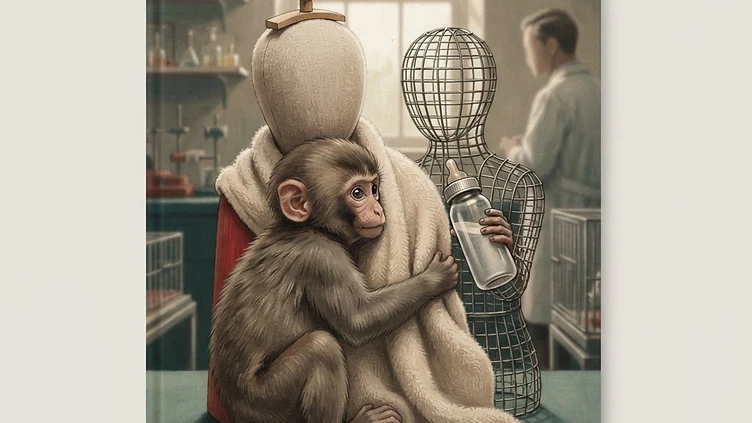
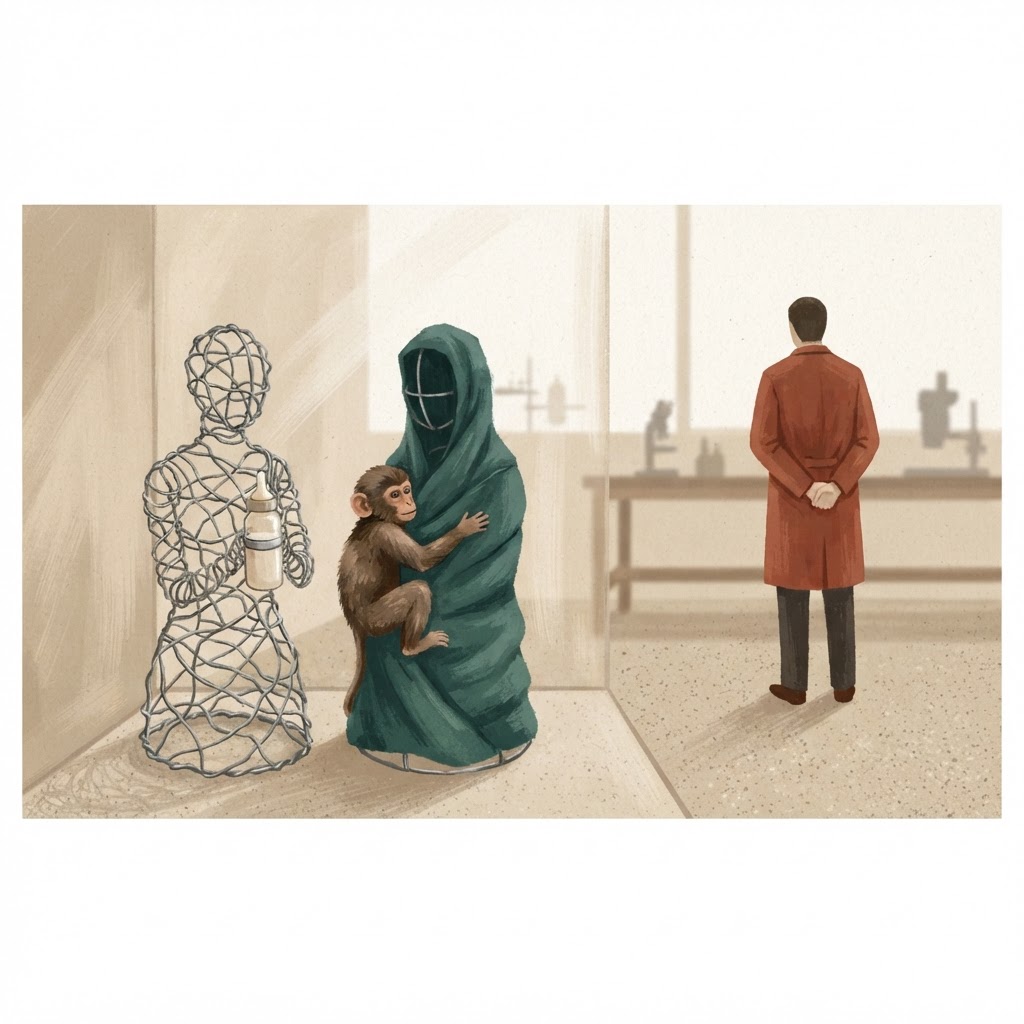
When we ask what love is, we usually turn to poetry, religion, or perhaps philosophy, but rarely to a laboratory. Yet, in the mid-twentieth century, a psychologist brought this most intimate of human emotions into a concrete-floored room and held it under the cold light of science. The question Harry Harlow asked was simple yet provocative: why does an infant love its mother? Is it because she feeds it, or because she offers touch and comfort? Until then, the answer was accepted almost without debate: love was merely a byproduct of nutrition. Harlow’s strange experimental setup with small rhesus monkeys in Wisconsin provided an answer that would shake this consensus to its roots and alter the course of psychology. ## The Wire Mother, The Cloth Mother At first glance, Harlow's experiment looked like a childish toy: inside a cage, two artificial mother figures were placed—one made of bare wire, the other covered in soft cloth. The wire mother was practical because a bottle could be attached to her, allowing the infant monkey to nurse. The cloth mother was useless in terms of nutrition; she was simply warm and offered a soft surface when touched. According to the behaviorist logic of the time, the infant monkey should have bonded with the wire mother because she satisfied the need for survival. However, the infants spent their days clinging to the cloth mother, going to the wire mother only to feed briefly when hungry, and then immediately returning to the soft fabric. This simple observation contained a massive claim. When the infant monkeys faced danger, they ran to the cloth mother with the same reflex, as if she were the very embodiment of trust and refuge. Upon seeing this, Harlow began to consider that love might be as fundamental as food, perhaps even a more primitive need. Consider this: why would a living organism, while having access to a source that satisfies hunger, leave it to run toward something dysfunctional that is only warm and soft? With a single experiment, this question punctured the portrait psychology had painted of human nature until then—the idea that humans are merely mechanisms responding to stimuli. ## The Collapse of Behaviorism In those years, the behaviorist paradigm dominating psychology viewed the mind as a black box and emotions as simple extensions of physiological needs. An infant's bond with its mother was considered a completely learned response; the mother provided food, food created satisfaction, and thus the mother was loved through association with that pleasure. This explanation was so dominant that some experts of the era even advised parents not to hug their children too much and to avoid emotional contact. Harlow's monkeys left the proponents of this theory with an unsettling question: if love were just a response reinforced by nutrition, how could this persistent attachment to the non-nutritive cloth mother be explained? Of course, there were objections; some researchers argued that monkey behavior could not be directly transferred to humans and that this might just be a species-specific instinct. But over time, Harlow's findings aligned with observations of human infants, where children raised in orphanages, despite having their physical needs met, showed severe developmental delays due to a lack of tactile affection. At this point, behaviorism's neat, mechanical model of the human began to crack. Love was no longer a side effect but a need in its own right; like hunger or thirst, it was a biological drive that left the organism truly deficient if unmet. This idea may seem ordinary to us today, but at the time, it caused a real seismic shift. ## The Dark Side of the Legacy Unfortunately, the legacy Harlow left to science was not limited to these enlightening findings. After proving the importance of love, he wanted to see what its absence could do and subjected infant monkeys to total isolation, keeping them away from both wire and cloth mothers, and other monkeys. These isolation experiments drove the animals into severe psychological collapse; some monkeys began to harm themselves, and others were so damaged they could not communicate when returned to social life. Looking back from today, these experiments are remembered as some of the most severe ethical violations in the history of science, and they are rightly remembered as such. Yet, to ignore this dark legacy would be to fail to understand the history in its entirety. If Harlow's ruthless methods had not so strikingly demonstrated the cost of the absence of love, it is difficult to say whether the attachment theory we consider fundamental in child development today could have sat on such a strong foundation. The understanding we possess today regarding the importance of touch, proximity, and secure attachment in child care has roots that extend directly to these painful experiments. The history of science sometimes harbors such paradoxical legacies; progress is occasionally built upon a moral cost, and we try to make sense of that progress without forgetting that cost. When I think of Harlow's monkeys, I realize that we are actually thinking about ourselves; the drive within that infant clinging to the cloth mother lives on in us with the same intensity. Perhaps that is why this story touches us so deeply, for what we see there is not just a monkey's preference, but the silent, insatiable demand that lies at the core of being human, which no amount of food can satisfy. We often think that love is immeasurable, but Harlow showed us that sometimes the most abstract emotions reveal themselves through the most concrete and painful experiments. Today, when we hold a baby or hug a loved one, perhaps we are unknowingly experiencing an echo of the truth proven in those small cages in Wisconsin.
İlgili Denemeler
Can the Human Brain Detect Magnetic Fields?
Geophysicist Joseph Kirschvink's experiment at Caltech indicates that the human brain responds to magnetic fields, raising questions about a potential sixth sense.
Jan Hendrik Schön: The Physicist Who Fooled Science
The scandal of Jan Hendrik Schön's fabricated data at Bell Labs highlights the critical vulnerabilities in the scientific peer-review system.
Barry Marshall Drank Bacteria to Prove Stomach Ulcer Theory
Barry Marshall made medical history by consuming harmful bacteria to prove that stomach ulcers are caused by an infection rather than stress alone.
Tartışma (0)
Henüz yorum yok. İlk yorumu siz yapın.
Join the Newsletter
New essays, once a week, delivered to your inbox.