GPS and Einstein: Why Time Flows Differently
Every location on our phones is a daily proof that time is not absolute.
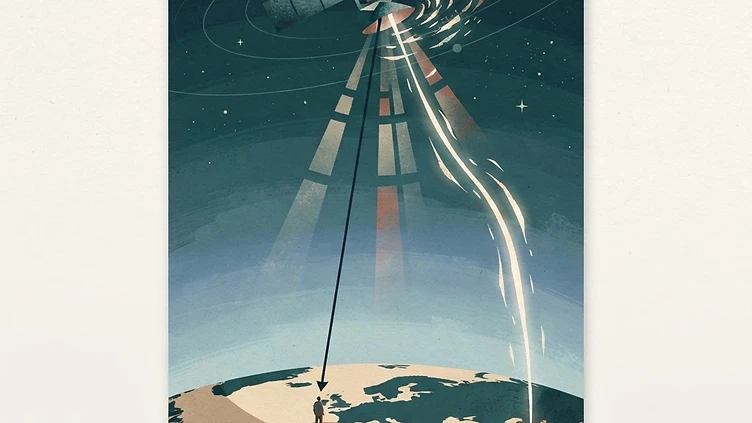
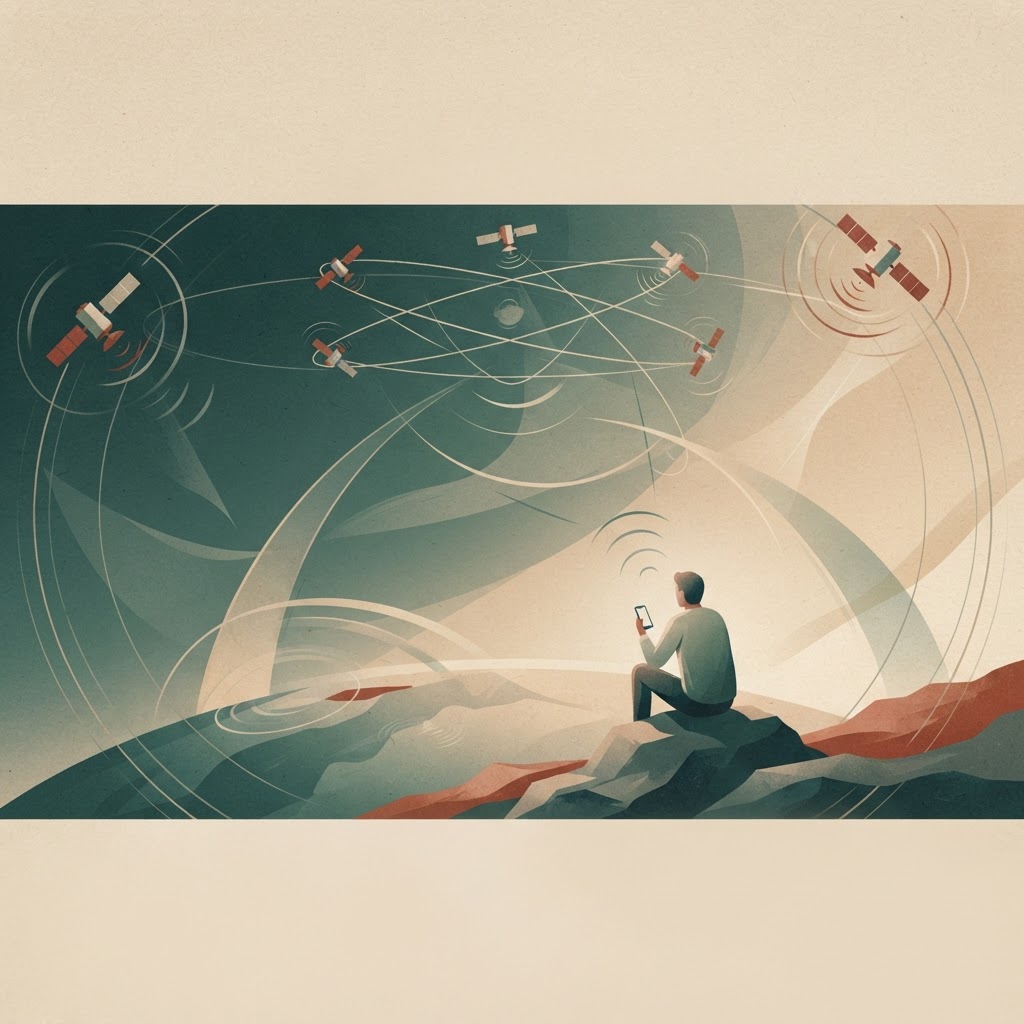
Have you ever wondered what lies behind the blue dot that appears on your screen when you pull out your phone to find your way? That dot is more than just signals traveling between satellites and your device; it is a tangible confession that time, contrary to intuition, does not flow at the same rate for everyone. A thought experiment Einstein penned on paper a century ago is now deployed every second to keep the map in your pocket accurate. Is that not peculiar? We remember relativity as an abstract physics topic, yet without that theory, we could easily lose our way to a restaurant. ## Time Stopped by Velocity Special relativity states, in simple terms, that a moving clock runs slower relative to a stationary observer. This premise sounds like a mental game at first; we never see clocks in daily life slowing down according to our speed because the velocity of our cars or trains is not high enough to make the effect noticeable. However, GPS satellites orbit the Earth at such speeds—exceeding fourteen thousand kilometers per hour—that this discrepancy becomes significant. Due to its speed alone, an atomic clock on a satellite lags behind a clock on Earth by about seven microseconds per day. While this number seems small, light travels more than a hundred meters in that duration, meaning the position calculation could drift by that much. A counter-argument might arise here: if the difference is so tiny, why do we care? The answer lies in the operating logic of GPS. The system must know when the signal was sent with sub-millisecond precision because it calculates position based on this time difference. If the clock drifts, the calculated distance shifts, and if the distance shifts, you find yourself on a different street. The issue is not the clock itself, but that the information carried by that clock must reach a phone on the other side of the world and be interpreted correctly. Special relativity reminds us here that motion is a force that alters time, not as an abstract formula, but as a risk of being late or arriving on the wrong street. ## Time Accelerated by Gravity If the story ended here, engineers would simply adjust the satellite clocks for this slowing effect and be done with it. But general relativity intervenes and reverses the situation. Einstein stated that gravity itself affects time; clocks run slower in a strong gravitational field and faster in a weak one. Because GPS satellites orbit twenty thousand kilometers above the Earth's surface, they exist in a region where the Earth's gravitational pull is much weaker. For this reason alone, their clocks run about forty-five microseconds faster per day than those on Earth. Here is where the initial expectation collapses. One instinctively wants to think that the two effects balance each other out. But physics is not that polite; the magnitudes of the two effects are not equal. With a velocity-induced slowing of seven microseconds and a gravity-induced acceleration of forty-five microseconds, the net result is a daily forward shift of thirty-eight microseconds. This number may still sound small, but when multiplied by the speed of light, it translates into a positional error of nearly nine kilometers per day. A navigation system that thinks you are nine kilometers away by the end of the day is practically useless. Thus, relativity here is not a single correction but the overlapping effects of two distinct physical realities that do not cancel, but rather add to each other. ## Physics Infiltrating Daily Life How do engineers resolve this discrepancy? The solution is to intentionally set the frequency of the atomic clocks on the satellites slightly wrong before launch. The clock begins to tick at a slightly lower frequency than its value on Earth, just enough to compensate for the expected acceleration in space; thus, when it reaches orbit, it ticks at the same rate as clocks on Earth despite relativistic effects. This is an abstract theory translated into the language of engineering. Someone did not just sit down and write that time is not absolute; they encoded that sentence into millions of satellite chips as a concrete number. One might wonder if this adjustment could be made once and forgotten, but the issue is its continuity. A system left without relativistic correction would reach a serious deviation not in minutes, but in hours; by twenty-four hours, the error would be measured in kilometers. This means that every time you open your phone and start navigation, a physics theory is being instantaneously tested and validated in the background. We are unaware of this because the system works perfectly, but the reason it works perfectly is that a century ago, someone proposed that the flow of time depends on speed and gravity. An abstract proposition has thus infiltrated the most mundane moments of daily life—the simple act of finding a street. Considering all this, the true miracle of GPS is not that it finds our location, but that it silently validates a reality beyond human intuition every single day. The belief that time flows at the same rate for everyone is so strong in our daily experience that accepting it as false still feels strange. Yet, that little blue dot in your pocket experiences this oddity every moment and resolves it without us even feeling it. Perhaps that is the fate of the greatest ideas: they first seem like mind games, and then one day we realize they have already become embedded in our most ordinary tasks.
İlgili Denemeler
Can the Human Brain Detect Magnetic Fields?
Geophysicist Joseph Kirschvink's experiment at Caltech indicates that the human brain responds to magnetic fields, raising questions about a potential sixth sense.
Jan Hendrik Schön: The Physicist Who Fooled Science
The scandal of Jan Hendrik Schön's fabricated data at Bell Labs highlights the critical vulnerabilities in the scientific peer-review system.
Barry Marshall Drank Bacteria to Prove Stomach Ulcer Theory
Barry Marshall made medical history by consuming harmful bacteria to prove that stomach ulcers are caused by an infection rather than stress alone.
Tartışma (0)
Henüz yorum yok. İlk yorumu siz yapın.
Join the Newsletter
New essays, once a week, delivered to your inbox.