Ottoman Miniature Art: The Choice of Shadowless Vision
What did the miniature want us to see by rejecting light and depth?
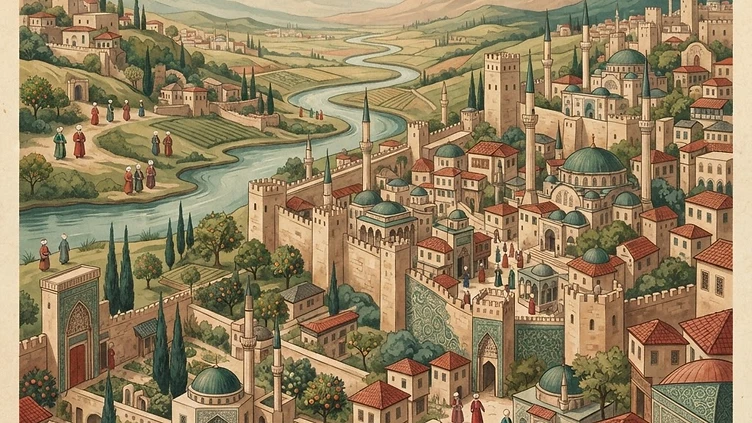
When you stand before a miniature and let your gaze wander across its surface, the first thing you may feel is a sense of lack. There is no shadow, no depth, and none of that familiar interplay created by light falling upon objects from a single source. Everything lies on the same plane, with the same clarity, as if the sun had risen from everywhere at once. To an eye raised on the Western tradition of painting, this initially reads as a deprivation; but then one pauses and asks, what if this is not a shortcoming, but a choice? The refusal of Ottoman miniature to employ light and depth is not the absence of a technique yet to be discovered, but an insistence on an entirely different way of looking at the world. To understand what this insistence wants us to see, we must first question the habits of our own gaze. ## The Tyranny of the Single Eye The single-point perspective that developed with the Renaissance brought a tremendous sense of reality to painting; yet this reality was one surrendered to a single, stationary, unmoving eye. When you draw a street scene with perspective, you can see that scene only from one place, at a specific height, from a specific angle; the painting tells you that this is the only correct way to see the world, and there is no other. While this is an aesthetically impressive achievement, it also establishes a kind of sovereignty, imprisoning what lies before the eye in a single point and ignoring all other possibilities of vision. Miniature, however, offers a completely different promise. A miniaturist depicting a palace courtyard may show some figures from the side, others from above, and some objects from the front; they might present a carpet pattern from a bird's-eye view while painting the person sitting upon it in profile. This is not a technical inconsistency but a conscious plurality. Each object is shown from the angle that best describes it; it is as if the artist, refusing to permit the tyranny of a single eye, has granted every element in the scene the right to present its own truth. Even today, it is not expected that everyone at a meeting sees from the same point; there is a reality that everyone sees from their own place, and by bringing this plurality into the painting, the miniature suggests a more democratic form of vision. A curious result of this plural perspective is that the viewer is no longer a passive observer. In a painting with perspective, you stand at the point imposed upon you by the artist; in a miniature, the eye is invited to wander within the scene, to pass from one corner to another, and to look from different angles. This invitation transforms the viewer from a passive recipient into a partner who thinks alongside the scene. Perhaps this is why the time spent before a miniature demands a different kind of patience than that spent before a photograph; the eye does not lock onto a point in haste, but wanders, searches, and traces its own route. ## Collecting Time in a Single Frame In Western painting, a scene is usually a frozen cross-section of time; the artist, like a photographer trying to capture a millisecond, chooses a single moment of an event and sacrifices everything else to that moment. If there is a battle painting, what you see is not the beginning, the result, or the struggle itself, but only a chosen frame; the before and after are left to the viewer's imagination. Miniature does not bow to this choice. In a depiction of a campaign, you can see the army's departure, its march, and its arrival on the same surface at the same time; time is not fragmented, but transported into the painting in its entirety. This is, in fact, a different attitude toward time. Compressing time into a single moment means severing the event and stripping it of its context; whereas the miniaturist acts as if they believe the meaning of an event is formed not only in that moment, but together with its before and after. In a wedding scene, the preparations, the ceremony, and the feast can stand side-by-side in the same composition; the viewer grasps the entirety of the event, the whole of a story, in a single glance. This is actually quite close to our reading habits; when reading a novel, we follow events not in pieces, but as a flowing whole. By bringing painting closer to this narrative logic, the miniature equates seeing with reading; the eye wanders across the page like a story, looking not at a single frozen image, but at a continuous time. ## The Truth That Shadow Rejects The absence of shadow seems like the easiest point to criticize at first glance; yet this absence is perhaps the most courageous decision of the miniature. A shadow is the trace of a temporary relationship an object establishes with light; as the angle of the sun changes, as the hours pass, as a cloud drifts by, the shadow also changes. The shadow of an apple is one thing in the morning, another at noon, and another in the evening; but the apple itself, in its essential being, remains the same apple. The miniaturist chooses to rescue the object from these temporary plays of light and show it with its own unchanging truth. When painting an apple, they depict it not as it appears at a specific hour of a specific day, but as it is at all times. This choice, combined with the lack of depth, frees objects from the physical rules of the three-dimensional world. In a painting with perspective, a building shrinks, recedes, and some faces disappear depending on your point of view; in a miniature, the building stands with its own integrity, in all its facades, as if viewed from beyond time and space. This is not naivety, but a belief that the object should not be reduced to its appearance. To show things on their own, with their own values, without surrendering to the play of light or the deception of distance—this is a remarkably sober philosophical stance, and perhaps even today it reminds us that there may be something more real behind what is seen than what is actually visible. This stubbornness of the shadowless world offers us a choice: we do not have to see everything from a single light, a single point, or at a single moment. While we live amidst the single frames flowing across our screens, photos with a single perspective, and images captured in an instant, this plural, timeless, shadowless world of the miniature leaves us with a question that is old yet strangely urgent. Perhaps instead of trying to fit everything into one gaze, one moment, and one light, we need to remember that respecting the integrity of objects and events can also be a way of seeing; the miniature tries to show us exactly this, with patience and stubbornness.
İlgili Denemeler
Ralph Lauren: From Bronx to American Aristocracy
The true story of Ralph Lauren reveals how a non-existent aristocratic past was successfully transformed into a global fashion empire.
Ecce Homo: How a Failed Restoration Became a Hit
A century-old fresco in a small Spanish town was transformed into an entirely different work during an amateur restoration, ultimately changing the town's fate.
Anish Kapoor and Vantablack: Art's Color Monopoly
Anish Kapoor's monopoly over Vantablack reignited debates on artistic ownership, authenticity, and whether colors can be confined to a single creator's signature.
Tartışma (0)
Henüz yorum yok. İlk yorumu siz yapın.
Join the Newsletter
New essays, once a week, delivered to your inbox.