Cosmic Rays and Technology: Space Particles That Cause Computer Errors
Could a computer error sometimes be a joke played by the universe rather than a software glitch?
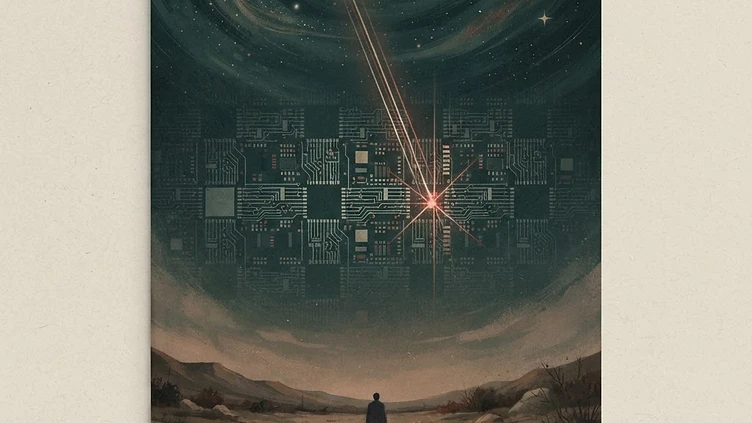
When a machine errs, we reflexively blame the software or human oversight. Yet, sometimes the error originates neither from a line of code nor a distracted engineer; it descends from the depths of space, a remnant of a star that exploded billions of years ago. While this sounds like science fiction, it is a sober reality within engineering. Sensitive systems, from flight computers to high-end processors, must occasionally contend with cosmic particles—a silent reminder of how fragile our reliance on technological perfection truly is. ## The Universe's Invisible Bullets A constant rain of particles falls upon the Earth. Known as cosmic rays, these are not photons but high-energy protons and atomic nuclei. Originating from solar flares or distant supernovae, they collide with our atmosphere to shower the planet with secondary particles. Some pass through buildings, our bodies, and the very electronic circuits we rely on; the device you are using right now may have just been traversed by a piece of a long-dead star. While the human body is largely unaffected, for a nanometer-scale transistor, this is significant. A single particle can flip a bit from zero to one. Engineers call this a single-event upset—a testament to the universe's ability to leave a mark on human systems, not through hardware failure, but through the universal noise the hardware inhabits. ## The Fragile Silence of Memory Such errors often go unnoticed due to error-correction mechanisms. However, not every system is immune; flight electronics, space probes, and massive data centers are particularly vulnerable. The truly striking realization is that even our most meticulously engineered systems cannot achieve complete immunity from a random cosmic particle. As scales increase, a once-a-year desktop glitch becomes a daily probability in a data center running millions of processors. As we entrust more of our infrastructure—finance, healthcare, and law—to these silent networks, this statistical noise transforms into a profound question of reliability. ## Vulnerability in the Age of AI The training of artificial intelligence requires trillions of flawless operations. At this scale, the probability of a cosmic-induced bit error becomes non-negligible. A medical prediction or a financial forecast could theoretically be influenced by a tiny deviation caused by a particle from the sky. This is not mere exaggeration; engineers take this risk seriously. What matters here is not just the technical detail, but the philosophical implication: we tend to view AI as an infallible machine, yet these systems are, like our own bodies, bound to the physical universe and its inherent randomness. A particle born from a stellar explosion billions of years ago can alter an algorithm's output today. It is a chilling yet poetic reminder that our faith in technology is a fragile compromise rather than an absolute truth. Perhaps the question is not how often these errors occur, but why we expect perfection in the first place. Our minds project a desire for order onto our tools to maintain a sense of control. Yet, the universe operates on balance rather than perfection. That invisible particle passing through a computer whispers that even our most intelligent machines are part of the cosmos—we cannot construct a sanctuary of perfection independent of it. Perhaps the lesson is not to fix the technology, but to recalibrate our own expectations of perfection.
İlgili Denemeler
Can the Human Brain Detect Magnetic Fields?
Geophysicist Joseph Kirschvink's experiment at Caltech indicates that the human brain responds to magnetic fields, raising questions about a potential sixth sense.
Jan Hendrik Schön: The Physicist Who Fooled Science
The scandal of Jan Hendrik Schön's fabricated data at Bell Labs highlights the critical vulnerabilities in the scientific peer-review system.
Barry Marshall Drank Bacteria to Prove Stomach Ulcer Theory
Barry Marshall made medical history by consuming harmful bacteria to prove that stomach ulcers are caused by an infection rather than stress alone.
Tartışma (0)
Henüz yorum yok. İlk yorumu siz yapın.
Join the Newsletter
New essays, once a week, delivered to your inbox.