GFAJ-1: Why Did NASA's Claim About Arsenic-Based Life Fail?
How did a bacterium that was thought to redraw the boundaries of life in 2010 manage to divide the scientific world within months?
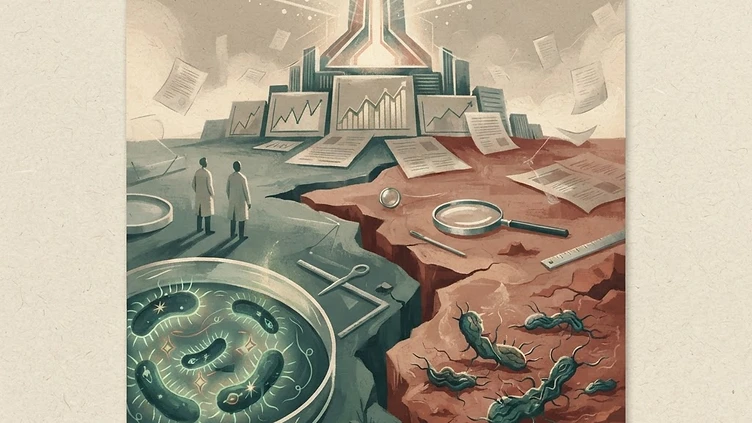
In December 2010, a press conference ignited a wave of excitement rarely seen in the history of science. What was announced at the NASA meeting was no ordinary discovery; it was the claim that one of the fundamental rules defining life itself might be rewritten. A bacterium that could substitute arsenic for phosphorus had allegedly been found, a discovery that raised profound questions not just about a microorganism, but about where and how life could emerge in the universe. But when a scientific finding captures the public imagination so rapidly, is something lost that can never be recovered? The case of GFAJ-1 provided a bitter answer to this question. ## The Grand Announcement NASA's press release bore no resemblance to the cautious and conditional language of a scientific paper. The study published in the journal Science by Felisa Wolfe-Simon and her team suggested that GFAJ-1, isolated from Mono Lake, could survive in an arsenic-rich environment and even incorporate arsenic into its DNA backbone in the absence of phosphorus. While the paper itself contained measured language, the press release invitation carried a much bolder tone, leaving the subject open enough to imply a connection to alien life forms. Journalists filled this void with their own interpretations, and headlines quickly declared that the chemical basis of life had been shaken. What is interesting here is why scientific institutions so often resort to hyperbole when communicating with the public. Perhaps the answer is simple: the true value of a finding rarely excites anyone outside of experts, but the sentence 'the definition of life is changing' captures everyone's attention. NASA's communication team likely wanted the public to connect with science; the desire itself was not malicious. However, the result was a fracture in how scientific uncertainty is communicated to the public. Because a press release does not carry the qualifiers found in a paper—such as 'possibly,' 'there are indications,' or 'further study is needed'—it instead promises certainty. And when certainty is promised, retreating becomes much more costly. ## The Rapid Collapse The collapse of the GFAJ-1 claim demonstrated the scientific community's healthiest reflex: skepticism. On the day the paper was published, microbiologist Rosie Redfield wrote a detailed critique of the methodology on her blog, which spread much faster than the slow-moving peer-review process of academic journals. Redfield's objection was simple yet powerful: the purification method used for the samples did not guarantee that residual phosphate had been completely removed, meaning the traces of arsenic observed in the bacterium's DNA could actually have resulted from trace amounts of phosphorus still present in the environment. As this objection spread rapidly across social media and science blogs, the question of whether the claim was reproducible became the focus of the scientific community. Within two years, independent studies confirmed Redfield's suspicions. It was true that GFAJ-1 could survive in the presence of arsenic, but this endurance stemmed from its extraordinary efficiency in using phosphorus, not from incorporating arsenic into its DNA structure. In other words, the bacterium was genuinely interesting, just not in the way it was claimed. What the scientific method demonstrated here was not that making mistakes is inevitable, but that mistakes are correctable. Data misinterpreted by one laboratory could be retested and refuted by others; this is the most fundamental characteristic distinguishing science from other forms of knowledge. Yet, this correction process did not reach the public with the same speed as the excitement generated by the initial announcement, because news of a collapse attracts far less attention than news of a discovery. ## The Arsenic Legacy The true legacy of the GFAJ-1 case should perhaps be sought not in the arsenic-loving bacterium itself, but in the fragility of the communication between scientific institutions and the public. The use of an exaggerated framework by a respected institution like NASA affected not just that single event, but the trust placed in subsequent announcements. If an institution claims that 'the definition of life has changed' only for it to be proven wrong, why shouldn't the reader be cautious the next time that same institution makes a similar claim? Trust is a capital that is difficult to earn and terrifyingly easy to lose, and scientific institutions often pay the price for risking this capital in exchange for media attention in the long run. Reading this case merely as a scandal simplifies the issue too much. The problem did not stem from malicious fraud, but from a tension inherent in the nature of scientific communication: researchers and institutions are constantly trying to strike a balance between remaining faithful to the complexity of science and attracting public interest. GFAJ-1 showed just how easily this balance can be disrupted. Today, this case is frequently cited in texts about science journalism because it embodies both the allure of discovery and the silence of correction; the asymmetry between the two determines which one remains in the reader's memory. GFAJ-1 eventually turned into an ordinary bacterium; an organism dependent on phosphorus, resistant to arsenic, but one that does not alter the fundamental chemistry of life. Its importance in the history of science lies not in what it was found to be, but in how it was described and how that description was corrected. The distance between a laboratory result and a press release may seem as small as the tone of a sentence, but that tiny distance can shape the public's view of science for years. Perhaps the real question should be what we ask ourselves when listening to the next big announcement: is this the language of the paper, or the language of the press conference?
İlgili Denemeler
Can the Human Brain Detect Magnetic Fields?
Geophysicist Joseph Kirschvink's experiment at Caltech indicates that the human brain responds to magnetic fields, raising questions about a potential sixth sense.
Jan Hendrik Schön: The Physicist Who Fooled Science
The scandal of Jan Hendrik Schön's fabricated data at Bell Labs highlights the critical vulnerabilities in the scientific peer-review system.
Barry Marshall Drank Bacteria to Prove Stomach Ulcer Theory
Barry Marshall made medical history by consuming harmful bacteria to prove that stomach ulcers are caused by an infection rather than stress alone.
Tartışma (0)
Henüz yorum yok. İlk yorumu siz yapın.
Join the Newsletter
New essays, once a week, delivered to your inbox.