Genie Wiley: The Tragic Case of Forbidden Language
The story of a child who received no linguistic input for thirteen years unveiled the most hidden boundaries of the human mind.
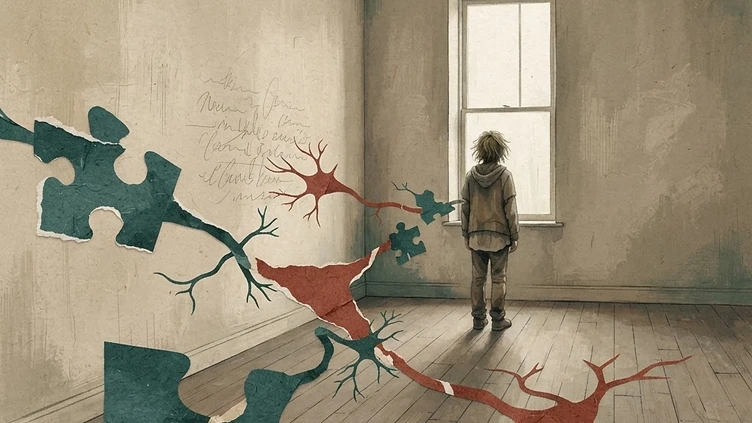
One of the deepest secrets of the human mind is often hidden within the most painful stories. Imagine a child growing up in a dark room for thirteen years without hearing a single word. Her name was Genie Wiley, and her silence brought to light a question that linguists and neuroscientists have debated for decades: does the human brain require a specific time window to learn language? Genie's story has gone down in history as one of the most brutal natural experiments performed by science; because no one invited her to be part of this study, life condemned her to this role. ## Thirteen Years of Silence Genie grew up in Los Angeles in an isolation room built by her father. Neither an audiobook, nor a song, nor ordinary family conversation could penetrate her world. When this situation was discovered by chance, the scientific community suddenly found itself on the brink of an unusual question: is language innate to the human mind, or is it shaped by environmental stimuli? Eric Lenneberg's previously proposed critical period hypothesis suggested that language must be acquired by a certain age, and once this window closes, full language proficiency can never develop. Genie was a rare, perhaps even the only example that could test this hypothesis; because in her story, environmental deprivation appeared in its purest form, without any confounding variables. What happened when this child was found? Researchers tried to teach her words and struggled to make her form simple sentences. Genie learned some words, could name objects, and even express her feelings with certain phrases. But the sentence structure, that invisible skeleton called grammar, never quite fell into place. It was as if a door in her brain had been left open just enough to receive words, but not enough to construct the complex architecture of grammar. This observation seemed like strong support for the critical period hypothesis; yet it also complicated the question because Genie's past included not only linguistic deprivation but also physical abuse, malnutrition, and emotional isolation. Which factor caused which result? This question turned into one of the most frustrating uncertainties in the history of science. ## Science or Exploitation After Genie was found, a group of linguists and psychologists gathered around her. Such a rare case was a unique opportunity for scientific careers, as an example of such pure linguistic deprivation had almost never been recorded in human history. But a conflict arose here: was Genie a research object, or was she, above all else, a child in need of treatment, love, and trust? Researchers surrounded her with tests, recordings, and observation sessions. Some of her acquaintances and later critics suggested that this intense interest served the collection of data rather than Genie's recovery. Is this claim justified, or is it inevitable that science, by its very nature, is always somewhat distant and objectifying? There is no easy answer here; because science sometimes reaches knowledge by passing through human suffering, and this path is not always clean. The crucial part of this debate is that Genie's own voice was never truly heard. She was surrendered first to her father's silence, then to the lens of science, and finally to the uncertainty of the care system. When research funding was cut, academic interest faded with it; as if it were not Genie herself, but the data she represented that mattered. At this point, one must ask: when a scientist views the person in front of them as proof of a critical period hypothesis, how much can they preserve that person's subjectivity? The Genie case remains an ethical lesson still taught and debated today regarding science's ability to cross human boundaries; because it makes us question who pays the price for knowledge. ## The Critical Period Remains Debated Today, despite so many years passing, the question of whether a definitive critical period exists for language acquisition is still open. Although Genie's case appears to offer strong evidence for this hypothesis, drawing a universal law from a single example is scientifically extremely risky. Because the trauma Genie endured deeply shattered her not only linguistically but also emotionally and cognitively; perhaps the deficiency in her language development stemmed not from the closing of the brain's language centers, but from a general psychological collapse. Making this distinction is difficult even in a controlled experimental environment; in Genie's story, this was impossible because no conditions were under control, everything happened spontaneously and ruthlessly. Modern linguistics does not completely reject the idea of a critical period, but places it in a more flexible framework. Some researchers now speak not of a fixed window, but of a learning curve that becomes progressively harder with age, yet never fully closes. Genie's limited progress could also fit this flexible model; perhaps her brain still possessed the capacity to acquire language partially, if not fully. This shows us that the human mind is too layered to be summarized by a single experiment or case. Instead of providing an answer, Genie's story perhaps proposed a more accurate form of questioning; it allowed us to rethink the question of where the limits of language begin and end, not as a sharp line, but as a blurred transition zone. Genie Wiley's story shows us the brightest and darkest faces of science simultaneously. On one hand, knowledge that sheds light on the hidden mechanisms of the human mind, perhaps unobtainable in any other way; on the other, a child's suffering serving as the raw material for this knowledge. Today, even though her name appears in textbooks like a case number, behind it there is still an unanswered question, an unhealed wound. Perhaps the hardest truth science has taught us is this: some questions can only be asked if someone pays the price, and we continue to acquire knowledge while being aware of that price. Genie's silence has ended, but the question she asked still echoes in some way every time we continue to think about the limits of language, memory, and being human.

İlgili Denemeler
Can the Human Brain Detect Magnetic Fields?
Geophysicist Joseph Kirschvink's experiment at Caltech indicates that the human brain responds to magnetic fields, raising questions about a potential sixth sense.
Jan Hendrik Schön: The Physicist Who Fooled Science
The scandal of Jan Hendrik Schön's fabricated data at Bell Labs highlights the critical vulnerabilities in the scientific peer-review system.
Barry Marshall Drank Bacteria to Prove Stomach Ulcer Theory
Barry Marshall made medical history by consuming harmful bacteria to prove that stomach ulcers are caused by an infection rather than stress alone.
Tartışma (0)
Henüz yorum yok. İlk yorumu siz yapın.
Join the Newsletter
New essays, once a week, delivered to your inbox.