Foreign Accent Syndrome: Why Do We Change Accents?
A millimeter of damage in the brain is enough for a person to hear their own voice as if it were coming from another country.
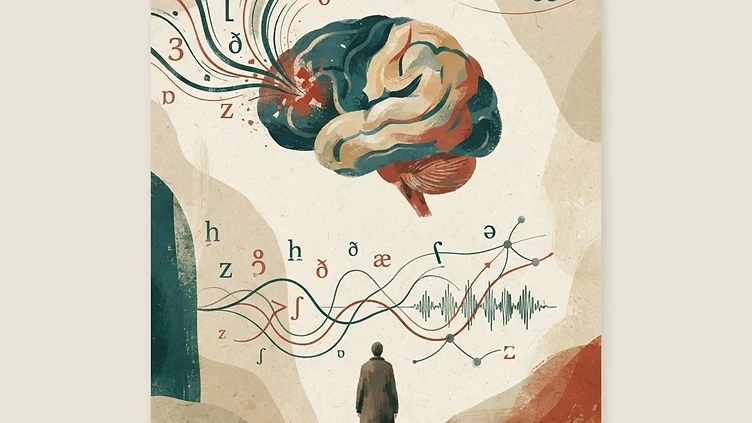
A person's most intimate signature is, in fact, their voice. We recognize a loved one in the dark or at the other end of a phone line from a single syllable. But what if this signature changed abruptly, without warning? What if someone waking up in a hospital bed found themselves still speaking their native language, but with the accent of a country they had never even visited? While this question sounds like science fiction, the condition known as Foreign Accent Syndrome, which emerges after brain injury, is well-documented in medical literature. Patients who begin to speak after a traffic accident, a stroke, or surgery start arranging their words with a completely different intonation, as if they had lived abroad for years. This article seeks to understand what lies behind this strange and unsettling phenomenon, and how closely the brain’s relationship with sound is woven into our identity. ## How Does an Accent Change? The first explanation that comes to mind is a simple illusion: the patient cannot truly have learned a new language; perhaps they are merely recalling an old memory or an accent heard in childhood. Yet, the actual mechanism of the event is far more technical and intriguing. Speaking is not just about arranging words in the right order; it is also a matter of rhythm, breathing patterns, syllable stress, and intonation. The areas of the brain responsible for this task function separately from those that produce the meaning of language. A stroke or trauma can disrupt this musical layer without touching the semantic part of speech. Thus, the patient still knows the same words and uses the same grammar, but the melody superimposed on the voice sounds as if it originates from somewhere else. What is truly striking here is that this change occurs without the person's control or conscious imitation. Patients are often surprised when they record and listen to their own voices because it sounds foreign even to their own ears. Imagine waking up in the morning, looking in the mirror, and seeing the same face, yet the voice emerging from your mouth is not yours. This illustrates how even the most fundamental connection between identity and body—speech—is tied to a delicate nerve network. A millimeter of damage in the brain can make a voice constructed over a lifetime appear, overnight, to belong to another geography. This reminds us of how mechanical and fragile a skill speech truly is. ## Why a Specific Country's Accent? A question immediately arises: if the type of damage is similar, why does everyone not start speaking with the same accent, instead shifting to intonations that sound Russian, Italian, or French? The answer to this may lie less in the patient and more in the listener. Recognizing an accent is entirely a matter of auditory habits. The listener matches the speaker's altered stress patterns with a reference point already stored in their own mind. The patient's voice is not clearly a specific accent; it simply carries a different stress pattern, and the listener’s mind interprets this difference by mapping it to the closest known pattern, such as a French character seen on television. While this explanation might seem to diminish the mystery, it reveals something even more fascinating: it is not just the voice that changes, but the ear as well. Perception is not a passive receiver that records external data; it is an active interpreter that constantly searches for familiar patterns and fills in the gaps with its own knowledge. The patient’s voice may not perfectly match any real country’s accent, but because the human brain cannot tolerate uncertainty, it forces the sound into the nearest known box. This demonstrates that even when we listen to others, we hear what we are prepared to hear, not necessarily what is there. Thus, Foreign Accent Syndrome becomes a two-way phenomenon occurring simultaneously in the brains of both the speaker and the listener. ## The Fragile Bond Between Identity and the Brain While all these neurological explanations may trap the issue in laboratory language, the true wound described by the patients is much more human. Not recognizing one’s own voice is not just living with a strange way of speaking; it is a different kind of looking in the mirror and not finding oneself. Language is not merely a tool for communication; it is where identity is woven. A person carries their city of origin, their family background, and the memories of their upbringing largely through their voice. Therefore, many patients struggle with a sense of alienation that lasts far longer than their physical recovery, as their bodies may return to normal, but their voices still feel as though they belong to someone else. What is truly striking here is how this syndrome reminds us that language is something borrowed. We usually consider speech a natural, even inevitable talent of our own; yet, these cases show that speech is a delicate coordination task dependent on the harmonious functioning of specific brain regions. When this coordination breaks down, one realizes how thin the thread is that connects one’s self to one’s language. Perhaps this is why the most heartbreaking sentence uttered by patients is: 'I am still me, but my voice no longer tells my story.' This sentence shows that the bond identity forms with the body, language, and voice is not as solid as we believe. Foreign Accent Syndrome tells us much more than a mere medical curiosity. It shows how a tiny injury in a corner of the brain can create a distance between a person and their own language—a distance that creates a rupture not only in the listener's ear but within the speaker’s inner world. Perhaps the simplest and heaviest lesson these stories teach us is this: our voice is much less 'ours' than we think, and much more entrusted to the delicate balance of our brain at any given moment. When this balance is disrupted, one can feel like a stranger even while listening to the words coming out of their own mouth. And this vividly reveals that our identity is not built on a solid rock, but on a fragile balance.
İlgili Denemeler
Can the Human Brain Detect Magnetic Fields?
Geophysicist Joseph Kirschvink's experiment at Caltech indicates that the human brain responds to magnetic fields, raising questions about a potential sixth sense.
Jan Hendrik Schön: The Physicist Who Fooled Science
The scandal of Jan Hendrik Schön's fabricated data at Bell Labs highlights the critical vulnerabilities in the scientific peer-review system.
Barry Marshall Drank Bacteria to Prove Stomach Ulcer Theory
Barry Marshall made medical history by consuming harmful bacteria to prove that stomach ulcers are caused by an infection rather than stress alone.
Tartışma (0)
Henüz yorum yok. İlk yorumu siz yapın.
Join the Newsletter
New essays, once a week, delivered to your inbox.