The Flynn Effect: Why IQ Scores Are Declining
Intellectual performance, which had steadily climbed for a century, has recently begun an unexpected and perplexing decline.
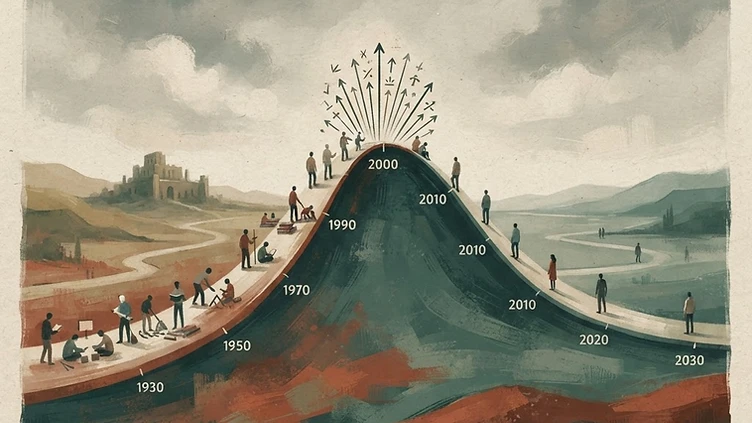
Have you ever looked at a test paper and wondered, Does this number truly define me? For a century, the IQ score has been considered the most reliable ruler for measuring the human mind; then, one day, the ruler itself began to warp. Named after the researcher James Flynn, this phenomenon led us to ask why average intelligence scores were constantly rising across the globe, and why that rise has since quietly reversed. This is not merely about statistics; it is an admission of how fragile the certainty we hold regarding the nature of intelligence truly is. ## The Silent Rise of the Century From the mid-twentieth century onward, a striking pattern emerged in intelligence tests conducted in various countries: generations taking the same test were consistently achieving higher scores. This did not mean that humans were suddenly born more intelligent; rather, what changed was not intelligence itself, but the environment that nurtured it. Improved nutritional standards directly impacted brain development in childhood. The spread of formal schooling turned abstract problem-solving skills into a part of everyday life. Modern existence itself forced people to grapple with unfamiliar, non-concrete challenges, such as completing patterns, solving analogies, or reading maps. The most striking aspect here was that this increase was not limited to a single country or culture. A similar curve emerged repeatedly in industrialized societies; it was as if intelligence behaved not as an individual fate, but as a collective climate. The year a child was born became as decisive a factor as the family into which they were born. This suggests that perhaps IQ tests were less a measurement of raw talent and more an indirect thermometer of a society's rate of modernization. The number rose because the world had transformed into a machine that compelled the human mind to think in a specific way. ## The Unexpected Turn However, this rising curve was not a law of nature destined to last forever. Measurements taken in recent years in several countries have shown that the increase is slowing down, or in some places, even reversing. Hearing this brings a strange sense of unease; it is like watching a river begin to flow backward. Yet, this reversal is no less logical than the initial rise. If intelligence scores are so sensitive to environmental conditions, it is expected that they would change when those conditions change. The real question is: which conditions have shifted? Some attribute this retreat to the different way of thinking brought about by the digital age; the problems people now face may prioritize fast and fragmented attention over deep information processing. Others point to changes in educational systems, declining reading habits, or the transformation of interpersonal dynamics within families. To seek a single culprit would be to oversimplify; this decline appears to be the sum of many small, intertwined changes rather than one cause. What matters is the lesson this turn teaches us: intelligence is not an achievement to be earned once and safely shelved, but a living faculty that requires constant nourishment and withers when neglected. ## The Question Behind the Number This story of rise and fall ultimately leads us to a deeper question: how much of the human mind's complexity can a single number carry? An IQ score reflects performance measured in a fleeting moment, under test conditions, and within a specific cultural context. Yet, what we call intelligence includes the empathy a child builds while telling a story, the silent dialogue a master holds with their tools, and the quick decision a mother makes during a crisis. Compressing all of this into a single number is like confusing a map with the land itself; the map is useful, but it never replaces the ground. Both the rise and fall of the Flynn Effect show us how unstable the ground is upon which this map is drawn. If a society's average intelligence can change significantly within a generation, presenting this score as a fixed biological reality is, at the very least, a hasty stance. Perhaps what we should do is not rank intelligence on a single axis, but try to understand the conditions under which it expands or contracts. For what is truly interesting is not how intelligent a person is, but the delicate, vibrant relationship their intelligence maintains with its environment. What the Flynn Effect leaves us with is not an answer, but the questioning of a habit. We have grown accustomed to looking at an intelligence test and seeing a fixed, immutable reality; yet this curve shows us a wave that rises and then recedes. Perhaps the most pertinent question is not Why have IQ scores dropped? but Why have we always wanted to reduce intelligence to a number? Because a number is comforting; it is comparable, rankable, and precise. But since the human mind is something that is reshaped in every generation and breathes alongside its environment, perhaps the most intelligent behavior is to learn to doubt that sense of certainty.

İlgili Denemeler
Can the Human Brain Detect Magnetic Fields?
Geophysicist Joseph Kirschvink's experiment at Caltech indicates that the human brain responds to magnetic fields, raising questions about a potential sixth sense.
Jan Hendrik Schön: The Physicist Who Fooled Science
The scandal of Jan Hendrik Schön's fabricated data at Bell Labs highlights the critical vulnerabilities in the scientific peer-review system.
Barry Marshall Drank Bacteria to Prove Stomach Ulcer Theory
Barry Marshall made medical history by consuming harmful bacteria to prove that stomach ulcers are caused by an infection rather than stress alone.
Tartışma (0)
Henüz yorum yok. İlk yorumu siz yapın.
Join the Newsletter
New essays, once a week, delivered to your inbox.