The First Labor Strike: Deir el-Medina Uprising
The individuals who launched the world's first recorded strike were the craftsmen constructing immortality for kings.
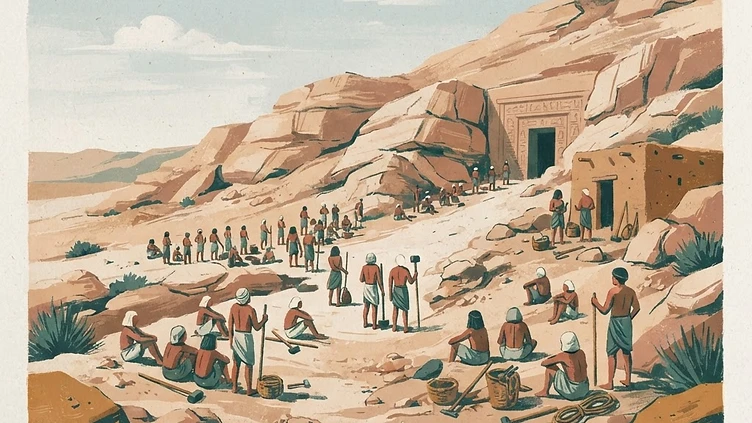
Consider this: can the hands that build immortality ever stop weaving that eternity? When the craftsmen who carved the pharaohs' tombs, shaped the stone, and painted the gods on walls laid down their tools one afternoon and declared 'enough,' they were essentially uttering the oldest and most human sentence in history. This scene, which took place in Egypt in 1157 BC, may feel like a distant legend to us today, yet it reminds us that the history of the boundaries of labor and justice is much older than we imagine. The workers who carved eternity for kings were able to challenge even the most sacred authority when they did not receive their share of bread on time. As I write these lines, I must admit I ask myself: are the most magnificent works of a civilization actually built upon the most mundane forms of unrest? ## The Silent Rebellion of Deir el-Medina Deir el-Medina was a small village west of Thebes, near the Valley of the Kings. Its inhabitants were not ordinary peasants; they were craftsmen specifically selected, trained, and housed by the state to build the pharaohs' tombs. Stonecutters, painters, and scribes worked together to shape the king's eternal home. These people were not from the lowest stratum of society; on the contrary, they were artisans with special status whom the royal court trusted. Yet this special status did not make them independent of the state's whims; their wages, paid in the form of grain and provisions, depended entirely on regular distribution by the state. That is exactly where a fracture appeared. When payments were delayed, these trusted craftsmen laid down their tools and halted work. They marched to the temples, held sit-ins, and demanded their rights. What is surprising about this is that those who rebelled were not slaves or foreign laborers, but people personally chosen by the pharaoh and entrusted with the kingdom's most intimate project. Hands that a king trusted could also be hands that said no to him. This contradiction creates a scene that questions where power ends and labor begins; no matter how sacred authority may appear, for a person who cannot feed themselves, that holiness loses its meaning after a while. ## The Truth Told by Papyrus The reason we know about this event today is not because of an oral legend or an inscribed monument, but because of a seemingly ordinary writing material: papyrus. This document, known as the Turin Strike Papyrus, is an administrative record kept by the scribes of the period. It contains notes detailing the delays, complaints, the workers' march to the temples, and their demands in chronological order. This is not a mythological narrative; it is a bureaucratic record, which is precisely why it holds extraordinary value for historians. The officials documenting the daily operations of an empire were unknowingly leaving behind the oldest labor document in human history. We must pause here and ask: what is required for an event to be remembered as the 'first'? Is it enough for it to have happened, or must it be written down? History is often the science of what is recorded, not what is remembered. Perhaps similar acts took place in other lands before Egypt; but if there is no written evidence that reaches us, those resistances have been buried in silence. The value of the Turin Strike Papyrus emerges exactly here: it adds a concrete, dated, anonymous, but real proof of a labor demand to the memory of humanity. A piece of papyrus can save a voice from being silenced even thousands of years later. ## An Ancient Voice Echoing in Today's Strikes Let us bring this closer to the present. One might reasonably ask: what connection can there be between a worker holding a picket sign in front of a factory and a stonecutter marching to a temple in Thebes thousands of years ago? The tools are different, the institutions are different, and even the form of the concept of 'wages' has changed beyond recognition. But when looking at the essence of the demand, the difference shrinks: the right to ask for the promised compensation on time from the person for whom one provides labor. The craftsmen in Deir el-Medina and today's unionized worker are actually saying the same sentence, just in different languages: give me what you owe me, or I will not work for you. This continuity makes me think of something interesting: perhaps while economic systems change, the human sense of justice hardly changes at all. That feeling of 'this is an injustice' that welled up in a tomb builder three thousand years ago swells in the same way within a delivery driver or a teacher today. It would be a comfortable narrative to link the origins of the modern labor rights struggle only to the industrial revolution and factory chimneys; but the truth reaches deeper, back to the age of the pharaohs. This shows us that the strike is not a tool invented by modern capitalism, but one of the oldest answers humans have found when facing power. When I put all these together, what remains in my mind is this: while kings had immortality carved into stone, the hands that carved that stone left their own transience—their hunger, their exhaustion, their expectations—to history as well. The pharaoh's tomb still stands today, but the silent resistance of the hands that built it still breathes on a piece of papyrus. Perhaps the truly immortal thing is not the king's tomb, but a person's courage to say, 'I demand what is mine.' If this courage was born in the middle of a desert three thousand years ago, it continues to echo with the same voice today in the crowds of a city.
İlgili Denemeler
The Mechanical Turk: History's Chess-Playing Mystery
The chess-playing automaton known as the Mechanical Turk deceived figures like Napoleon and Benjamin Franklin, masking a hidden human operator as a machine.
Bournville: The Utopian Town Built by Chocolate
The streets, gardens, and teetotal order of Bournville reveal how the Quaker faith imprinted a distinct form of morality upon the foundations of industry.
Levi's: The Story of Riveted Jeans Born from Gold Rush
In 1873, a tailor's discovery of a riveted solution for torn pockets redirected the true fortune of the gold rush toward the enduring garment industry.
Tartışma (0)
Henüz yorum yok. İlk yorumu siz yapın.
Join the Newsletter
New essays, once a week, delivered to your inbox.