Fetal Microchimerism: Cells That Stay in Your Body
These cells, which continue to live in the mother's body long after pregnancy ends, blur the biological boundaries between self and other.

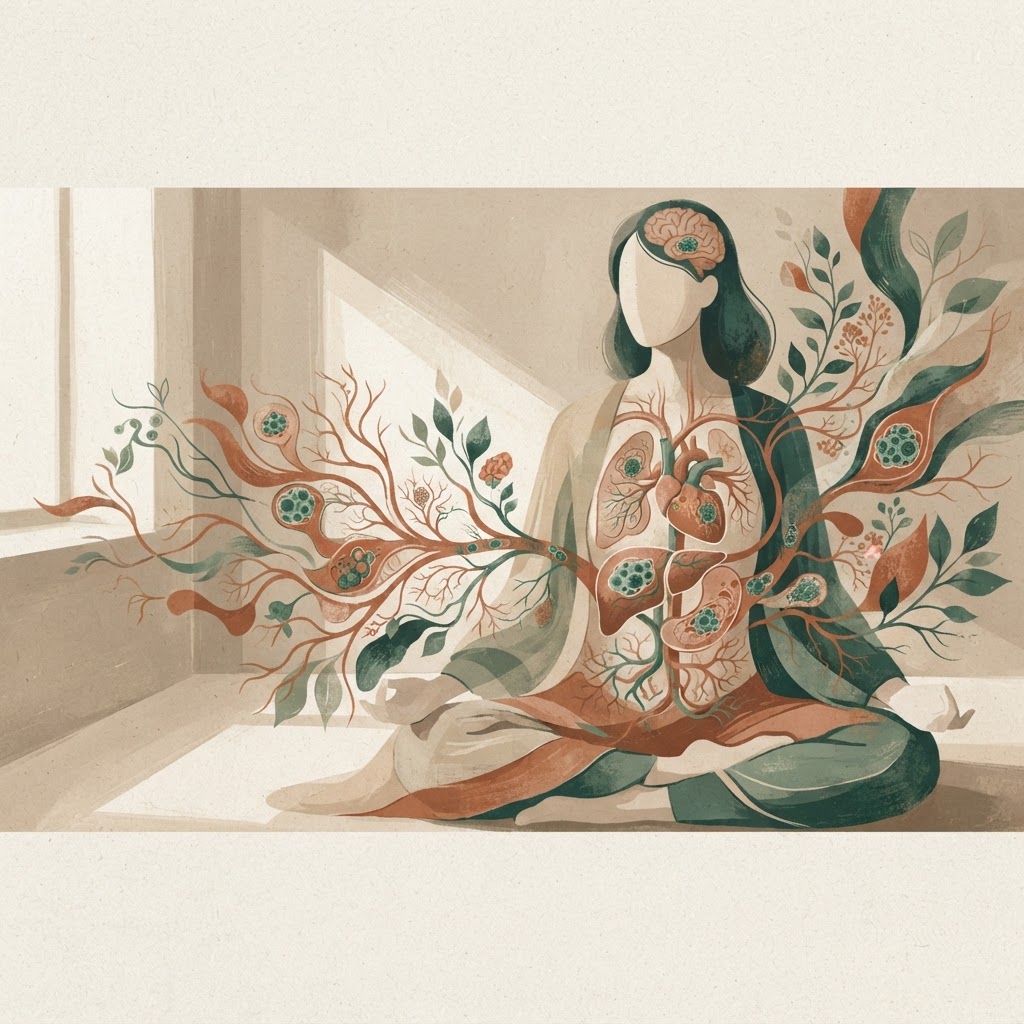
We often think that the story between a mother and child ends the moment the umbilical cord is cut. Mother and baby are seen as two separate bodies, two separate beings, two separate selves. Yet science whispers to us that this clear separation is not as absolute as it appears. It turns out that long after birth, even decades after the child reaches adulthood, cells belonging to that child continue to live silently within the mother's body. This phenomenon is called fetal microchimerism, and it presents a strange, slightly haunting invitation to rethink the boundaries of what we call the self. ## The Secret Leaked by the Placenta We often imagine the placenta as a strict firewall, a filter that allows the passage of nutrients and oxygen between mother and child while meticulously keeping their cells separate. This image is comforting because it seems to guarantee the indivisible integrity of the body. But reality is messier and more fascinating. The placenta is actually a border zone that is occasionally breached, allowing cells to leak in both directions. Fetal cells take advantage of these leaks to enter the mother's bloodstream, from where they migrate to various tissues. What is truly striking is that this transition is not one-sided. The mother also sends her own cells to the baby, turning pregnancy into a mutual exchange where two bodies permeate each other. The concept of the individual taught to us by biology begins to crack here; pregnancy is not merely one body carrying another, but merging with it at a cellular level. This integration is so profound that it leaves traces even after birth, and these traces sometimes persist for decades. ## Traces Found Years Later Researchers have found cells belonging to children in the brains, hearts, livers, and even lungs of women long after they have given birth. These are not merely passing traces circulating in the blood; they are living parts that have settled into organ tissue. Finding cells from a child born years ago in a woman's brain is deeply startling, as it directly contradicts the idea that the body is a property with a single owner. Imagine that in a sixty-year-old woman's heart, the cells of the child she bore thirty-five years ago may still be pulsing. This knowledge transforms the concept of motherhood from a metaphorical bond into a physical, cellular reality. Furthermore, this persistence is not limited to born children; cells from miscarried or lost pregnancies can also survive in the mother's body for years. This shows us that the body acts like an archive, biologically carrying the traces of every connection and relationship we have experienced. Even if our memory forgets, our cells do not. ## Protection or Threat? The existence of these persistent cells pulls scientists in two directions. On one hand, there are suspicions that these foreign cells might trigger the immune system and pave the way for certain autoimmune diseases. It is thought that as the body struggles to distinguish between its own tissue and that of the child, a kind of confusion may occur, leading the immune system to attack its own organs. This possibility leads us to view microchimerism as a risk factor, raising the question of whether a mother pays a price for these silent guests she carries. However, the same research shows the other side of the coin. Some findings suggest that these fetal cells may protect the mother against certain diseases; as if these small parts from the child's body offer the mother a kind of additional support, an extra layer of immunity. In this case, microchimerism appears not as a threat, but as a gift or a protective mechanism. The coexistence of these two possibilities reminds us that these cells are neither good nor bad; they are simply there. Perhaps the real issue is to stop trying to label these cells as good or bad. Because microchimerism, like life itself, is a layer too complex to be reduced to a clear calculation of benefit and harm. The maternal body might receive its child's cells as an ally at one moment and as a stranger the next; the boundary between these two is not as sharp as we think. This duality is one of the most honest answers biology offers us, because life and our relationships are just like this: both support and burden, both bond and price. Ultimately, what remains is the truth that the body is too complex a structure to fit into a single narrative. The bond between mother and child is not a string severed at birth, but a conversation that continues at a cellular level for years. Fetal microchimerism shows us that what we call the self is a much more permeable, more collectively constructed concept than we imagined. Perhaps by carrying the traces of every relationship we have touched throughout our lives, our body reminds us that identity never exists alone or in a pure form.
İlgili Denemeler
Can the Human Brain Detect Magnetic Fields?
Geophysicist Joseph Kirschvink's experiment at Caltech indicates that the human brain responds to magnetic fields, raising questions about a potential sixth sense.
Jan Hendrik Schön: The Physicist Who Fooled Science
The scandal of Jan Hendrik Schön's fabricated data at Bell Labs highlights the critical vulnerabilities in the scientific peer-review system.
Barry Marshall Drank Bacteria to Prove Stomach Ulcer Theory
Barry Marshall made medical history by consuming harmful bacteria to prove that stomach ulcers are caused by an infection rather than stress alone.
Tartışma (0)
Henüz yorum yok. İlk yorumu siz yapın.
Join the Newsletter
New essays, once a week, delivered to your inbox.