Han van Meegeren: The Forger Who Fooled the Art World
How a painter's rejection turned into the century's greatest art forgery and his own trial for patriotism.
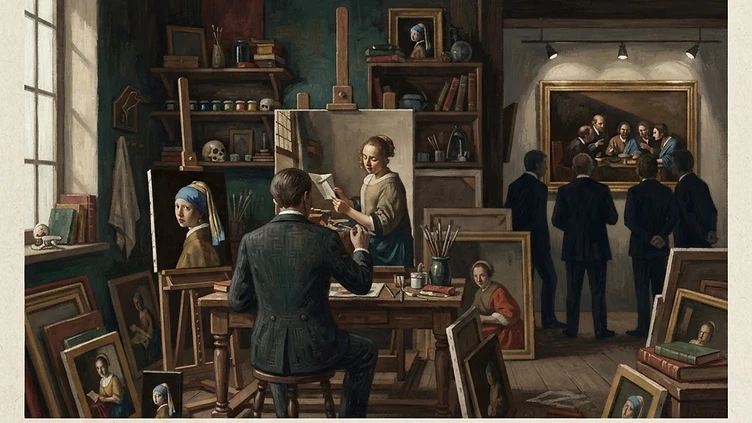
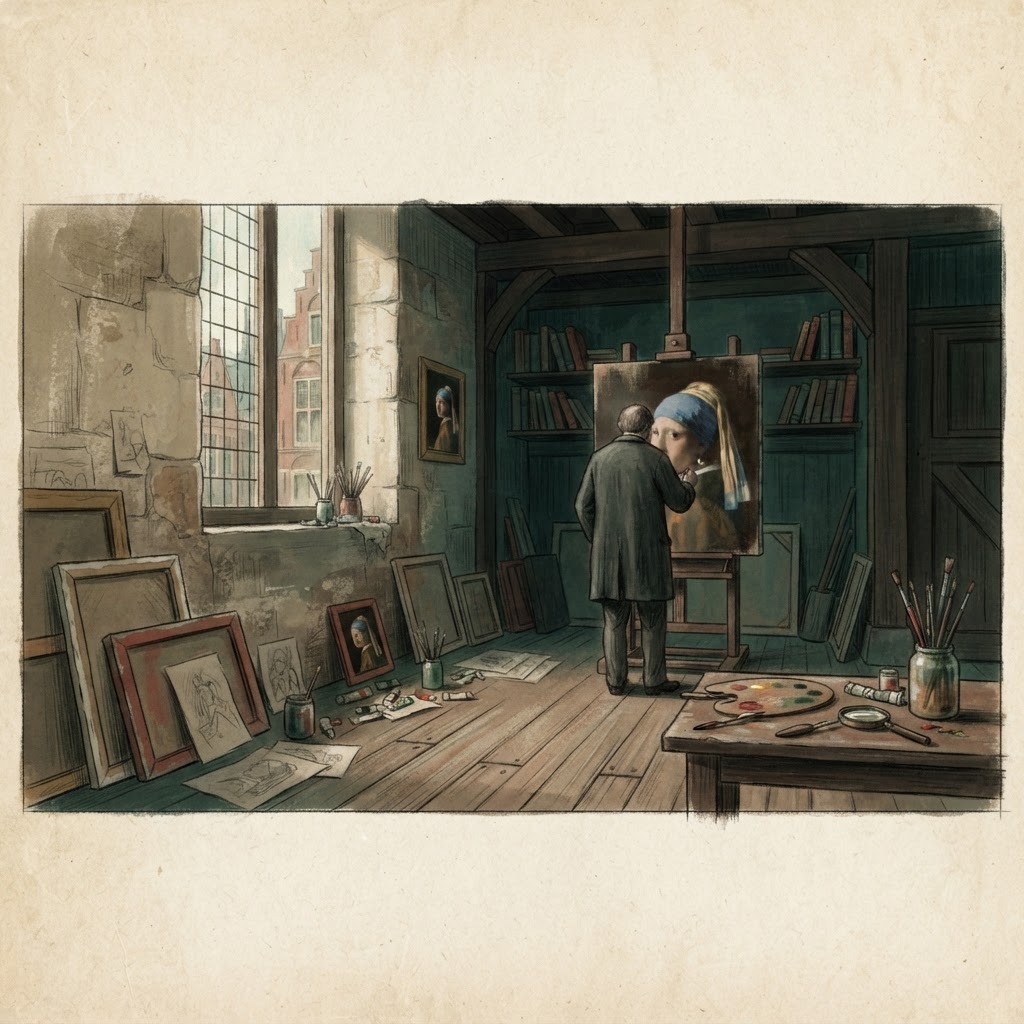
Perhaps the most authentic moment of a painting is the instant its falsehood is revealed. For centuries, art history has taught us that every brushstroke from a master carries a truth; yet, the life of a Dutch painter fundamentally shook this belief. When you hear the name Han van Meegeren, you first think of a forger, perhaps a swindler. But his story opens a deeper question: is a work made real by the hand that touched it, or by the trust we place in it? The best Vermeer painting was not made by Vermeer himself; while this sounds like a paradox, it highlights the most fragile point of the art world. ## The Revenge of the Rejected Painter In his youth, Van Meegeren was a meticulous painter loyal to classical techniques; however, critics of the era, caught in the winds of Cubism and Expressionism, found an artist looking toward the past irrelevant, even anachronistic. To him, painting was not about distorting form but serving it; to the critics, this was cowardice. The paintings he proudly presented in exhibitions were pushed aside as products of an untalented imitator, a label that clung to him like a curse. Being ignored by his own century birthed a silent but sharp desire for reckoning; if modern art did not want him, he would speak through the masters of the past. What is interesting here is how Van Meegeren orchestrated his revenge. He did not merely mimic the style of old masters; he noticed a gap in Vermeer’s biography: there were almost no religious works from the painter's early period. Van Meegeren read this void as an invitation and set out to create a lost Vermeer; his goal was not just to make a painting, but to pull art history back a step, toward his own invention. He gave a silent answer to the critics who claimed he could only imitate by achieving it at the highest level. ## The Fake Masterpiece on Göring's Desk When the forgery, titled Christ and the Woman Taken in Adultery, was presented to one of the most respected Vermeer experts of the era, something unexpected happened: the expert accepted the painting as a genuine Vermeer. This approval acted like a signature; once a reliable voice declared it real, everyone else chose to admire rather than doubt. The question here is this: what determines the reality of a painting—the chemistry of the paint layers, or the reputation of the person interpreting that chemistry? Van Meegeren’s brush was certainly masterful, but his true forgery lay in his ability to read the ego of an expert and the prestige hunger of an institution. As the work changed hands, its value multiplied; then came the war years, and this lost Vermeer was sold through intermediaries to the Nazi leader Hermann Göring. Göring’s ambition to collect Europe’s most precious art was well known; unaware that the piece was the product of a fraud, he saw it as a cultural victory. The irony was so profound that one of the most ruthless power brokers of the era had fallen victim to the most subtle of games. Some might read this as mere luck, but I believe it shows a more unsettling reality: even a man at the height of power was so ready to believe in the story placed before him. At this point, the objection arises: perhaps the issue was simply the inadequate technical capabilities of the era, and today’s scientific analysis would not make the same mistake. This may be true, but the real issue was never the age of the pigment; the issue was how our gaze changes when we hear a name. When Vermeer is written, everyone’s gaze softens, criticism falls silent, and admiration takes over. Van Meegeren’s true achievement was not imitating the paint, but the gaze itself. ## From Traitor to Artistic Genius When the war ended, it was revealed that a Dutchman had sold what was considered a national treasure to the enemy, and this was not just a simple fraud but a charge of treason; in that era, the penalty for this crime was death. Van Meegeren suddenly found himself trapped between being a hero and a traitor; his only exit was a strange confession he had to make to save his skin. The painting sold was not a genuine Vermeer but a product of his own hand; therefore, what was sold to the enemy was not a treasure, but a trick. Thus, the way to escape the death penalty was to declare his own genius—his forgery—in front of everyone. The court was not easily convinced, of course, as it was known a man might say anything to save his life. Thus, under surveillance and in the presence of witnesses, Van Meegeren was forced to create a new Vermeer imitation; he was asked to restage his own crime. As his brush moved, those sitting in the room witnessed both a miracle and a confession. What is truly striking here is that authenticity had become a matter of performance and an exhibition of trust, rather than material science; the judges had to believe in the mastery they saw with their own eyes, not the lab reports. ## Closing Van Meegeren’s story always reminds me of this: the reality of a work is often a decision made by our minds, not our eyes. When Vermeer is written on a painting we have, we show respect; when Van Meegeren is written, we laugh off the same brushstrokes; yet, the only thing that changes in both is a name. Perhaps the fact that the best Vermeer is not a Vermeer is the most painful but most honest lesson art teaches us: what we admire is often not the work itself, but the story we choose to believe in. Van Meegeren went down in history not as a despised painter, but as a genius who could not bear his own name; and this strange justice forces us to keep asking who truly holds the essence of authenticity.
İlgili Denemeler
Ralph Lauren: From Bronx to American Aristocracy
The true story of Ralph Lauren reveals how a non-existent aristocratic past was successfully transformed into a global fashion empire.
Ecce Homo: How a Failed Restoration Became a Hit
A century-old fresco in a small Spanish town was transformed into an entirely different work during an amateur restoration, ultimately changing the town's fate.
Anish Kapoor and Vantablack: Art's Color Monopoly
Anish Kapoor's monopoly over Vantablack reignited debates on artistic ownership, authenticity, and whether colors can be confined to a single creator's signature.
Tartışma (0)
Henüz yorum yok. İlk yorumu siz yapın.
Join the Newsletter
New essays, once a week, delivered to your inbox.