From Stone to Concrete: The Evolution of Architecture
Why does the hand that once carved stone now touch no structure at all?
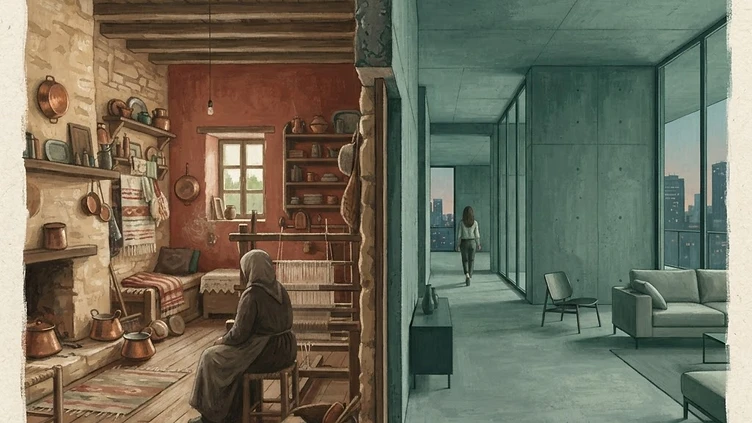
What do you feel when you place your hand against the wall of a home? On the stone wall of an old village house, you can see chisel marks left like fingerprints, each one behind it a human effort, a choice, a period of waiting. Yet, when you touch the wall of the apartment building where we live today, what you feel is nothing more than a cold and indifferent surface; as if no one built that wall at all, as if it appeared on its own. This difference is no coincidence; it is the trace of an era withdrawing its hand. Why does the hand that once carved stone, kneaded mud-brick, and sculpted wood now touch no structure? This question is not merely an architectural curiosity, but an inquiry into the relationship man establishes with his own space, and perhaps with himself. ## The Time When Stone Was Labored Upon Constructing an old house, from today's perspective, is an act of unfathomable patience. Stone is extracted from the quarry, the village master weighs it with his hands, reads its grain, and talks to the stone as he decides which wall it belongs to. For mud-brick, soil is selected, straw is added, and it is left to wait under the sun; before timber is cut, the phase of the moon is observed. This entire process requires submission to the rhythm of the material itself; one enters the space not with haste, but with respect. When the house is finished, what emerges is not just a shelter; the story of the family living there, the soil of that region, and the hand of the master are etched into the stone. This is why old houses are not identical; each bears the signature of its geography and its labor. Modern housing production, conversely, operates on the opposite logic. The moment concrete is poured into a mold, it loses its identity, produced by the same formula regardless of which city or climate it is destined for. Speed is the highest value here, for housing is no longer a living space but an investment tool, a commodity. Today, the housing projects surrounding the edges of large cities look like copies of one another; the same facades, the same balconies, the same window gaps repeat endlessly. This similarity is not a coincidence but the natural result of a logic of production; because labor is expensive, time is limited, and profit is a fixed target. Man no longer carves his home; he chooses it from a ready-made catalog. Perhaps that is why it takes time for us to feel a new house belongs to us, for those walls were built not for us, but for everyone, and therefore, for no one. ## Roles Scattered Around the Hearth At the center of the traditional home lies the hearth, and the life built around it carries a structure quite different from today's separation of public and private spheres. While the woman kneads the dough, the man cuts the wood, children run between them, and even animals share the same courtyard as an extension of the house. There is a division of labor, of course, and the tasks of the woman and the man are distinct, but this separation does not divide the space; everyone lives under the same roof, in each other's sight, as part of a common labor. The home is a totality where production, eating, conversation, and rest all occur simultaneously. This integrity does not distance family members from one another; rather, it draws them into the same rhythm. Modernization broke this rhythm. The factory and the office pulled the man away from the home and placed him in a distant, public space; the woman, meanwhile, was imprisoned within the closed box called home, a confinement often presented under the guise of liberation. The kitchen shrank because production no longer took place there, only preparation; the living room grew, as it became an area for displaying status. This spatial shift shaped relationships within the family; the woman and the man became people of separate worlds, not the same labor. Some might say this divide was already bridged by women working outside the home, and that is true, but the space still bears the trace of that old division.till bears the trace of that old division.tilltill bears the trace of that old division.till bears the traces of that old division; the duties a working woman takes on when she enters the house still carry the weight of that old hearth-side labor, only now this burden is no longer shared, but accumulated. ## The Silence Following the Ruin The promise modernism gave us was grand: progress, comfort, liberation, and an equal standard of living for all. This promise was partially kept; amenities like water, electricity, and heating made life easier, this is undeniable. But the same modernism severed the individual from their neighbor, their street, and their history. Gated communities, high walls, and closed doors produced a loneliness where everyone remains alone with their television in their own apartment. In the old neighborhood, everyone knew each other's children; today, it is not uncommon to live in the same apartment building for ten years without knowing the name of one's neighbor. This is not the same thing as the freedom modernism promised; it is a kind of invisible prison. What, then, does a society that realizes this collapse do? Strangely, it cannot return to the old order either. Collective labor is now a subject of nostalgia, hearth-side conversation a memory; the pace of life, economic conditions, and urbanization do not allow for the reconstruction of this old totality. Simultaneously, the new totality proposed by modernism proved hollow, for that totality consisted only of material comfort and did not satisfy the human need for belonging. Thus, society lives in an in-between space, neither fully old nor fully new, suspended between the two. This emptiness manifests itself most clearly in space; people no longer choose their homes with love but out of necessity, and they establish no bond with where they live because they do not even know what kind of bond could be formed. Living in this intermediate void clearly breeds unrest, but perhaps this restlessness is an opportunity to rethink, to ask again. The withdrawal of the hand from stone may be an irreversible process, but the meaning of the hand can be re-examined. Perhaps the issue is not to return to the methods of old masters, but to find ways to inject labor, attention, and relationship into space despite the speed of today. If you still want to feel something when you place your hand on the wall of a home, you must first ask who made that wall, why, and how; because space continues to silently carry the stories of the hands that touched it, even if we have forgotten how to listen.
İlgili Denemeler
The Mechanical Turk: History's Chess-Playing Mystery
The chess-playing automaton known as the Mechanical Turk deceived figures like Napoleon and Benjamin Franklin, masking a hidden human operator as a machine.
Bournville: The Utopian Town Built by Chocolate
The streets, gardens, and teetotal order of Bournville reveal how the Quaker faith imprinted a distinct form of morality upon the foundations of industry.
Levi's: The Story of Riveted Jeans Born from Gold Rush
In 1873, a tailor's discovery of a riveted solution for torn pockets redirected the true fortune of the gold rush toward the enduring garment industry.
Tartışma (0)
Henüz yorum yok. İlk yorumu siz yapın.
Join the Newsletter
New essays, once a week, delivered to your inbox.