Eliava Institute: The Return of Phage Therapy
In an era where antibiotics are failing, how did the concept of treating infections with bacteria-killing viruses survive in a small Georgian institute?

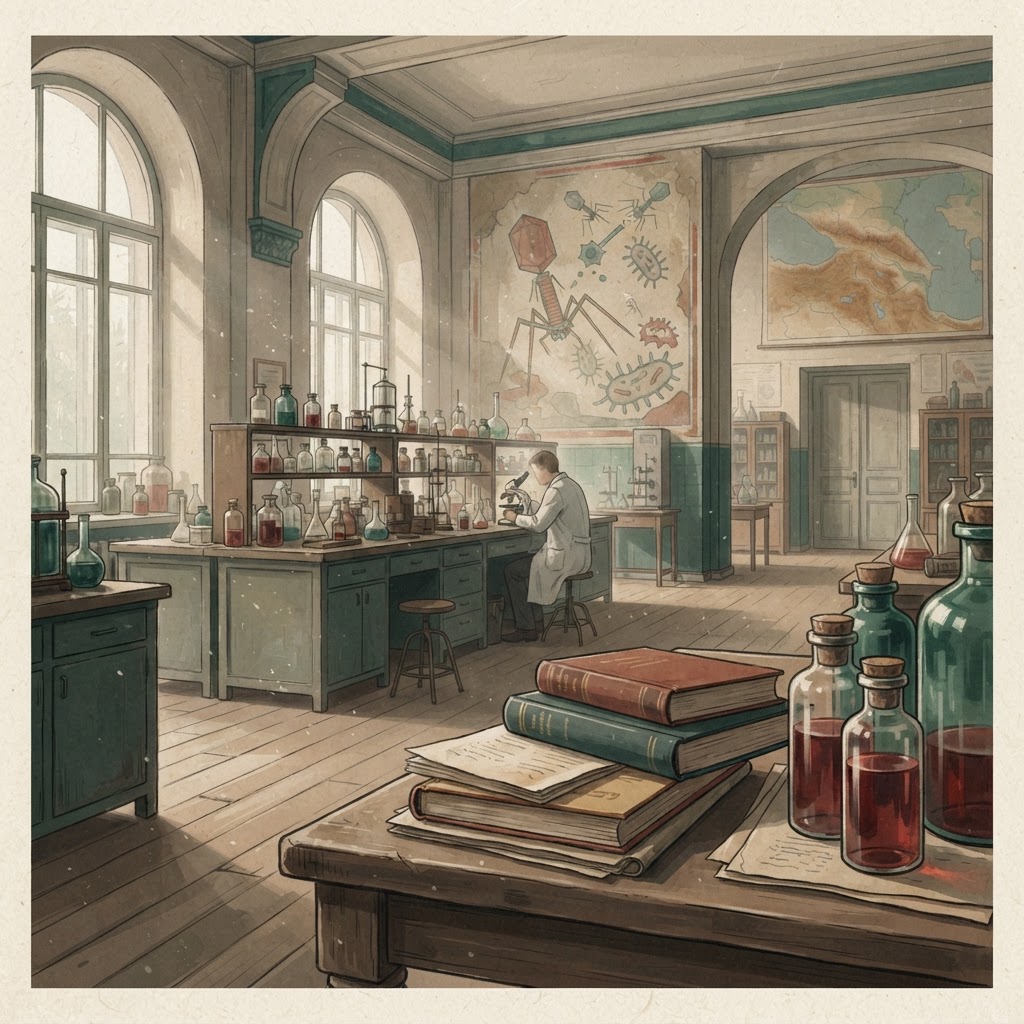
Outside Tbilisi, in a small building barely visible on most maps, the same work has been carried out for over seventy years: cultivating, purifying, and administering viruses that kill bacteria. Western medicine abandoned this idea long ago; once penicillin was discovered, no one looked back. But now, in a world where antibiotics are increasingly ineffective, doctors and researchers have begun to ask a strange question: What if Soviet science held a solution we forgot? The story of the Eliava Institute is actually a tale of how science is forgotten and how it is remembered. Moreover, this forgetting is by no means accidental; it is a striking example of how politics, economics, and ideology shape science. ## Viruses That Fight Viruses When you first hear the word bacteriophage, it might sound like science fiction, but it is actually one of nature's oldest predator-prey relationships. Every type of bacteria has one or more phages that specifically target it; these viruses attach to the bacteria, inject their genetic material, force the bacteria to produce copies of themselves, and eventually cause them to burst. They do not harm human cells because their target is highly specific; in a sense, it is the most precise weapon system ever designed by nature. This idea was discovered at the beginning of the twentieth century, long before antibiotics. When scientists like Felix d'Herelle found a mysterious agent destroying bacteria in the stool of dysentery patients, the medical world was suddenly excited. Why, then, is such a simple and elegant idea still not sufficiently recognized today? The answer is partly scientific and partly historical. Because phages are highly specific, one must find the exact phage for every infection; this seems laborious compared to the broad-spectrum convenience of antibiotics. But this effort is also the source of the phages' power. While an antibiotic kills thousands of bacterial species at once, ruining the gut flora, phage therapy eliminates only the target bacteria with surgical precision. At the beginning of the twentieth century, this sensitivity seemed like a disadvantage; now, it is exactly what we need. ## Science Surviving Behind the Iron Curtain The large-scale production of penicillin in the 1940s led to the abandonment of phage research in Western medicine almost overnight. It was a logically understandable choice: if you can take a pill to treat a wide range of infections, why waste time looking for patient-specific viruses? But things did not work that way on the other side of the Iron Curtain. The Soviet Union was largely deprived of access to the Western pharmaceutical industry; penicillin production was a difficult goal to reach both technologically and economically. In such an environment of isolation, existing phage research became not a luxury, but a necessity. The Eliava Institute in Tbilisi grew as a product of this necessity. The Soviet military produced phage cocktails to treat infections in wounded soldiers on the front, and civilian hospitals adopted the same method. This is, strangely, one of the rare examples where political isolation turned into scientific continuity. An idea forgotten in the West developed, improved, and evolved into protocols in Soviet laboratories for fifty years. The institute itself struggled with funding crises and a lack of equipment after the collapse of the Soviet Union, but it never fully closed. Today, there are still researchers working in the same buildings with the same methods; it is as if time flowed differently for them. ## A Forced Return in the Age of Resistance Now the situation has reversed. The crisis of antibiotic resistance, which the World Health Organization has been highlighting for years, is no longer a theoretical threat but a part of daily clinical practice. Some types of bacteria do not respond to any antibiotics we have; for these patients, medicine has almost no options left. At this point, phage therapy, which was once considered an ideological byproduct, suddenly becomes a scientific necessity. Western research centers have begun to look at the Eliava Institute's seventy-year archive, experience, and phage library; because the knowledge accumulated there is a capital that their own laboratories would take a long time to build from scratch. This return is not just a nostalgic discovery; it is also proof of how much science develops depending on environmental conditions. An idea can be abandoned under the right conditions; in other circumstances, it can be the only way to survive. The story of Eliava shows us that scientific progress is not linear but shaped by historical coincidences, political borders, and economic pressures. Today, re-testing phage therapy in clinical trials carries the irony of a method once pushed aside as unmodern stepping in just where modernity is in crisis. When I think of the story of the Eliava Institute, a larger question about science itself emerges in my mind: do lost ideas never truly vanish, or do they just wait patiently somewhere until the day someone needs them? That small building in Tbilisi perhaps offers us a metaphor for how the memory of science works; an abandoned idea can return to the center once it finds the right moment of crisis. In the midst of the antibiotic resistance crisis, this forgotten legacy of Soviet science now stands before us not just as a historical curiosity, but as a potential part of the medicine of the future.
İlgili Denemeler
Can the Human Brain Detect Magnetic Fields?
Geophysicist Joseph Kirschvink's experiment at Caltech indicates that the human brain responds to magnetic fields, raising questions about a potential sixth sense.
Jan Hendrik Schön: The Physicist Who Fooled Science
The scandal of Jan Hendrik Schön's fabricated data at Bell Labs highlights the critical vulnerabilities in the scientific peer-review system.
Barry Marshall Drank Bacteria to Prove Stomach Ulcer Theory
Barry Marshall made medical history by consuming harmful bacteria to prove that stomach ulcers are caused by an infection rather than stress alone.
Tartışma (0)
Henüz yorum yok. İlk yorumu siz yapın.
Join the Newsletter
New essays, once a week, delivered to your inbox.