Edward Lorenz and the Birth of Chaos Theory
How a meteorologist shortening computer output and re-entering it forever changed the scientific belief in predictability.
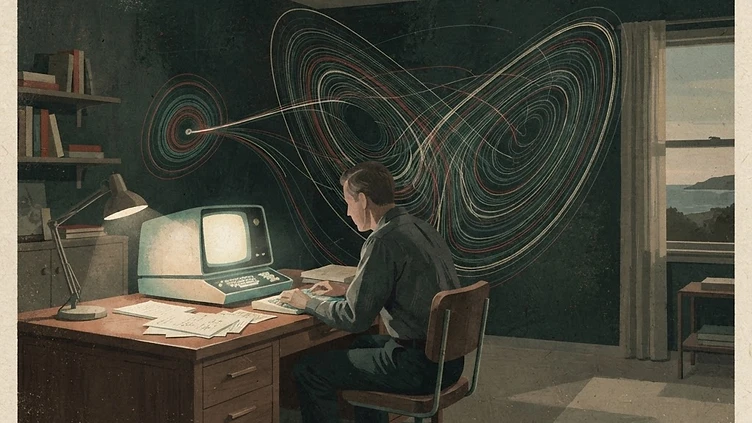
In the winter of 1961, in a dimly lit computer room at the Massachusetts Institute of Technology, a meteorologist named Edward Lorenz wanted to rerun a small program simulating weather patterns via mathematical equations. To save time, he decided to resume the simulation not from the beginning, but from the middle; he took a number from previous output, entered it into the computer as he saw it on the printer's paper, and leaned back to sip his coffee, only to encounter an unexpected result. As he left the room that day, one question likely occupied his mind: had the computer broken, or was nature itself this capricious? This simple question would eventually shake the most fundamental scientific assumptions about predictability.
The Truncated Tail of the Number
The model Lorenz operated represented atmospheric air movements through several simplified equations; variables like temperature differences, air currents, and convective cycles were interconnected, with each step building upon the previous one. He had run his initial simulation from start to finish, but instead of repeating the outcome, he chose to pick a point from the middle of the previous output to move forward. The number appeared on the printout with six decimal places, but to save time, Lorenz rounded it to three; the difference was less than one in a thousand, small enough to be invisible to the eye. Normally, such a minor deviation would be expected to result in a delay of a few seconds or a negligible difference.
But that is not what happened. As the simulation progressed, the two weather patterns diverged; what began as a slight difference in slope transformed, after a certain point, into completely different storm patterns and entirely different weather. Lorenz first thought the machine had malfunctioned, because the scientific mind of that era largely operated with Newtonian confidence: the same equations and nearly identical initial conditions should yield nearly identical results. Laplace's famous claim still lived as an ideal in physics and mathematics circles; an intellect that knew the position and velocity of every particle in the universe could predict the future with infinite precision. What Lorenz encountered challenged this ideal quietly but decisively; the system was deterministic, there was no randomness, yet long-term precise prediction became impossible.
When Lorenz realized this discrepancy was not a computational error, he was facing a different kind of nature entirely. The equations had not changed, and there was no bug in the program; the problem was that the system itself possessed an unimaginable sensitivity to small differences. This observation, later dubbed sensitive dependence on initial conditions, would form the mathematical backbone of chaos theory. What Lorenz realized that day was that no matter how precise knowledge may be, predicting the future beyond a certain point becomes practically impossible because no measurement in the universe can be made with infinite precision, and this tiny omission grows exponentially over time.

The Birth of the Butterfly Metaphor
Lorenz's finding initially drew the interest of a narrow academic circle, but its entry into public memory occurred through an image he used in a talk years later. Speaking at a scientific conference, he posed a question anyone could understand instead of using complex mathematical formulations: could a butterfly flapping its wings in Brazil set off a tornado in Texas? Technically, this question was neither a claim nor a proof; it was simply a thought experiment embodying the nature of the system. Yet, precisely because of its simplicity, it transcended academic boundaries, infiltrating newspapers, interviews, and eventually, everyday language.
The power of this image lay in its ability to translate an abstract mathematical truth into a scene the human mind could easily grasp. People were not accustomed to thinking in differential equations, but when you place the flapping of a butterfly's wings side-by-side with a tornado, they immediately feel what sensitivity means. Yet, this popularization did not come without a price; the metaphor was eventually reduced in most minds to a simple causal proposition like small causes produce large effects, whereas what Lorenz actually meant was not causality, but unpredictability. The butterfly does not create the tornado; it merely demonstrates that the system is so complex that it is impossible to know whether the presence or absence of the butterfly dictates the outcome. This distinction may seem small, but it exemplifies the most typical shift between science and popular culture: as a complex idea is simplified, it often loses its most critical nuance.
Some scientists argue that the metaphor dilutes the science, turning it into a slogan rather than true mathematical content, and there is merit to this criticism. But on the other hand, without the butterfly image, could the idea of chaos theory have reached such a wide audience? A set of equations can never be a newspaper headline, but the tension between a butterfly and a tornado finds a place in everyone's mind. Perhaps what is needed for science to reach the public is not always total accuracy, but asking the right question with the right image.
Where Chaos Hides Today
The most direct legacy of Lorenz's finding still lives on in his own field, meteorology. When you ask why weather forecasts cannot be reliable for more than ten days, the answer is not a lack of computational power, but this sensitivity inherent in the nature of the atmosphere; no matter how powerful the computers used, small measurement errors in initial data grow exponentially over time, and beyond a certain threshold, the forecast loses its meaning. This is why modern meteorologists no longer provide a single precise forecast but instead run hundreds of simulations with slightly different initial conditions to produce probability clouds; saying there is a seventy percent chance of rain tomorrow is, in essence, chaos theory translated into daily life.
But the traces of chaos were not limited to the atmosphere. Researchers studying irregularities in heart rhythms discovered that even a healthy heart does not beat in a perfectly regular manner and that certain types of arrhythmias share similar patterns with chaotic dynamics; this opened a new way to understand the disease. Climate models struggle with a similar tension while attempting to predict the planet's long-term future: while general trends can be predicted with confidence, the exact weather pattern in a specific region during a specific year remains uncertain. Economists hit a similar wall in their long-term predictions of markets, consumer behavior, and even political events; not even the most sophisticated models can eliminate the reality that a small deviation within the system can transform into an entirely different scenario a few years later.
This common denominator shows that in complex systems, probability is the true language, not certainty. This is not an admission of defeat, but rather a more honest form of knowledge; because a model that accepts uncertainty is often more reliable than one that promises false precision. That small rounding error on Lorenz's desk had left a humble but lasting lesson for science: although it is impossible to know the universe completely, it is possible to map the boundaries of its unknowability.
Looking back today, it is somewhat surprising that three decimal places on a computer screen transformed into a framework of thought spanning from heart disease to climate policy half a century later. Yet such shifts are not rare in the history of science; major paradigm changes often arise not from planned experiments, but from a small anomaly noticed by a prepared mind. Lorenz may have only wanted to save time that day, but without realizing it, he found one of the most honest answers regarding how much certainty nature can promise us. Perhaps the real issue is not whether the butterfly creates the tornado, but what it means to live knowing that the world stands on such a delicate balance.
İlgili Denemeler
Can the Human Brain Detect Magnetic Fields?
Geophysicist Joseph Kirschvink's experiment at Caltech indicates that the human brain responds to magnetic fields, raising questions about a potential sixth sense.
Jan Hendrik Schön: The Physicist Who Fooled Science
The scandal of Jan Hendrik Schön's fabricated data at Bell Labs highlights the critical vulnerabilities in the scientific peer-review system.
Barry Marshall Drank Bacteria to Prove Stomach Ulcer Theory
Barry Marshall made medical history by consuming harmful bacteria to prove that stomach ulcers are caused by an infection rather than stress alone.
Tartışma (0)
Henüz yorum yok. İlk yorumu siz yapın.
Join the Newsletter
New essays, once a week, delivered to your inbox.