Dyatlov Pass: The Mystery of the Nine Hikers Solved?
The enigma of nine hikers fleeing their tent in the Ural Mountains in 1959, only to perish in the cold, was solved sixty years later by an unexpected method.
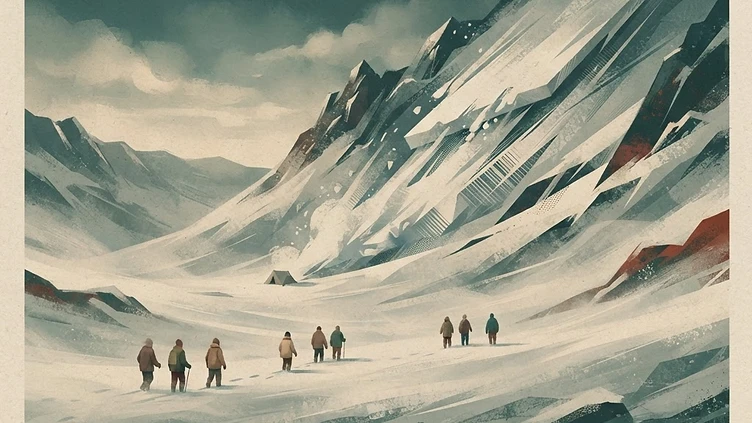
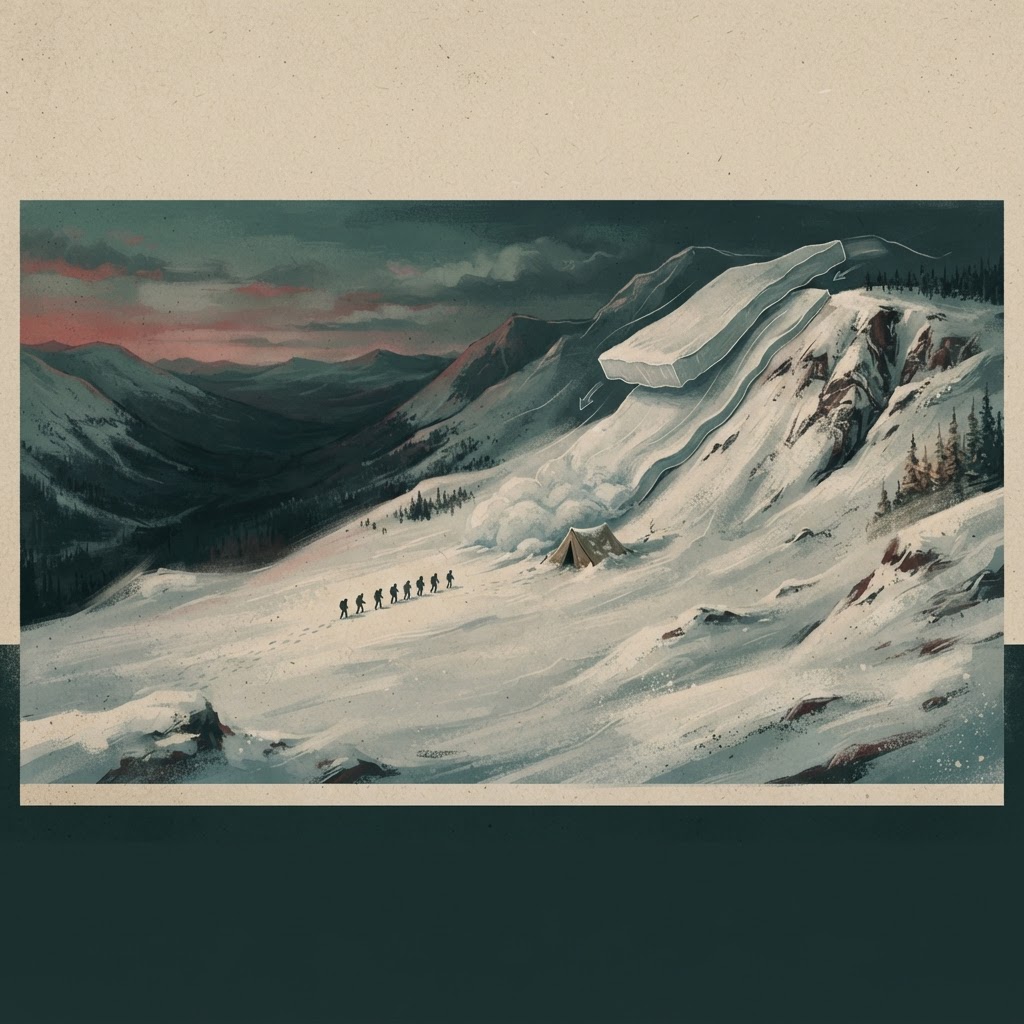
At midnight, with no storm and no scream, nine people tear their tent from the inside and flee into the darkness, into the snow, into the freezing cold. What comes to mind when you read this? A murder, mass panic, or an unexplainable natural phenomenon? This event, which took place on a desolate slope of the Ural Mountains in the winter of 1959, has been remembered as one of the most bizarre death cases in history for over sixty years. When I first heard this story, what surprised me was not the death itself, but the logic of the strange decision made before death: why would experienced, cold-hardy, mountaineering experts leave a warm tent to run into the icy darkness? The answer to this question became material for conspiracy theories, amateur detective curiosity, and science fiction scenarios for years. What is truly interesting is where the answer finally came from: not a murder investigation, but the snow simulation code of an animation studio. ## The Unexplained Death of Nine Hikers The event begins when a nine-person mountaineering team led by Igor Dyatlov sets up camp on a slope in the Ural Mountains. For this group of experienced individuals familiar with cold weather and skilled in skiing and mountaineering, this route posed no unusual difficulty. When no word was heard from the team days later, the search effort revealed that the tent had been cut from the inside, with tracks showing nine people fleeing the tent down the slope. Even this was strange enough, but the real question lay in the state of the bodies. Some hikers had died of hypothermia, which was expected. However, others had severe internal trauma without any external signs of impact; broken ribs, skull damage, and reports even noted a missing tongue. Moreover, many were barefoot and some were half-dressed; it was as if their departure from the tent was not an escape, but a moment of sheer terror. The official investigation of the time struggled to explain this picture and eventually closed the file with the phrase a compelling unknown force; this expression sounded more like a confession than a scientific explanation. In a sense, the state was admitting the inadequacy of its own investigation. This void became the soil in which the mystery grew for the next sixty years. Because the human mind wants to fill in the gaps when it sees something unexplainable; the larger the void, the more fantastic the theory stuffed into it. The reason the Dyatlov Pass case remained alive for so long was not a lack of evidence, but that the evidence contradicted itself. Each clue seemed to support one theory while debunking another, and this contradiction was an invitation for curious minds. ## Theories from Radiation to Military Conspiracies One of the first explanations was radiation leakage. The presence of low-level radioactive traces on some pieces of clothing, combined with the paranoia of the Cold War era, gave birth to the claim that a secret nuclear test was conducted in the area. But this theory could not explain the type of trauma found on the bodies; radiation exposure does not cause broken ribs or skull damage. Another popular explanation was the infrasound effect; it was suggested that low-frequency sound waves, which the human ear cannot hear but which deeply affect the body, triggered sudden panic and an irrational escape reflex in the hikers. Although this theory seemed psychologically plausible, it could not explain why such an effect occurred exactly on that night and on that specific slope; infrasound was always there, yet the hikers had not always fled. A third and perhaps most cinematic theory was a secret military experiment: it was claimed that a weapon or vehicle being tested in the region frightened the hikers or even directly injured some of them. This scenario received the most attention in popular culture because it contained both a conspiracy and horror. However, field evidence did not support this theory; no physical evidence of any military activity was found in the region, neither shell casings nor signs of an explosion. The problem was this: every theory explained a part of the event but never embraced the whole. Radiation traces were real but did not explain the trauma; panic was real but did not explain the timing; the conspiracy claim was interesting but lacked evidence. The mystery did not die precisely because of this fragmentation; every generation invented a new theory to fill its own void. ## The Mystery Solved by an Animation Code The real turning point came with a study published by Swiss researchers in 2021. These researchers examined the event not through forensics or military archives, but through the physics of snow mechanics. The question they asked was simple: was a delayed avalanche possible on the slope where the tent was located under those night conditions? The computational model they developed to find the answer was inspired by a surprising source: the calculation methods used in the snow and ice simulations for the movie Frozen. Because the mathematical problem an animation studio needed to solve to produce realistic snow movement was to model how a snow mass slides, accumulates, and collapses, which was exactly what was needed to understand what happened at Dyatlov Pass. The researchers' model showed that the wind continuously carried snow to the slope, creating a dense and unstable mass over the tent, and that this mass collapsed as a small but intense slab avalanche when it reached a certain threshold. This small avalanche was not large enough to fully bury the hikers, but it applied a sudden and massive pressure to the tent fabric and the bodies inside; exactly the kind of pressure that would explain broken ribs and skull trauma. The fact that the hikers fled this sudden pressure by tearing the tent from the inside no longer looked like irrational panic, but a cold-blooded reaction of survival instinct. The beauty of this explanation was that it did not contradict any physical evidence; the radiation traces came from a separate source, the traumas resulted from the avalanche, and the cause of death was hypothermia. For the first time, the pieces fit together. What this solution taught me is that science sometimes waits in places that seem the most distant. The snow simulation of an animated film could provide the mathematical framework needed to solve a deadly mystery because both were asking the same fundamental question: how does snow behave? This showed that interdisciplinary thinking is not just a trendy concept, but sometimes the only real path to a solution. A physicist reading an animator's code and applying it to their own question reminds us that the boundaries of science are not as rigid as we draw them. The Dyatlov Pass mystery was like a mirror showing how the human mind filled the void for sixty years; radiation, conspiracy, supernatural power, each was an attempt to close the same deficiency with a different story. But when the real solution arrived, no confession was made and no curtain of secrecy was lifted; just a patient physical model showed that when asked correctly, nature answers in its own language. Remembering this story today reminds us not only that a mountaineering tragedy was solved, but that when curiosity is directed in the right direction, a response can emerge from even the most unexpected places.
İlgili Denemeler
Can the Human Brain Detect Magnetic Fields?
Geophysicist Joseph Kirschvink's experiment at Caltech indicates that the human brain responds to magnetic fields, raising questions about a potential sixth sense.
Jan Hendrik Schön: The Physicist Who Fooled Science
The scandal of Jan Hendrik Schön's fabricated data at Bell Labs highlights the critical vulnerabilities in the scientific peer-review system.
Barry Marshall Drank Bacteria to Prove Stomach Ulcer Theory
Barry Marshall made medical history by consuming harmful bacteria to prove that stomach ulcers are caused by an infection rather than stress alone.
Tartışma (0)
Henüz yorum yok. İlk yorumu siz yapın.
Join the Newsletter
New essays, once a week, delivered to your inbox.