Bacterial Antibiotic Resistance: Evolution in Action
In a massive petri dish, scientists captured evolution on camera, frame by frame, observing how bacteria overcome deadly barriers.
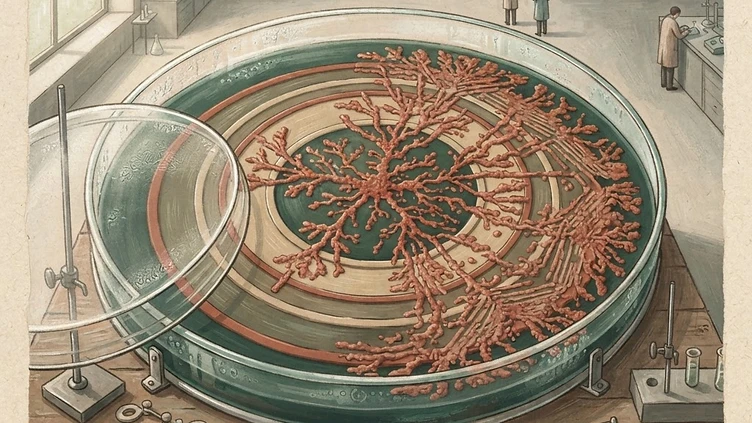
Inside a closed box, cells negotiate with death before our very eyes. A massive petri dish sits silently under the cold laboratory light; within it unfolds a pace of life that a human lifespan could never witness. Scientists have recorded this dish for days, then condensed hours into seconds to present us with a different kind of film: one where bacteria overcome the walls of antibiotics lined up to destroy them, one by one. For the viewer, this is not merely a curious microscopic image; it is a visible, breathing testament to evolution, that abstract and often elusive process. What is it that makes an idea so tangible? Perhaps the answer lies in the peculiar vertigo that comes from compressing time itself. ## The Visible Face of Evolution When we speak of evolution, most of us think of fossils, layers of rock spanning millions of years, or perhaps bones gathering dust in a museum. This is a habit that makes evolution feel distant and abstract; the process operates so slowly that none of us has the chance to see its beginning and end within a single lifetime. Yet, this petri dish experiment removes that distance. Here, evolution does not appear as a river carving a bank over millions of years, but as water suddenly piercing stone in a time-lapse recording. The surface of the dish is divided into zones with increasing antibiotic concentrations from the center outward; each zone is more lethal than the last. Bacteria first multiply in the safe center, then encounter the first wall. For hours, the camera seems to show almost nothing; then, suddenly, a small spot appears right on the wall, and that spot quickly grows, leaking into the second zone. Watching this, one cannot help but wonder: how is it possible to cross such a clear boundary in such a short time? This question reveals the true power of the experiment. Because what we are observing is not a single organism making a clever decision; it is a scene of selection where millions of cells, each with its own tiny destiny, are tested simultaneously. Some perish before the wall, while others manage to survive due to a minor difference they happen to carry. The footage transforms evolution from a distant theory into an event unfolding right before our eyes. ## The Cold Logic of Resistance At this point, some might rightly object: how can bacteria find a solution to the very substance meant to kill them so quickly? Does this look like intelligent design or a hidden intent? No; what is at work here is a blind but relentless logic. Mutations arise randomly; no cell anticipates a future threat and shapes itself accordingly. But when millions of cells exist at once, that randomness turns into statistical abundance; somewhere, in one cell, a mutation that happens to work appears. Natural selection works like a cold-blooded filter processing this chance. Of the millions of bacteria waiting before the wall, only those with a slight advantage in resistance survive and multiply; their descendants carry the same advantage, often adding a new one over time. This is not a leap occurring all at once, but a climb taken one step at a time. Each step preserves the previous gain and adds to it; eventually, a lineage emerges that can cross a dose initially considered lethal without any struggle. Therefore, what we are watching is not a miracle born of luck, but a calm calculation woven by numbers and time together. ## The Future Waiting Behind the Wall Viewing this small box in the laboratory merely as a scientific demonstration would mean missing the crux of the matter. Because the same logic is at work in hospital corridors, in human bodies, and on a global scale. Every time we produce and use antibiotics, we are essentially spreading a miniature version of that massive petri dish across the world; each dose builds a new wall for bacteria to overcome. And with billions of years of practice, they are a party much more patient and much faster at learning how to bypass walls than we are. It becomes inevitable to ask whose side time is on. Humanity spends years researching, conducting clinical trials, and setting up production lines to develop a new antibiotic; in the same span, bacteria can produce countless generations, testing a small chance of mutation in every one. This asymmetry becomes strikingly apparent in that silent but persistent progress captured on camera. Perhaps what is truly unsettling is not the walls themselves, but this patient future that is always waiting for the next step behind them. Seeing this picture, one might think, perhaps for the first time, that antibiotic resistance is not a distant laboratory issue. The speed we see inside that small box is actually a summary of a process occurring in hospital rooms around the world—at a much slower pace, but with the same logic. When the camera stops, the bacteria do not; only our chance to observe them comes to an end. Perhaps the most lasting feeling this experiment leaves us with is that strange moment where awe and anxiety are intertwined. On one side, there is pure curiosity about the elegant, almost aesthetic logic of evolution; on the other, the confrontation with the reality that this same logic could render our most trusted medical weapons ineffective, one by one. That small colony of cells in the petri dish actually reminds us of ourselves: nature never stops; sometimes we are just patient enough to watch it.
İlgili Denemeler
Can the Human Brain Detect Magnetic Fields?
Geophysicist Joseph Kirschvink's experiment at Caltech indicates that the human brain responds to magnetic fields, raising questions about a potential sixth sense.
Jan Hendrik Schön: The Physicist Who Fooled Science
The scandal of Jan Hendrik Schön's fabricated data at Bell Labs highlights the critical vulnerabilities in the scientific peer-review system.
Barry Marshall Drank Bacteria to Prove Stomach Ulcer Theory
Barry Marshall made medical history by consuming harmful bacteria to prove that stomach ulcers are caused by an infection rather than stress alone.
Tartışma (0)
Henüz yorum yok. İlk yorumu siz yapın.
Join the Newsletter
New essays, once a week, delivered to your inbox.