Dunning-Kruger Effect: A Scientific Flaw?
Could one of psychology's most famous experiments actually be a mathematical trap where numbers deceive themselves?
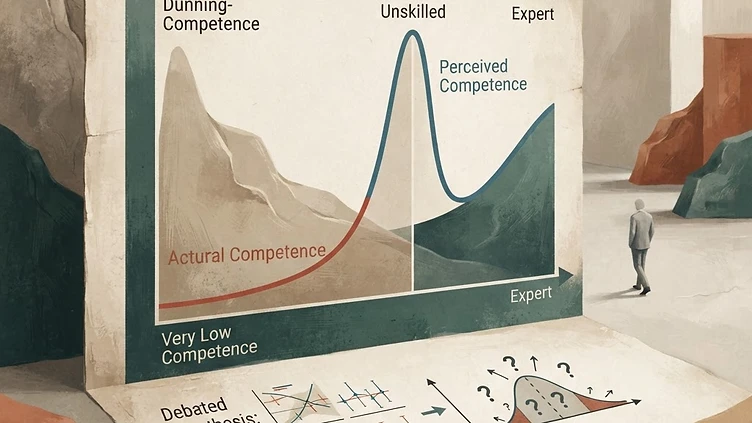
I remember the confidence of the man at the next table in a restaurant; although he did not fully understand the subject, he spoke without lowering his voice, posturing as an expert in a field where everyone else was ignorant. In such moments, the same phrase comes to mind: this is the Dunning-Kruger effect. Having become one of the most cited and joked-about findings in psychology, this effect describes how people with low ability often perceive themselves as far more skilled than they actually are. Yet, there is a strange irony here: a finding that is repeated so often and presented as such an absolute truth is actually at the center of a serious debate among statisticians. So, does this curve show a genuine flaw in the human mind, or is it merely a mathematical illusion where numbers trick themselves?
The Legend Born at Cornell
In 1999, David Dunning and Justin Kruger conducted a simple yet clever experiment at Cornell University: they gave participants tests on topics such as logic, grammar, and humor, and then asked them to estimate their own performance. The result was striking: the group that scored the lowest systematically inflated their own success, while those who scored the highest slightly underestimated themselves. This finding transcended the boundaries of an academic paper and leaked into popular culture; the phrase 'the ignorant think they are talented' is now used as an absolute judgment in every discussion and social media post. Yet, the original paper did not make such an ambitious generalization; it only spoke of a tendency observed in specific tests under specific conditions.
What is interesting here is not the scientific finding itself, but how it transformed into a slogan. While an experiment started as a narrow pattern observed under laboratory conditions, it began to be described over time as a universal law of human nature. Behind this transformation lies the desire to compress a complex finding into a single sentence, because the human mind loves simple, easy-to-remember formulas more than nuanced explanations. This is why the Dunning-Kruger effect ceased to be just a scientific finding and became a cultural tool: a shortcut weapon used to belittle someone, shut down a debate, or imply one's own superiority. But this popularity overshadows the question of how robust the finding itself actually is.
The Mathematical Trick Behind the Curve
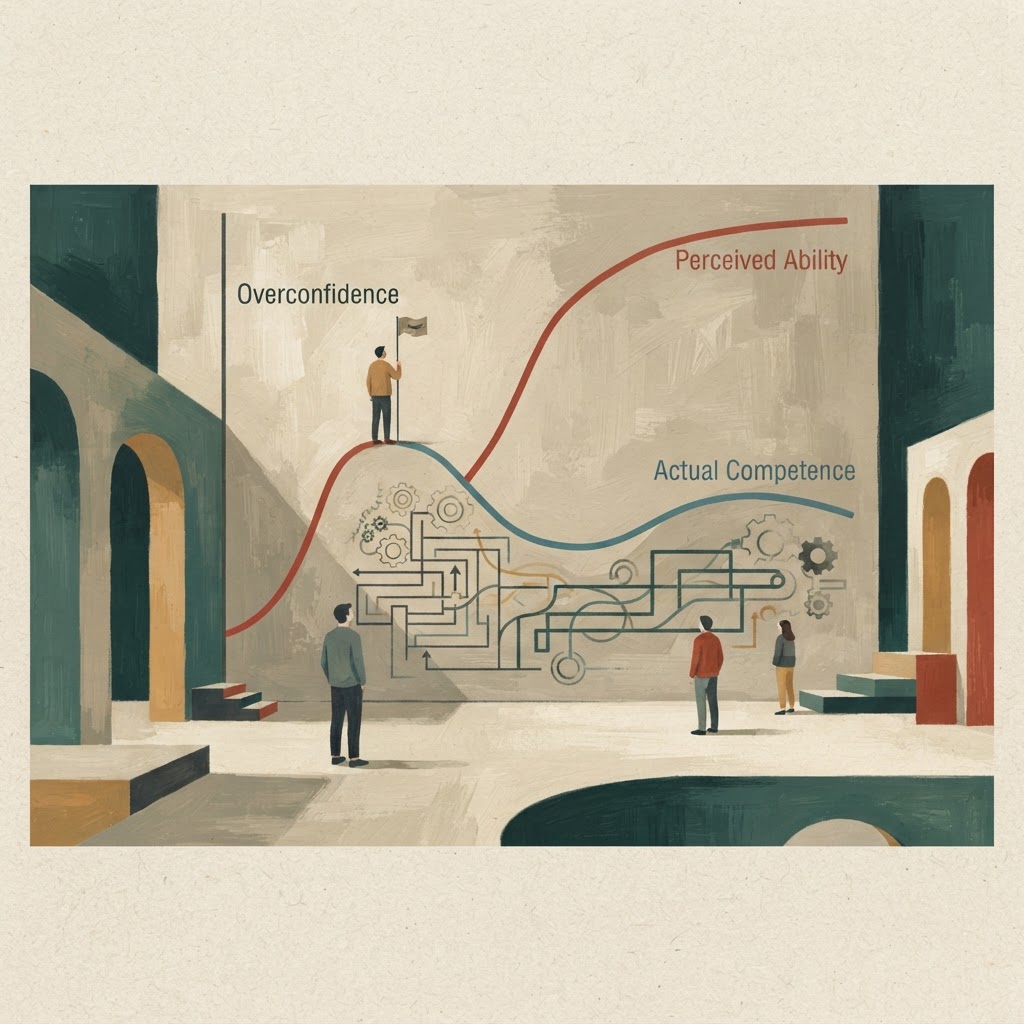
The most striking aspect is that in subsequent years, some statisticians were able to recreate this famous curve using entirely randomly generated data. Imagine taking numbers from zero produced by a computer that have nothing to do with real skill, placing them into two columns as actual scores and estimated scores, and then plotting the graph. You end up with a curve that is surprisingly similar to the one found by Dunning and Kruger. This situation suggests that the problem might not be in human psychology, but in the measurement method used. Because when you plot the difference between a person's actual performance and their own estimate against the actual performance, a statistical artifact comes into play; some researchers call this artifact the tendency toward the mean.
Let us consider a simple example to visualize this: let every student's grade in a classroom be determined by a completely random dice roll, but let every student try to guess their own grade. Students who roll low will appear to have overestimated themselves because they made a guess closer to the average, while those who roll high will appear to have underestimated themselves. There is no cognitive flaw here; the mathematical structure of the measurement produces this pattern on its own. This forces us to ask: does the part of the Dunning-Kruger effect we observe stem from a genuine flaw in the mind? human mind failing to see its own limits, or is it just a phenomenon that emerges because we have incorrectly established the relationship between two variables?
Some researchers who hear this mathematical critique follow a more cautious line instead of claiming that the finding has collapsed entirely, suggesting that part of the effect might stem from a real cognitive tendency and part from the nature of the measurement. Even if this distinction sounds like a technical detail, it is actually the heart of the whole debate. Because there is a huge difference between rejecting a finding and questioning it; the point here is not to discard the Dunning-Kruger effect, but to distinguish which part reflects a real mental pattern and which part consists of the numbers' own games.
The Bias of a Bias Theory
What truly makes me think here is the irony within the theory itself. The Dunning-Kruger effect fundamentally argues that the human mind cannot see its own incompetence and lacks the knowledge to evaluate its own limits. However, the scientific community that defends and propagates this theory has been slow to notice the exact same blind spot within itself. While statistical criticisms have existed for years, popular science narratives have ignored these critiques and continued to repeat the simple, catchy version. This bears the traces of a confirmation bias: once we accept an idea, we become less attentive to data that would disprove it and more eager for data that supports it.
the truly interesting side of this is the loss that occurs during the popularization of science. As a finding passes from an academic paper to public discourse, its conditions, limitations, and statistical warnings are pruned; only a striking sentence remains. The Dunning-Kruger effect is perhaps the most instructive example of this process, because it describes both how the human mind fails to see its own limits and, by being slow to see the methodological limits of the scientific community carrying this narrative, it repeats the content of the theory in its own history. It seems as if a theory has written its own fate with the example it uses to prove its claim; this carries a frightening warning for everyone who follows science: the findings we love the most and explain most easily are perhaps the ones we question the least.
This entire debate does not say that the Dunning-Kruger effect is completely wrong; there is still a real tendency observed in certain contexts with certain measurement methods. But the real issue is to distinguish how much of this tendency belongs to human psychology and how much to the games of statistics itself. Perhaps the real question this essay asks is not whether the ignorant are confident, but how cautiously we can stand against our own 'certain' knowledge. Because, is repeating a finding without questioning it not committing the very error that the finding itself tells us about?
İlgili Denemeler
Can the Human Brain Detect Magnetic Fields?
Geophysicist Joseph Kirschvink's experiment at Caltech indicates that the human brain responds to magnetic fields, raising questions about a potential sixth sense.
Jan Hendrik Schön: The Physicist Who Fooled Science
The scandal of Jan Hendrik Schön's fabricated data at Bell Labs highlights the critical vulnerabilities in the scientific peer-review system.
Barry Marshall Drank Bacteria to Prove Stomach Ulcer Theory
Barry Marshall made medical history by consuming harmful bacteria to prove that stomach ulcers are caused by an infection rather than stress alone.
Tartışma (0)
Henüz yorum yok. İlk yorumu siz yapın.
Join the Newsletter
New essays, once a week, delivered to your inbox.