DishBrain: How Lab-Grown Neurons Learned to Play Pong
When a cluster of neurons in a petri dish learns a video game, the assumption that intelligence is exclusive to the brain is called into question.
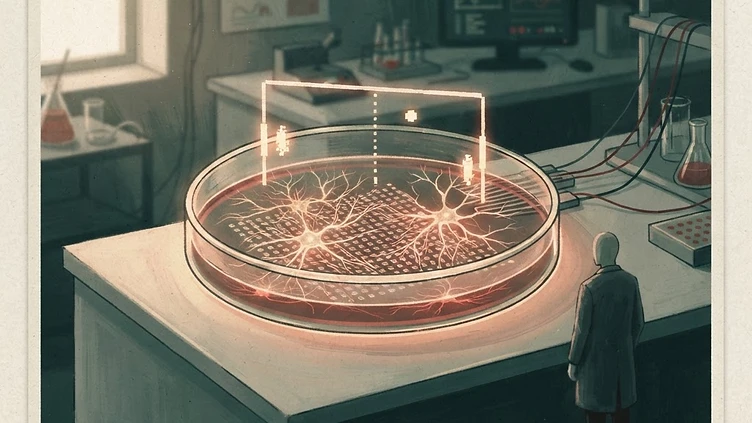
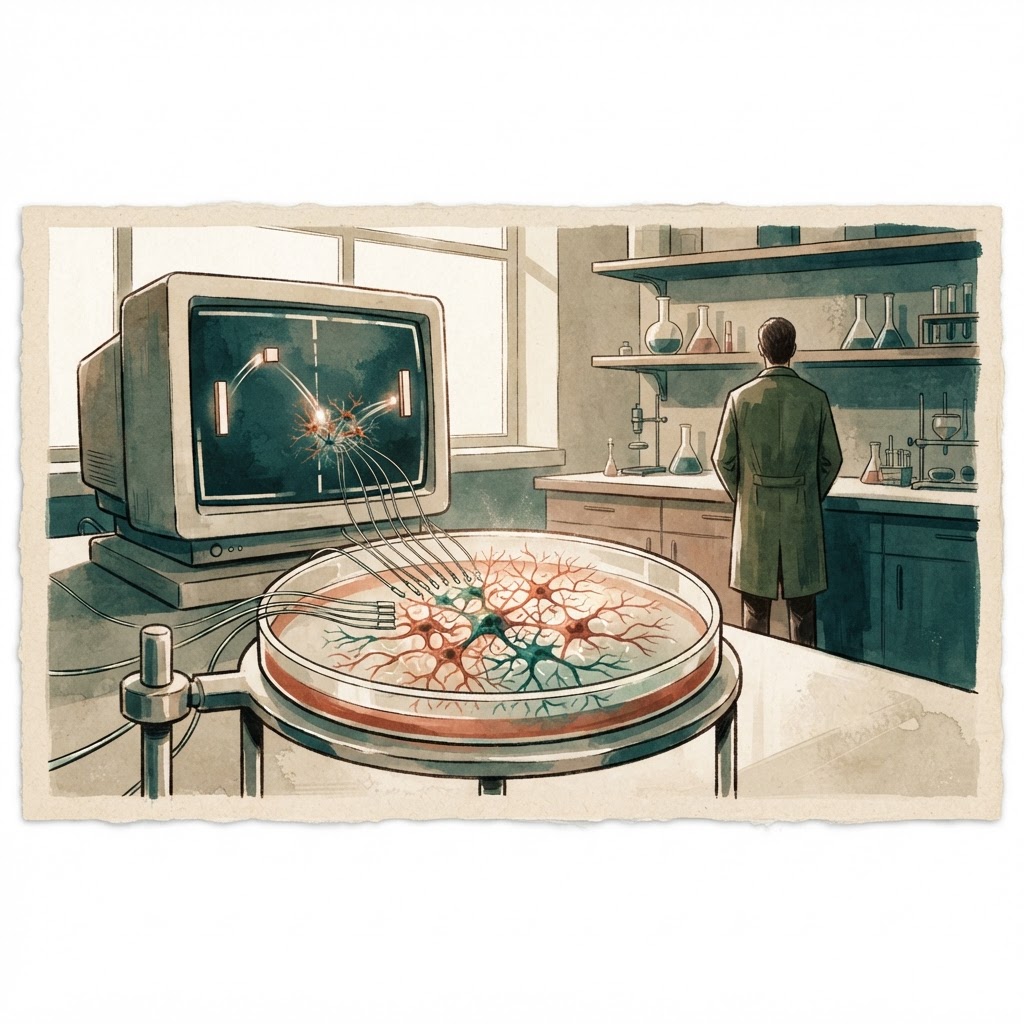
If someone told you that you could look into a petri dish and see something playing a game, you would likely laugh it off. Yet, that is exactly what happened in the laboratory of Cortical Labs: human neurons grown on a high-density electrode array inside a glass dish eventually learned to play Pong. A collection of cells trying not to miss the ball, sliding its paddle in the right direction, and learning from its mistakes... Even as I write this sentence, I feel a sense of strangeness, because we have always confined learning to the inside of the skull, to the complex symphony of billions of neurons. This system, called DishBrain, breaks that confinement and whispers to us that intelligence might be something far more mundane, something much cheaper than we ever thought. ## How Do Cells in Glass Learn? The operational logic of DishBrain tests a complex philosophical proposition with a remarkably simple setup. Neurons placed on the electrode array embedded in the base of the petri dish are subjected to two types of electrical signals: one regular and predictable, acting as a reward; the other chaotic and noisy, acting as a punishment. When the neurons produce a firing pattern that sends the ball in the right direction, they receive the regular signal; when they miss, they are subjected to a random storm of electricity. Over time, the cells change their own connection patterns to avoid the chaotic noise and gravitate toward the regular signal; in other words, they literally learn to avoid discomfort and seek predictability. The theoretical framework behind this learning rests on a concept called the free energy principle: living systems are described as biological mechanisms that seek to minimize surprise—that is, unexpected and irregular stimulation—in their interactions with the environment. For the neuronal cluster, the chaotic signal is that very surprise, a form of existential tension; the regular signal is the address of predictability, and thus, a form of equilibrium. The cells, of course, do not form a conscious strategy, but the system as a whole, through long sequences of trials, bends itself toward behaviors that reduce noise. What is truly striking here is that this bending does not require a brain architecture, a memory center, or a dedicated reward circuit; it is enough for the cells to simply rearrange the strength of their connections. ## Intelligence Is Not a Privilege Exclusive to the Brain We must stop here and ask ourselves: why do we always equate intelligence with the brain, and the brain with the skull? Yet the DishBrain experiment clearly shows that changing behavior—or in its simplest definition, learning—does not require a central nervous system, a hippocampus, or a cortex. The neurons on the electrode do not possess the layered architecture, specialized regions, or feedback loops found in the human brain; yet they succeed in avoiding errors and approaching rewards. This raises the following possibility: perhaps what we call intelligence is not a capability monopolized by a single organ, but a common, fundamental tendency of living cells; a reflex inherent to the cell, just like growing or dividing. Of course, one might argue that this is merely simple conditioning and not true intelligence, and that objection is not entirely unfair; playing Pong does not require high-level cognitive abilities like abstract reasoning, language, or long-term planning. But this objection misses the crux of the argument: we largely explain human intelligence through the layering of similar conditioning mechanisms, only through many more layers and many more connections. If intelligence is a matter of thresholds, rather than dismissing everything below that threshold as not intelligence, perhaps we should accept that intelligence is a matter of degree, a spectrum extending from the simplest network of cells to the most complex human brain. Once this perspective is accepted, our view of the world inevitably changes. A plant turning toward the light, a bacterium swimming toward nutrients, or a fungus weaving a network to share resources no longer appear as mere mechanical reactions, but as different manifestations of a primitive form of learning. Removing intelligence from the brain and spreading it to the cell, or even to a collection of cells, shakes our human-centric hierarchy; perhaps that is why the news of DishBrain felt so unsettling and science-fictional when it was first announced. ## The Question of Consciousness Is Now in the Petri Dish Once we can separate intelligence from the brain, the next question forces itself upon us: can consciousness be separated in the same way? Do the neurons in DishBrain experience the chaotic electrical signal given when they miss the ball as a form of pain, or is this just a human-like metaphor we are projecting? We do not currently have the tools to answer this question definitively, because there is still no reliable way to measure subjective experience from the outside. But the very existence of DishBrain demonstrates that this question must now be asked not only in philosophy seminars but also in laboratory protocols. As the number of hybrid biological-digital systems increases, the questions facing ethics boards will grow with a similar strangeness: should a cluster of neurons in a petri dish be treated as an experimental animal, or do these cells remain far below that threshold? Today, no one can offer evidence that these neurons are suffering, but no one can offer conclusive evidence that they are not; and this very uncertainty provides a sufficient reason to act with caution. Perhaps the point is not to decide today whether these neuronal clusters are conscious, but to keep our doors open to new evidence that may emerge as science advances, maintaining the humility to say we do not know yet, rather than claiming it is impossible. The most valuable thing DishBrain teaches us is perhaps not an answer, but the reshaping of a question. We no longer seek intelligence, learning, or even consciousness solely within a single organ; instead, we begin to search for them at different points along a continuum that stretches from cell to brain, from bacterium to human. When a cluster of neurons in a petri dish learns to play Pong, it actually reminds us that our own intelligence is perhaps not so special or unique, and that we might just be living in a much larger and much noisier petri dish. When I am left alone with this thought, I cannot decide whether I should feel uneasy or a sense of lightness; but I suspect that true intelligence lies in the ability to carry that indecision.
İlgili Denemeler
Can the Human Brain Detect Magnetic Fields?
Geophysicist Joseph Kirschvink's experiment at Caltech indicates that the human brain responds to magnetic fields, raising questions about a potential sixth sense.
Jan Hendrik Schön: The Physicist Who Fooled Science
The scandal of Jan Hendrik Schön's fabricated data at Bell Labs highlights the critical vulnerabilities in the scientific peer-review system.
Barry Marshall Drank Bacteria to Prove Stomach Ulcer Theory
Barry Marshall made medical history by consuming harmful bacteria to prove that stomach ulcers are caused by an infection rather than stress alone.
Tartışma (0)
Henüz yorum yok. İlk yorumu siz yapın.
Join the Newsletter
New essays, once a week, delivered to your inbox.