Cotard Syndrome: Why Do Patients Believe They Are Dead?
Some patients remain convinced they are dead despite feeling their own pulse; how is neuroscience tracing this strange belief in the brain?
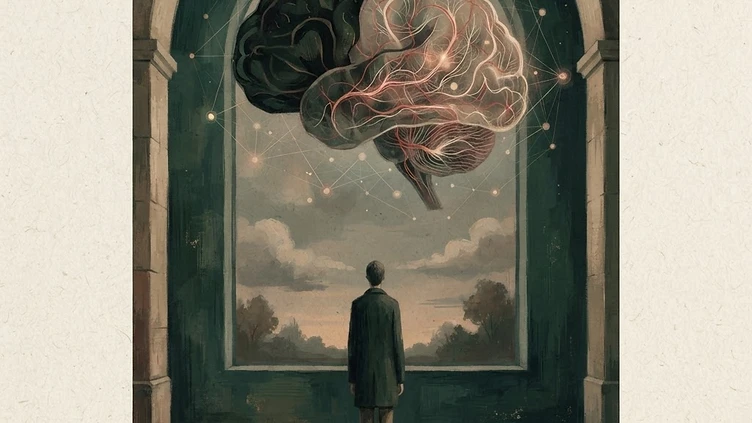
Imagine waking up one morning, feeling your heart beating, your breath flowing in and out, and the sun warming your face. Then, looking in the mirror, you say, "I no longer exist." Those around you might think you have lost your mind, but you state this sentence as your most vivid reality. Medical history is filled with people experiencing this very strangeness. A person who can count their pulse, feel pain, and eat food can hold onto a rock-solid belief that they are dead, decaying, or even that they never existed at all. This is not a trick of the mind; it is a sign that something has truly broken down in the way the brain generates a sense of being. This condition, known as Cotard Syndrome, shows us how fragile the mechanism is that allows us to feel that we exist. ## The Strange Case Described by Jules Cotard in 1880 The story takes place in late nineteenth-century Paris. French neurologist Jules Cotard, listening to a patient in his clinic, encounters an unusual narrative: the woman claims she has no blood, her intestines are rotting, and her body is merely a shell. Even more striking, she believes she is immortal, because since she is already dead, she cannot die. Cotard labeled this condition a "nihilistic delusion" and left a name in medical literature that we still use today. At the time, this case remained a curiosity, as there were no brain imaging techniques or current knowledge of how neural networks function. There was only observation and a sense of wonder at how differently the human mind could unravel. Today, the picture described by Cotard has moved beyond an isolated curiosity to become a syndrome woven with neurological and psychiatric disorders. It can emerge alongside schizophrenia, severe depression, certain brain injuries, or neurodegenerative diseases. This shows that there is not a single cause for the problem, but rather that different paths can lead to the same strange destination. But how can a person deny the vitality of their own body with such definitive language? What is interesting here is that the patient's capacity for logical reasoning remains intact. They can answer questions consistently and recognize their surroundings, but amidst all this consistency, the phrase "I am dead" stands like an unshakable axiom. At this point, medicine does not stop at saying "the patient's perception is distorted"; it begins to ask in which layer of the brain this crack occurs. ## The Disconnection in the Brain: Separating Emotion from Recognition Imaging studies point to an interesting pattern in the brains of Cotard patients. The regions responsible for recognizing faces and bodies, specifically the visual recognition networks, are functional; the patient knows the face in the mirror is their own. However, the emotional resonance that should accompany this recognition seems to be cut off somewhere. Normally, when we recognize a face, a body, or a memory, our brain automatically adds a sense of familiarity, a warmth; this addition is what makes us say, "Yes, that is me." In Cotard patients, this addition seems to drop away. The face is recognized, but no emotional response is triggered, and precisely for this reason, the patient reads the reflection not as their own, but as the image of a corpse. Another disorder immediately comes to mind here: Capgras Syndrome. Those patients also have a similar disconnection, but the result heads in a different direction. A Capgras patient recognizes the face of a loved one but, failing to feel that warmth, concludes, "This is not my spouse; it is an impostor wearing their skin." A Cotard patient turns this same cold recognition toward their own face and body, concluding, "I am no longer me; I am dead." Thus, in both cases, the emotional validation mechanism is disabled, but one is directed outward and the other inward. This shows us that our brain calculates not only what we see but also what we should feel about what we see, and these two systems can become decoupled. What the human mind calls "reality" is perhaps nothing more than the harmony of these two layers. The neurological map of this disconnection has not been fully charted, but the prime suspects include areas related to emotional processing and the networks that connect these to body perception. Researchers are not looking for a single point here, because the brain never works through one center; it is a matter of synchronization across multiple networks. Cotard Syndrome appears to emerge when this synchronization fails, as if the orchestra is playing but one instrument never joins in, and this silence changes the meaning of the entire symphony. ## A Counter-Evidence to Descartes: Is Feeling Existence Mandatory? We are all familiar with Descartes' famous proposition: I think, therefore I am. This sentence presents existence as a result of reasoning; if I can think, my existence is an inescapable logical necessity. Cotard patients seem to prove this proposition in reverse, for they too think, reason, and speak, yet they deny their own existence. If thinking guarantees existence, why can these patients still say, "I do not exist"? Perhaps there is something Descartes overlooked: the sense of existence comes from an emotional foundation that precedes logical deduction. A counter-argument might arise here: perhaps the patient has simply fallen into a false belief, their logic is still sound, and only one input is faulty. This objection is partially true but misses the essence of the matter. The issue is not that the patient believes a false premise to be true, but that they reject a true premise—the premise "I exist"—because they find no emotional support for it. A sense of existence is effectively a validation that the brain whispers to us constantly: "You are here, you are inside this body, you are in this world." When this whisper ceases, even if the mind functions as usual, the individual begins to experience their own existence not as a reality, but as a riddle that must be solved. This is why Cotard Syndrome carries a philosophical tremor; it shows us how much of existence is actually a neurological construction and how little of it is truly "given." The accounts of these patients hold a mirror to us in a sense. Because every morning, when we look in the mirror and say, "This is me," we are using this emotional validation without realizing it. We never question this because the system works flawlessly. But Cotard patients show us how a momentary failure of this system can drive a person into an abyss. Perhaps existence begins with feeling before it begins with thinking, and understanding how thin a neural network this feeling relies upon is somewhat chilling. Reading about Cotard Syndrome leaves one with this question: How do we know so easily that we exist? The story of these patients reminds us that existence is not a philosophical certainty, but a delicate feeling that the brain reproduces every moment. Perhaps our ability to call ourselves "I" with such confidence is merely thanks to a lucky neural harmony. This shows us that even on our most mundane days, we are actually living with an extraordinary balance.
İlgili Denemeler
Can the Human Brain Detect Magnetic Fields?
Geophysicist Joseph Kirschvink's experiment at Caltech indicates that the human brain responds to magnetic fields, raising questions about a potential sixth sense.
Jan Hendrik Schön: The Physicist Who Fooled Science
The scandal of Jan Hendrik Schön's fabricated data at Bell Labs highlights the critical vulnerabilities in the scientific peer-review system.
Barry Marshall Drank Bacteria to Prove Stomach Ulcer Theory
Barry Marshall made medical history by consuming harmful bacteria to prove that stomach ulcers are caused by an infection rather than stress alone.
Tartışma (0)
Henüz yorum yok. İlk yorumu siz yapın.
Join the Newsletter
New essays, once a week, delivered to your inbox.