Clever Hans: How a Mathematical Horse Changed Science
How the belief that a German horse could solve arithmetic revealed that scientists could not even trust their own observations.
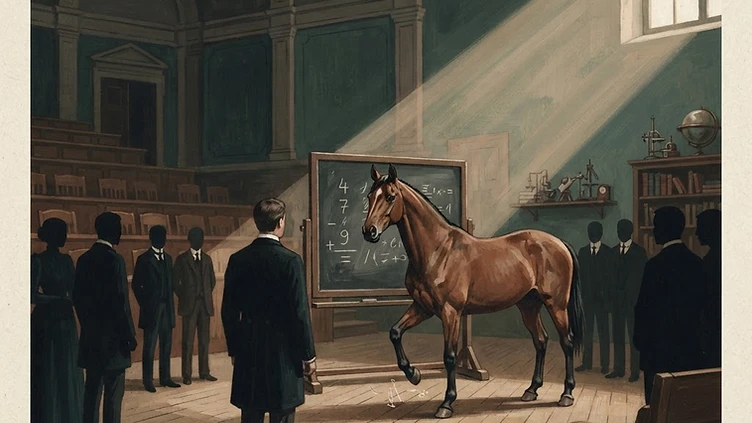
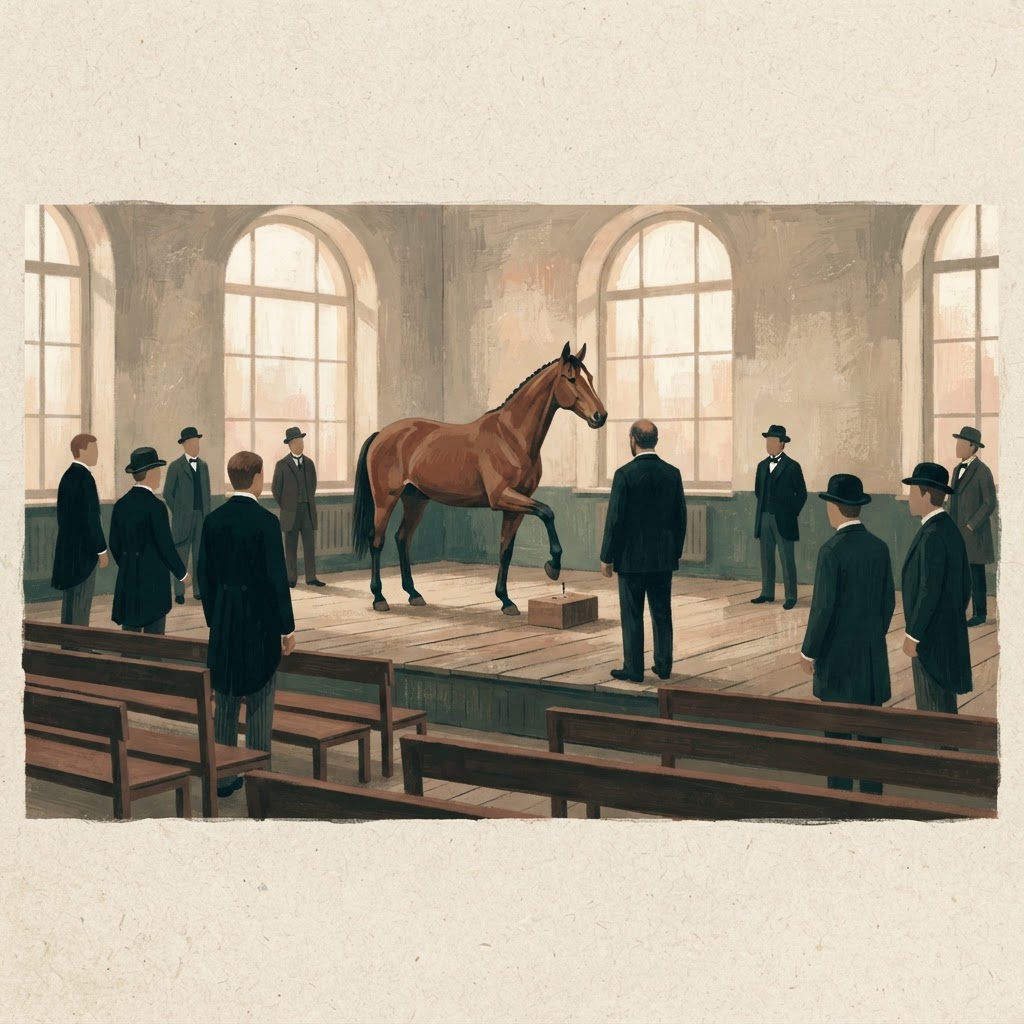
Believing that a horse can perform multiplication might seem like a ridiculous delusion today. Yet, at the beginning of the twentieth century, in the heart of Berlin, even respected scientists fell prey to this misconception. Was the story we constructed about an animal's intelligence actually a test of how much we can trust our own eyes? The tale of Clever Hans remains one of those rare moments that forces science to question itself, for the truth that emerged was not about how smart the horse was, but about how easily a human can be deceived. ## The Horse That Knew Numbers Wilhelm von Osten was a retired schoolteacher from Berlin whose true passion was animal training. He believed his horse could count with hoof taps, perform addition and subtraction, and even solve calendar problems. A question would be posed to Hans, and the horse would tap his hoof a certain number of times, stopping at the correct answer. This spectacle attracted curious locals, then journalists, and eventually academic circles. A commission of Berlin scientists was even formed to determine whether there was any trickery involved. The commission's conclusion was striking for its time: no trickery had been found. Von Osten had no hidden signaling device, no one was secretly feeding the horse, and Hans continued to provide correct answers even when the questioner changed. This only deepened the mystery, as the absence of fraud left only one explanation: the horse must truly understand numbers. Relying on their own observations, the scientists were willing to accept the most extraordinary explanation rather than the simplest. Yet, the real problem was that the question was being asked in the wrong place. ## Pfungst's Discovery This is where the psychologist Oskar Pfungst entered the scene. Pfungst focused on a detail the commission had overlooked: the horse guessed correctly when the questioner knew the answer, but failed surprisingly when the questioner did not. This simple yet critical observation changed everything. Pfungst discovered that the human questioner would unconsciously become tense, lift their eyebrows, or alter their breathing the moment the horse approached the correct number. Hans was not reading numbers; he was reading these micro-cues, sensing the moment to stop tapping based on the tension revealed by the human body. The true value of this discovery lay not in debunking the horse's intelligence, but in serving as a warning about how humans observe. Pfungst showed that these cues were given independently of the questioner's intent; no one was intentionally signaling Hans, yet everyone was doing it involuntarily. This revealed that the most trusted tool of scientists—careful observation—was actually the faculty most easily deceived. Pfungst's name is remembered in psychology today because, while exposing a horse's false intelligence, he left an enduring lesson on how the human mind deceives itself. ## The Invisible Enemy of the Laboratory Known as the Clever Hans effect, this phenomenon has transcended being a mere horse story to become a cornerstone of the scientific method. The reality that an experimenter can unconsciously influence results explains why double-blind study designs are so rigorously applied. If a researcher testing a drug's effectiveness does not know which patient receives the actual medication and which receives the placebo, the risk of leaking their own expectations into the patient or the results is eliminated. This means an idea born on the stage of a German horse a century ago has permeated almost every field of medicine, psychology, and social science today. For animal intelligence research, this warning remains particularly sensitive. Whenever claims arise that a chimpanzee has learned sign language or a parrot understands concepts, researchers inevitably face the Clever Hans question: is the animal understanding, or are we giving it the responses we want to see? A similar skepticism applies to today's most ambitious artificial intelligence systems. Asserting that a language model truly understands is as tempting as saying Hans knew arithmetic, but it is an equally dangerous shortcut; the correct answer the system provides us may sometimes be merely a reflection of the way we ask. Finally, this effect is not limited to laboratories; countless moments in daily life where a teacher subconsciously cues a student, a manager their team, or a journalist their interviewee, function as small-scale repetitions of the same mechanism. The story of Clever Hans ultimately persisted not as an issue of how smart a horse was, but of how much one can trust one's own perception. After this event, science learned that when searching for the truth, it must approach not only the object of study but also its own gaze with skepticism. Perhaps the reason we still cling so passionately to double-blind experiments, independent verification, and reproducibility tests today is that we have never forgotten this lesson hidden in the hoof taps of a horse from a century ago. Hans did not know math, but he taught us something about ourselves that we did not know.
İlgili Denemeler
Can the Human Brain Detect Magnetic Fields?
Geophysicist Joseph Kirschvink's experiment at Caltech indicates that the human brain responds to magnetic fields, raising questions about a potential sixth sense.
Jan Hendrik Schön: The Physicist Who Fooled Science
The scandal of Jan Hendrik Schön's fabricated data at Bell Labs highlights the critical vulnerabilities in the scientific peer-review system.
Barry Marshall Drank Bacteria to Prove Stomach Ulcer Theory
Barry Marshall made medical history by consuming harmful bacteria to prove that stomach ulcers are caused by an infection rather than stress alone.
Tartışma (0)
Henüz yorum yok. İlk yorumu siz yapın.
Join the Newsletter
New essays, once a week, delivered to your inbox.