Chernobyl's Radiation-Eating Fungi: Future of Space Travel
A fungus growing on the reactor’s lethal walls could rewrite the future of Mars missions by transforming radiation into food.
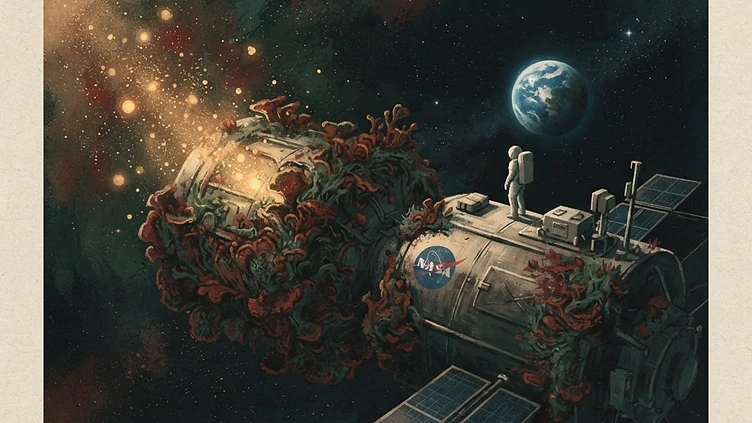
When we hear the name Chernobyl, the image that surfaces in our minds is usually the same: rusted metal structures, an abandoned city, and a silence so toxic that no human can ever enter. Yet, right in the middle of that silence, in the most lethal corners of the reactor, something unexpected was happening. Life had taken root in the place where it was least expected to survive. As I write these lines, I cannot help but ask myself: while we always try to equate survival with safe conditions, why does nature stubbornly show us the exact opposite? Perhaps that is not the real question; the real question is what this small fungus tells us about space travel. ## Life Growing Inside the Reactor After the Chernobyl disaster, when scientists entered the reactor to collect samples, they assumed that no living thing could withstand the environment. The radiation levels were high enough to cause the human body to collapse within hours. But on the walls, there was a dark layer, and contrary to all expectations, this layer was alive. This fungus, Cladosporium sphaerospermum, was not just surviving; it seemed to be drawing strength from that environment. The equation of radiation equals death, established by the human mind, lost its meaning here instantly. The truly striking aspect of this discovery is not that the fungus merely maintains its existence there, but that it grows faster as radiation levels rise. Imagine for a moment: what is poison to us becomes a kind of food source for it. The picture that emerges here requires us to redraw the boundaries of life. Perhaps we have always defined life based on the fragility of our own bodies, which is why we are so surprised. Throughout the history of science, we have encountered organisms called extremophiles that live in extreme conditions, but a living thing that can use radiation almost like sunlight stands as the oddest member of this list. ## The Mechanism of Turning Radiation into Energy How does this fungus turn radiation into an advantage? The key to the answer lies in the melanin pigment in its cells. Melanin is a familiar substance to us; it works like a protective shield against the sun in human skin. But in this fungus, melanin performs a much different function. Researchers discovered that melanin absorbs radiation and transfers this energy into cellular processes. This is surprisingly similar to the process of photosynthesis, where plants convert sunlight into sugar; the only difference is that gamma radiation is used here instead of sunlight. The first reaction of a person to this finding might be skepticism; after all, what we call photosynthesis is a concept we have identified with plants, sunlight, and green leaves for centuries. The idea that radiation could trigger a similar energy conversion chain pushes the boundaries of known definitions. But the history of biology has taught us this: nature is not jealous about energy sources. Sunlight works, chemical compounds work, and now we see that ionizing radiation can work too. This ability of the fungus does not remain just an interesting biological phenomenon; it also opens an unexpected door to one of humanity's greatest problems: the issue of protection from radiation in space. It should be added here that the discovery of this mechanism connected the pieces of a puzzle scientists have been working on for years. The fact that melanin actively uses radiation, rather than just neutralizing it, indicates more than a defensive strategy at the cellular level; it points to a real energy production system. This leads to the question: could a similar mechanism be developed in human cells? For now, this remains a question on the fringes of science fiction, but the fungus itself is already being put to work in a much more practical field. ## A New Shield for Space In an experiment conducted on the International Space Station, a thin layer of this fungus was tested against cosmic radiation. The result was beyond expectation: the fungal layer significantly reduced the amount of radiation reaching the surface beneath it. In the space environment, radiation is one of the greatest threats to astronauts; as one moves away from the Earth’s magnetic shield, cosmic rays can directly damage cells. For a crew heading to Mars, this means a cumulative, growing risk over a journey lasting months. Traditional solutions rely on heavy metal shields, but every kilogram of weight exponentially increases the launch cost of the spacecraft. Here, the appeal of the fungus emerges: a lightweight, self-healing material that can even grow thicker. When a metal plate is damaged, you have to replace it, but a fungal colony can regenerate itself if it finds enough moisture and nutrients. This is an unusual idea for space engineering: using a living material. A skeptical voice might rightly ask here: isn't it risky to carry a living organism onto a spacecraft? Uncontrolled growth, oxygen consumption, and potential effects on crew health cannot be ignored. However, NASA's work in this direction aims to use the fungus in closed panels under controlled conditions; in other words, it is not an organism released outside the laboratory in an uncontrolled way, but a biological component integrated into engineering. ## Conclusion This small fungus, growing in the dark corridors of Chernobyl, shows us both how persistent life can be and how human intelligence can be inspired from the most unexpected places. This discovery, emerging from the wreckage of a disaster, perhaps carries the greatest irony: from within a destruction created by humanity itself, a partner emerges that will help us on our way to the stars. Imagining a species of this fungus growing on the walls of a ship headed to Mars is no longer far from science fiction. Perhaps what we truly need to learn is that simple truth that nature constantly reminds us of: even in the most seemingly impossible conditions, life knows how to find a way, and we can learn to follow that path.
İlgili Denemeler
Can the Human Brain Detect Magnetic Fields?
Geophysicist Joseph Kirschvink's experiment at Caltech indicates that the human brain responds to magnetic fields, raising questions about a potential sixth sense.
Jan Hendrik Schön: The Physicist Who Fooled Science
The scandal of Jan Hendrik Schön's fabricated data at Bell Labs highlights the critical vulnerabilities in the scientific peer-review system.
Barry Marshall Drank Bacteria to Prove Stomach Ulcer Theory
Barry Marshall made medical history by consuming harmful bacteria to prove that stomach ulcers are caused by an infection rather than stress alone.
Tartışma (0)
Henüz yorum yok. İlk yorumu siz yapın.
Join the Newsletter
New essays, once a week, delivered to your inbox.