Chernobyl Dogs: Radiation and Survival Evolution
The descendants of pets abandoned thirty years ago are carrying out an experiment in their own bodies that humans could never intentionally design.
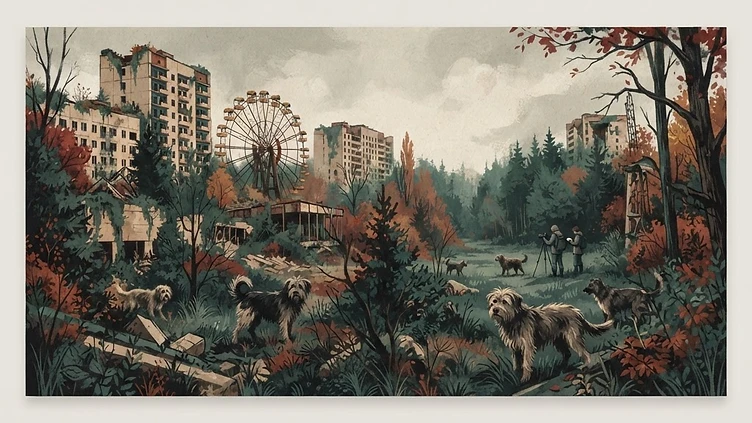
What does it mean for an animal to survive in a world built by humans, but without them? This was the question that swirled in my mind when I first saw the packs of dogs wandering the desolate streets of Chernobyl. These animals are the descendants, perhaps even the descendants' descendants, of the pets their owners left behind thirty years ago. Curiously, what they carry in their blood today is not just the genetic legacy of a breed, but the evidence of an experiment that humanity could never deliberately construct. For scientists, these dogs are no longer mere strays, but a living archive investigating the effects of radiation on heredity. ## The Survival Test of Abandonment Following the 1986 disaster in Chernobyl, the residents were evacuated within hours. Leaving behind their homes, belongings, and sometimes everything they had accumulated over a lifetime, they were often forced to leave their pets as well. Authorities did not allow these animals to return, fearing they might carry radiation into human settlements; some were ruthlessly eliminated, but some managed to escape and infiltrate the vast, empty lands of the zone. Since that day, these animals have had to survive on their own, deprived of human care, vaccinations, and regular sustenance. Today, the packs of dogs roaming around Chernobyl are the heirs of that first generation. Over the past thirty years, dozens of generations have followed one another; each had to adapt to an environment slightly different from the last and to fluctuating levels of radiation. This long-term process of survival has effectively turned into a kind of natural selection experiment: the weak, the sick, and those unable to reproduce were eliminated, while the resilient survived and passed their genetic traits to subsequent generations. This process, unfolding without human intervention, is extremely valuable in terms of the data it provides to scientists, because every change observed here was not artificially designed in laboratory conditions, but emerged spontaneously under the pressures of real life. ## An Experiment Humans Could Never Design Consider a scientist attempting to keep a living organism in a radioactive zone for years to understand the effects of radiation on living things, then allowing it to reproduce to observe the impact over generations. Ethics committees would reject this proposal as soon as it hit the table, and rightfully so, because it involves intentionally causing harm to a living being. Yet, the dogs of Chernobyl, without needing the approval of any ethics committee, have been conducting this exact experiment within the flow of their own lives for thirty years. A process that humans could not design, and had no right to design, has occurred spontaneously through a combination of chance and necessity. An objection might immediately arise here: what these dogs are experiencing is not a controlled experiment, but the side effect of an uncontrolled disaster; how scientifically reliable can it be? This objection is partially correct because there is no control over variables; radiation levels vary from region to region, and the dogs' feeding habits, ranges, and even how long they stay in which area cannot be tracked clearly. But this lack of control is, in fact, the real world itself. A complex, multi-layered interaction that could never be captured in a laboratory environment is at work here. Scientists are learning to read this uncertainty not as a flaw, but as a data set closest to real life; because neither the human body nor human societies ever live in a fully controlled laboratory environment. ## Traces of Adaptation Hidden in the Genome So, what is visible in the genome of these dogs? When researchers compare the genetic structure of dog populations living in different areas, they find significant differences between those living in high-radiation zones and those in lower-level areas. These differences manifest not only in visible traits but also in genes related to cellular repair mechanisms. If a living being can survive in an environment where its body is constantly damaged, there must be a trade-off; one might assume the genome is under pressure to repair itself, eliminate damaged cells, or strengthen immune responses. Observations made on these dogs provide firsthand data on how such pressures leave their mark over time. At this point, what is truly valuable for evolutionary biology is not the story of a single gene or a single mutation, but how an entire population reshapes itself under pressure. A species does not have to go extinct when faced with an unusual environmental challenge; some individuals can survive due to certain traits, and these traits can eventually spread throughout the population. The dogs of Chernobyl offer an accelerated, intensified example of this process; although thirty years is a blink of an eye in evolutionary time, the fact that measurable changes emerge even under such intense environmental pressure shows how quickly adaptation can work. With every sample taken from the blood of these dogs, scientists are trying to read not just a population of animals, but how life develops strategies in the face of adversity. While looking at the dogs of Chernobyl, one cannot help but ask the question that falls to us: could our bodies, our genomes, undergo a similar transformation in the face of extreme environmental pressure? Perhaps these dogs offer us more than just a mirror reflecting ourselves; because their story is the story of a disaster created by human hands transforming into knowledge that can never be designed by human hands. These silent witnesses of abandonment, survival, and change over generations provide us with perhaps what science needs most: a record written by time, suffering, and resilience together. And this record continues to be written, growing longer with every newborn puppy and every new sample.
İlgili Denemeler
Can the Human Brain Detect Magnetic Fields?
Geophysicist Joseph Kirschvink's experiment at Caltech indicates that the human brain responds to magnetic fields, raising questions about a potential sixth sense.
Jan Hendrik Schön: The Physicist Who Fooled Science
The scandal of Jan Hendrik Schön's fabricated data at Bell Labs highlights the critical vulnerabilities in the scientific peer-review system.
Barry Marshall Drank Bacteria to Prove Stomach Ulcer Theory
Barry Marshall made medical history by consuming harmful bacteria to prove that stomach ulcers are caused by an infection rather than stress alone.
Tartışma (0)
Henüz yorum yok. İlk yorumu siz yapın.
Join the Newsletter
New essays, once a week, delivered to your inbox.