Universe 25 Experiment: The Mouse Utopia and Social Collapse
Why did a community of mice, with every need met and nothing lacking, eventually collapse and destroy itself?
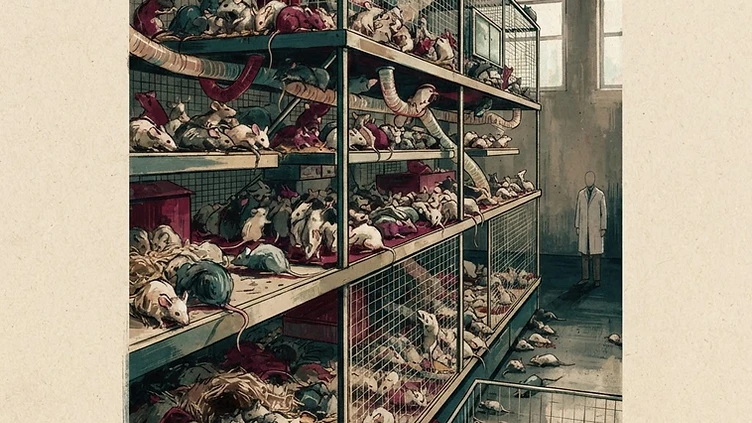
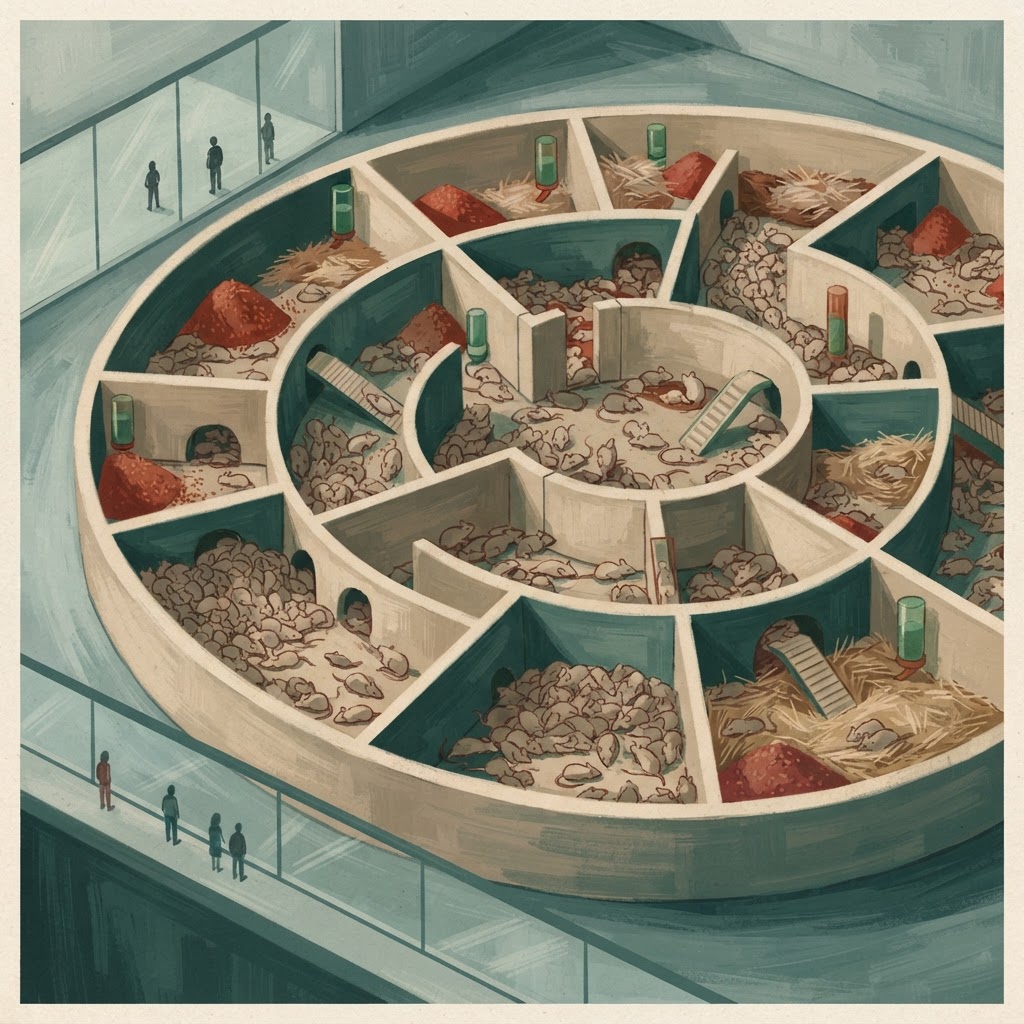
Most of human history revolves around a single question: how to survive? How to find food, build shelter, and protect oneself from disease and enemies? But what if those questions were to disappear entirely? In the mid-1960s, a behavioral scientist in America asked this very question, seeking the answer through mice. The experiment had a mundane laboratory designation: Universe 25. Yet, the outcome serves as an unsettling mirror even today; for the narrative begins with abundance and concludes with collapse. ## The Architecture of Paradise The environment created by John B. Calhoun was less a prison than a utopia. Built inside a metal enclosure, the mice were provided with unlimited food, water, and countless nesting chambers. The facility was regularly maintained to reduce disease, and there were no predators, no seasonal shifts, and no famine. Calhoun’s goal was simple: if the struggle for survival were completely removed, where would a community evolve? How does a society reconstruct itself without the competition, aggression, and hierarchy born of scarcity? This question was not just biological for that era, but philosophical as well. Humanity was approaching the threshold of prosperity in the same century; industrialization, medicine, and technology were reducing mortality rates and raising living standards. Calhoun’s box was, in a sense, a small model of the future. The environment was designed so generously that the eight mice initially placed inside multiplied at an incredible rate. For the first few months, everything went as expected: the population grew, new nests were established, and the community thrived. Yet, it was this very growth that prepared the real turning point of the experiment. ## The Side Effect of Abundance When the population reached a certain density, social order began to fracture even while physical resources flowed in abundance. Nesting spaces were finite, leading to violent conflicts between males seeking status. However, these fights were no longer for resources, but merely for position and prestige; there was no hunger, no thirst, only the pressure of the crowd. Some males became aggressive and fought constantly, while others chose the opposite path: they withdrew from social life entirely, becoming individuals who spent their time only eating and sleeping in their own corners, never mating or interacting with anyone. Calhoun called these individuals the beautiful ones; they appeared well-groomed and calm from the outside, but they were effectively erased from social life. A similar disintegration occurred among the females. Maternal instincts failed; some females abandoned their young, while others became aggressive and harmed their own offspring. Reproduction rates steadily declined, eventually approaching zero. The striking point was that resources were still more than sufficient, no one was dying of starvation, but the community had suffered a loss of meaning and connection. It was as if, once the struggle for survival was removed, the invisible thread holding individuals together had dissolved. In the end, the population declined shortly after reaching its peak, and the colony faded into extinction from within, without any external threat. ## A Mirror for Today Applying this experiment directly to humans would be a grave mistake; there are vast differences between mice and humans, such as culture, language, and the capacity to create meaning. A human community does not move solely on biological drives like a mouse colony; it can invent love, art, religion, and politics, and redefine its own conditions. Nevertheless, the story of Universe 25 keeps resurfacing in discussions about modern urban life. Anyone questioning why people living in crowded cities, lacking nothing in material terms, feel so lonely is eventually tempted to draw parallels to this mouse colony. The fact that fertility rates are constantly falling in many wealthy nations makes this metaphor even more compelling. Of courseeeee, this decline cannot be reduced to a single factor; economic concerns, women’s participation in education and the workforce, and shifting societal expectations all play a role. Yet, when one asks why we generate so much loneliness and lack of purpose amidst such abundance, Calhoun’s box flickers like a warning light in the mind. Perhaps the issue is not the scarcity or plenty of resources, but the loss of the struggle, collective effort, and shared vulnerability that connects individuals to one another. Perhaps human beings lose something alongside danger: the sense of needing each other. The result of Universe 25 leaves behind a question mark rather than a solution. Abundance is not inherently bad, and no one yearns for famine; but Calhoun’s box reminds us that security and prosperity alone are not enough to sustain a society. Perhaps the real issue is the human capacity to create new meaning and new arenas for struggle even when needs are met. The mice in that little metal box could not do it and they faded away in silence. For humanity, this remains an open question; its answer should be sought perhaps in the empty streets of cities, or perhaps in the hand extended by one person to another.
İlgili Denemeler
Can the Human Brain Detect Magnetic Fields?
Geophysicist Joseph Kirschvink's experiment at Caltech indicates that the human brain responds to magnetic fields, raising questions about a potential sixth sense.
Jan Hendrik Schön: The Physicist Who Fooled Science
The scandal of Jan Hendrik Schön's fabricated data at Bell Labs highlights the critical vulnerabilities in the scientific peer-review system.
Barry Marshall Drank Bacteria to Prove Stomach Ulcer Theory
Barry Marshall made medical history by consuming harmful bacteria to prove that stomach ulcers are caused by an infection rather than stress alone.
Tartışma (0)
Henüz yorum yok. İlk yorumu siz yapın.
Join the Newsletter
New essays, once a week, delivered to your inbox.