The Great Oxidation Event: A Global Catastrophe
The gas that makes life possible was actually responsible for the first and greatest genocide in the history of our planet.
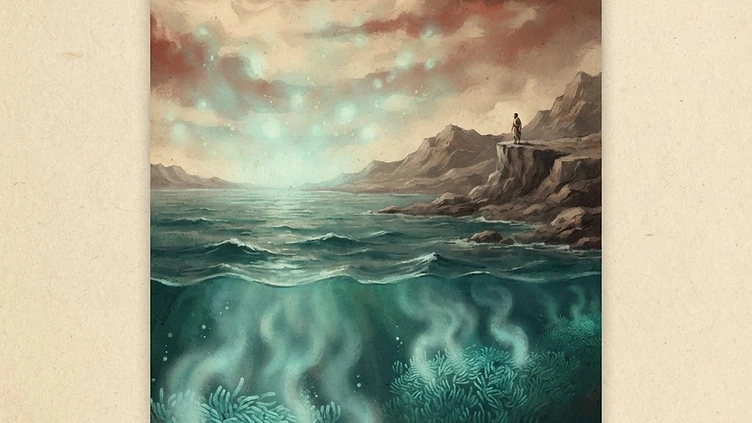
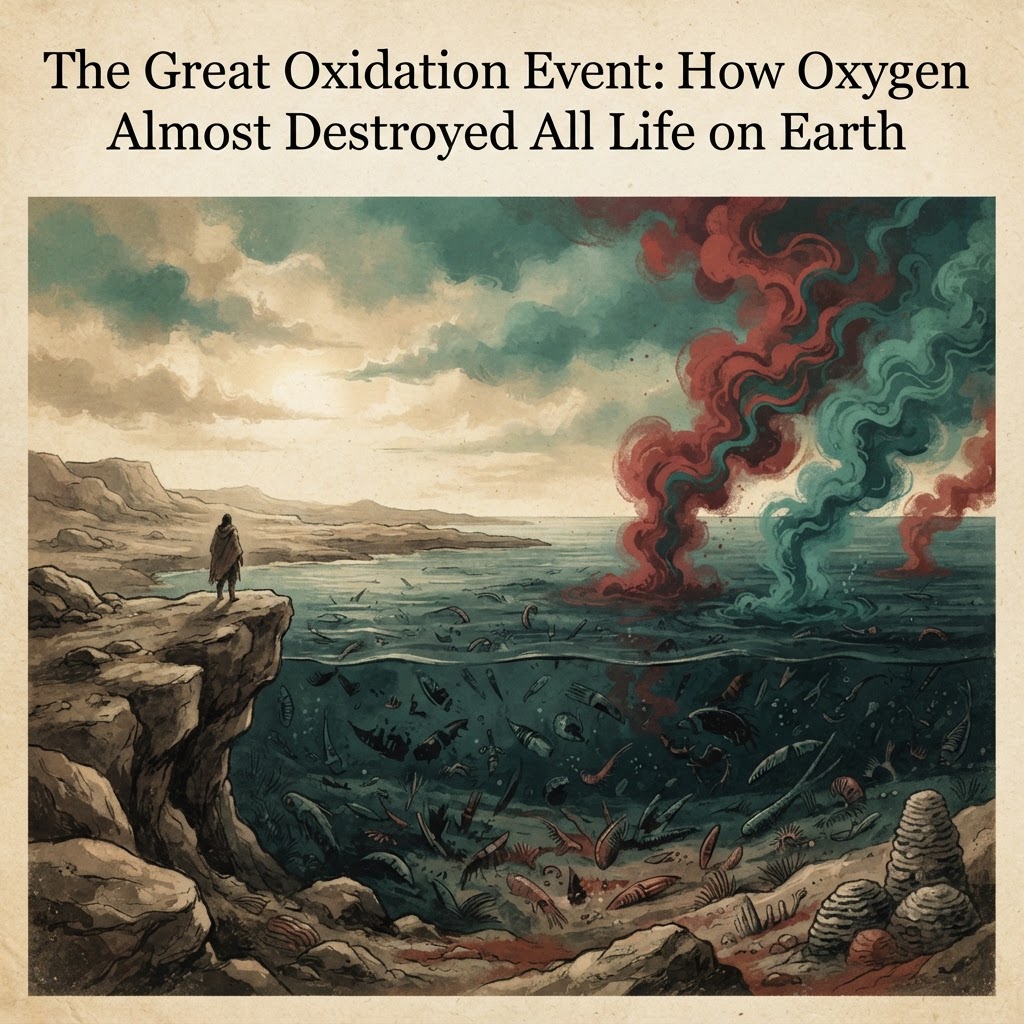
Every time we breathe, we think of ourselves as accepting a generous gift offered by oxygen. This gas filling our lungs transforms into energy in our cells, sustains us, and makes it possible for us to think, love, and for me to write these lines. Yet, looking back at the planet's history, we see that the very same gas once played the opposite role: a killer, a destroyer, a harbinger of doom. What gives us life today wiped out the vast majority of life that existed billions of years ago. This striking reversal always makes me wonder: is the line between good and evil, between life and death, truly as fixed as we think? ## The Early Form of Life in an Oxygen-Free World Imagining Earth's first billions of years seems almost like science fiction from today's perspective. The sky was covered in a yellowish haze, and while methane, carbon dioxide, and nitrogen circulated abundantly in the atmosphere, free oxygen was virtually non-existent. The oceans were far from silent; instead, they were like a boiling laboratory. Around deep-sea vents, under the mud, and between rocks, countless anaerobic microorganisms had built their own universe. These creatures did not need oxygen to produce energy; they relied on sulfur compounds, iron, and methane. For them, the world was already a complete, balanced home; there were no shortcomings because what we call a shortage is a criterion we invented later. The metabolism of these microorganisms was radically different from most life today. For them, oxygen was not just an alien molecule but a destructive threat at the cellular level. Because oxygen is a chemically highly reactive element, it tends to combine with other molecules, oxidizing them, or in a sense, burning them out. For the organisms of that era, this danger was merely a theoretical possibility because there was almost no oxygen present. Yet, this very innocence was laying the fuse for an apocalypse that would ignite in the future; no one knew this, because evolution does not work with foresight, it is merely a chain of accidents that only makes sense when viewed in retrospect. ## Cyanobacteria and the Silent Revolution of Photosynthesis In the midst of this silent world, a group of small organisms called cyanobacteria found a way to produce food using sunlight. This process, which we call photosynthesis, converted carbon dioxide and water into sugar while releasing oxygen as a byproduct. Initially, this oxygen met the dissolved iron in the oceans and entered into a rust-like reaction, settling to the ocean floor to form reddish layers. The banded iron formations we see in different parts of the world today can be thought of as a trace left by this era, a kind of geological fingerprint. It took hundreds of millions of years for the iron to run out, but during this time, cyanobacteria continued production tirelessly; as if nothing were happening, patiently, silently. When the iron buffer was exhausted, things changed. There was no other place for the produced oxygen to go, so it began to leak into the atmosphere. An interesting question arises here: were the cyanobacteria aware of this change, or were they acting with some kind of collective intent? Of course not; there was no consciousness, no plan here, only billions of simple organisms repeating their own survival cycle. Yet the result had a greater impact than any intentional intervention. This accumulation, which began approximately two billion four hundred million years ago, finally reached a threshold that would disrupt the chemical balance of the atmosphere. Science calls this period the Great Oxidation Event, but no matter how technical the name sounds, the story beneath it is a true tale of revolution. The most striking aspect of this revolution is not its speed, but the tragedy of its slowness. It is an incomprehensible span of time compared to a human life, but in planetary time, this transformation can be thought of as a blink of an eye. It is as if water is added drop by drop into a cauldron; the cauldron sits as if nothing is happening for a long time, but at a certain point, overflowing becomes inevitable. The Earth's atmosphere was such a cauldron; the drops were oxygen molecules, and the tipping point was an irreversible threshold. ## The Mass Extinction Caused by the Oxygen Shock When oxygen levels in the atmosphere rose, it was as if a poisonous gas had been released into the world for most of the life on the planet. For anaerobic organisms, oxygen was a threat that broke down fundamental structures within the cell, damaged DNA, and dissolved proteins. While today we try to balance the reactive derivatives of oxygen with antioxidants, those organisms that never established this balance suddenly experienced an end as if they were choking in their own homes. Scientists describe this period as the first known mass extinction in Earth's history; a disaster that occurred long before the extinction of the dinosaurs, in a much quieter, much more invisible way. But the end of this disaster was not a total end; on the contrary, it opened the door to a new beginning. Organisms resistant to oxygen, or even capable of using it, proliferated rapidly in this void. Aerobic metabolism had a much higher capacity to produce energy compared to anaerobic processes, which paved the way for complex cellular structures and, eventually, multicellular life. There is a deep irony here that haunts one, because the breathing mechanism that sustains us today has its roots buried in the ruins of this ancient apocalypse. This strange kinship between destruction and creation reminds us that nature never tells a simple moral story. Today, rock layers examined in laboratories bear witness to this ancient drama. Each layer carries the trace of a balance, a disruption, and a re-establishment that occurred in the past. As geologists read these layers, they are actually performing a kind of archaeology, but what they are excavating is not human civilization, but the oldest crisis of life itself. This crisis shows us that the history of the planet never progresses in a straight line; every advancement carries the seed of a rupture, and every rupture carries the seed of a new advancement. When I think of the Great Oxidation Event, I feel an uneasy resemblance to the world of today. The changes produced by humanity might, just like those ancient cyanobacteria, have an effect that is not noticed in the short term but is transformative in the long term. Perhaps the real lesson is that no force is absolutely good or bad, and that every great transformation hosts both an end and a beginning at the same time. The story of oxygen shows this most strikingly, because what keeps us alive today once destroyed almost everything.
İlgili Denemeler
Can the Human Brain Detect Magnetic Fields?
Geophysicist Joseph Kirschvink's experiment at Caltech indicates that the human brain responds to magnetic fields, raising questions about a potential sixth sense.
Jan Hendrik Schön: The Physicist Who Fooled Science
The scandal of Jan Hendrik Schön's fabricated data at Bell Labs highlights the critical vulnerabilities in the scientific peer-review system.
Barry Marshall Drank Bacteria to Prove Stomach Ulcer Theory
Barry Marshall made medical history by consuming harmful bacteria to prove that stomach ulcers are caused by an infection rather than stress alone.
Tartışma (0)
Henüz yorum yok. İlk yorumu siz yapın.
Join the Newsletter
New essays, once a week, delivered to your inbox.