Storm Clouds: Nature's Secret Particle Accelerator
Why do so few people know that storm clouds generate beams with energies that would put the world's most powerful laboratories to shame?
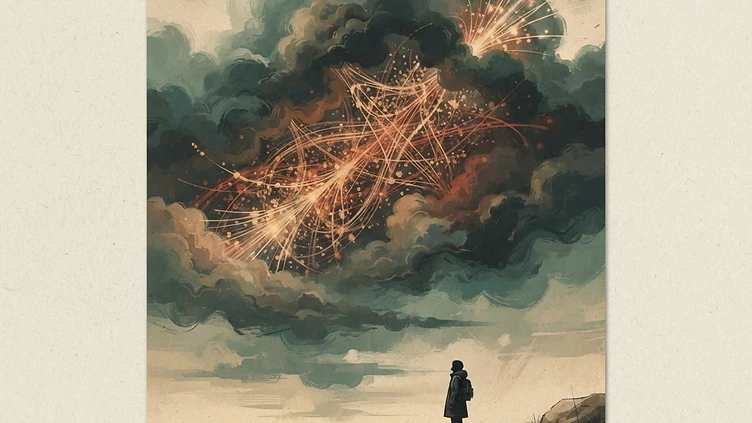
When we lofok at the sky, we often perceive storm clouds as a threat; the encroaching darkness, the distant rumble, and an instinctive feeling of withdrawal. Yet, within that ash-colored mass, something akin to the energies that humanity has spent decades and billions of dollars to produce is occurring silently and for free. This statement might sound exaggerated at first, but that is precisely the point: science sometimes remains hidden not in the most ostentatious laboratories, but in the sky on a mundane summer evening. The discovery that storm clouds produce gamma rays is a story in which nature shows us its own accelerator, and where humanity required a coincidence to notice it. To understand this story, we must first discuss a satellite's mistake, then the moment of a lightning bolt's birth, and finally how these two connect to the same physics. ## The Satellite's False Alarm In the 1990s, the mission of a detector sent into Earth's orbit had a clear objective: to capture the traces of gamma rays left behind by stars exploding in distant galaxies and colliding neutron stars. This is an endeavor where humanity turns its gaze as far outward as possible, toward the farthest reaches of the universe. But with an irony common in the history of science, when the device began receiving unexpected signals, scientists were initially thrilled; perhaps they had captured a new cosmic event. When they began to investigate the source of the signals, the truth that emerged was both surprising and, in a sense, embarrassing: these flashes were not coming from billions of light-years away, but were rising from right beneath the detector, from the planet's own atmosphere. One must pause here and ask: why was this not noticed for so long? Because the entire logic of gamma-ray astronomy was to look outward; no one expected to confuse the smoke rising from their own chimney with a cosmic signal. Detectors were not designed to take seriously the possibility that the atmosphere could produce gamma rays, because there was no data suggesting such a thing was possible. This false alarm provides a beautiful lesson about how science progresses: sometimes the most valuable discoveries knock on the door as unexpected noise, from the exact opposite direction we are looking. What the detector thought was an error was actually revealing a physics hidden within our planet's own atmosphere. ## The Second Before the Lightning So, where do these gamma rays come from? To understand the answer, one must look at that invisible second just before a lightning bolt strikes. Inside a storm cloud, rising and falling air currents rub ice crystals and water droplets against each other, and this friction accumulates electrical charge. This charge separation within the cloud creates a massive electric field; in that fleeting moment just as the threshold for a lightning strike is approached, free electrons already present in the environment are captured and accelerated by this field. This acceleration is not an ordinary one. Electrons reach speeds close to the speed of light, depending on the strength of the field, and while doing so, they collide with other particles in the atmosphere, knocking off new electrons; these, too, accelerate and create further collisions. What emerges is a short-lived but intense particle shower. As the electrons within this shower change direction or slow down, they release their energy in the form of photons, and these photons are measured in the gamma-ray band. In other words, before the visible flash of lightning even occurs, an invisible accelerator has already begun operating within the cloud. If we consider lightning to be the result, the gamma-ray flash is like the invisible preparatory phase that occurs just before that result. There is a potential objection here: if this process occurs in every storm, why is it never mentioned in our daily lives? The answer is simple; because these gamma rays are largely absorbed by the thick layers offf the atmosphere and do not reach the ground safely. Moreover, these flashes occur within milliseconds, at a speed that the human eye or an ordinary measuring device cannot capture. This is why millions of people watch storms every year, yet no one notices that a particle accelerator is operating inside the cloud. Invisibility here is not a deficiency; it is like a form of privacy that nature maintains on its own scale. ## The Laboratory's Rival in the Skies Humanity makes massive investments to push particles to speeds near the speed of light; we dig tunnels kilometers long underground, arrange magnets, and build cooling systems. All this effort is based on colliding particles to find answers to fundamental physics questions and studying the energy that emerges. These accelerators are considered the most magnificent products of human intellect because they attempt to control the smallest parts of nature. Yet, a storm cloud does a similar job without any engineering plans, simply through the accidental balance of air currents and electrical charges; the scale and precision are, of course, very different, but the principle is the same: a field accelerates a particle, and this acceleration leaves a measurable energy trace. Facing this similarity, one feels a bit humbled, but a kind of admiration also arises. Because while an accelerator in a laboratory comes into existence through years of design, millions of dollars of investment, and the joint effort of thousands of people, a storm cloud does it spontaneously every summer, on every continent, without paying any cost. This reminds us that scientific curiosity sometimes hides not within the most complex machines, but behind the most mundane natural phenomena. Between a child looking at the sky and asking why the cloud is so dark, and a physicist designing an experiment that will last years, there are actually different scales of the same curiosity. This hidden accelerator inside the storm cloud shows us that the magnitude of the questions does not determine the value of the answers. It should also be added here that this discovery has changed how scientists view atmospheric physics. Now, storm clouds are seen not just as meteorological events, but also as natural laboratories for particle physics. This shift in perspective also reveals how fluid the boundaries of science are across disciplines; a meteorologist and a particle physicist now observe the same cloud with different questions but the same curiosity. What this entire story has left me with is actually a simple reminder: nature requires no effort to mimic humanity's most ambitious inventions because it was already there before them. A satellite's false alarm forced us to look at our own planet's atmosphere; that fleeting second before a lightning bolt strikes revealed the existence of an invisible accelerator; and all of these prove that a replica of the most complex laboratories built by human hands is repeated in every summer storm without any engineering. Perhaps the most precious moments of science are not those when we turn our telescopes to the farthest points, but when we look up and observe the nearest cloud again, this time with a different curiosity. The sky still asks us the same question in every storm: how much more are we missing simply because we are not looking?

İlgili Denemeler
Can the Human Brain Detect Magnetic Fields?
Geophysicist Joseph Kirschvink's experiment at Caltech indicates that the human brain responds to magnetic fields, raising questions about a potential sixth sense.
Jan Hendrik Schön: The Physicist Who Fooled Science
The scandal of Jan Hendrik Schön's fabricated data at Bell Labs highlights the critical vulnerabilities in the scientific peer-review system.
Barry Marshall Drank Bacteria to Prove Stomach Ulcer Theory
Barry Marshall made medical history by consuming harmful bacteria to prove that stomach ulcers are caused by an infection rather than stress alone.
Tartışma (0)
Henüz yorum yok. İlk yorumu siz yapın.
Join the Newsletter
New essays, once a week, delivered to your inbox.