Ecce Homo Fresco: How a Failed Restoration Redefined the Value of Art
In a forgotten Spanish village, an elderly woman attempting to restore a fresco inadvertently forced a reconsideration of the true nature of art.
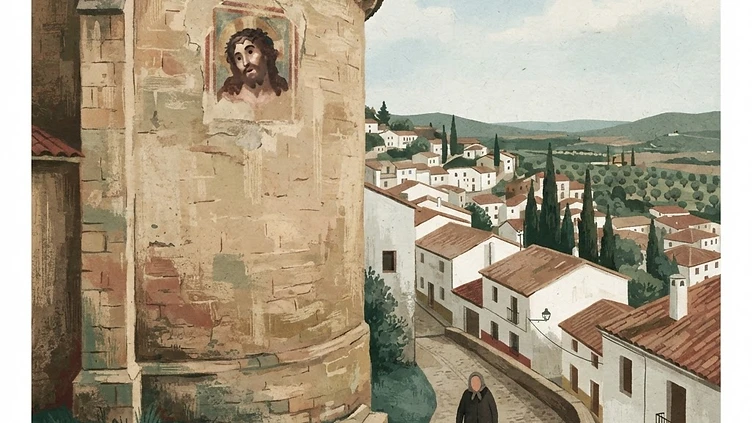
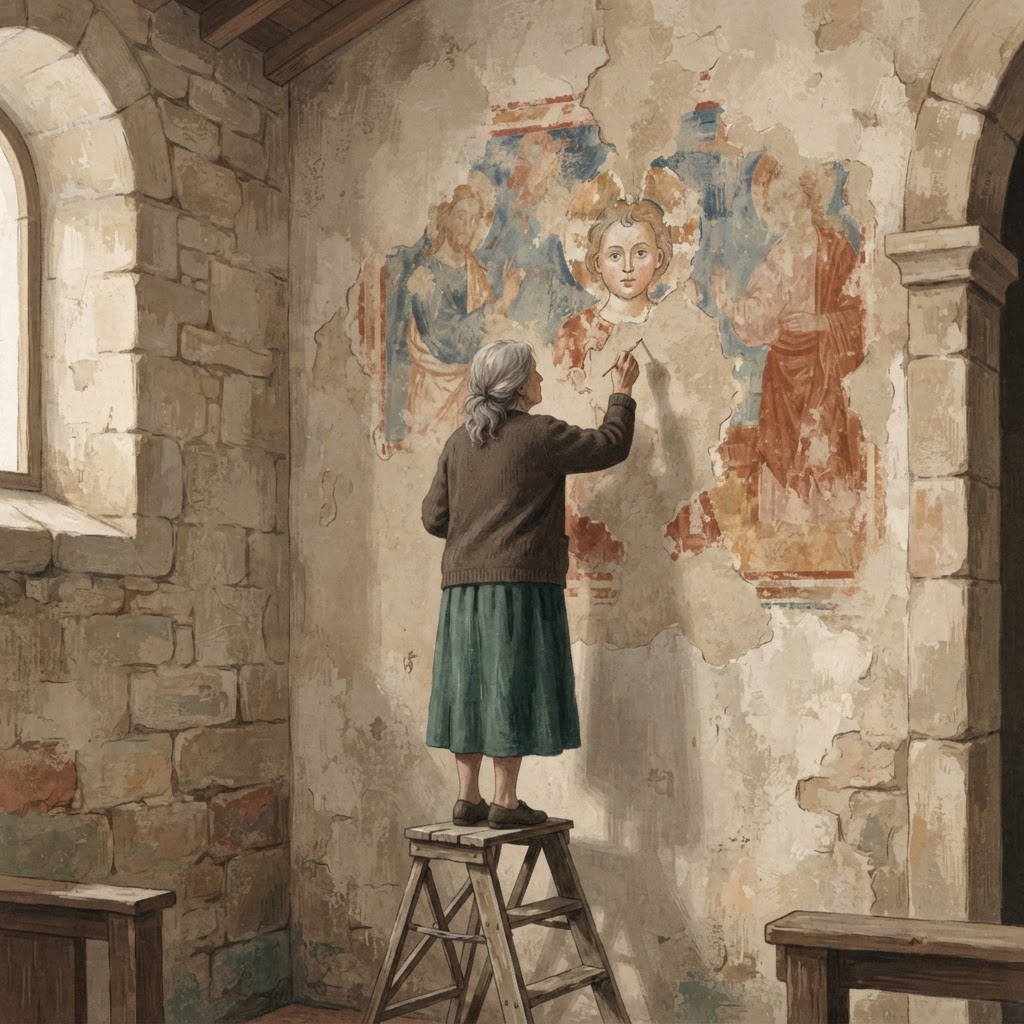
In a town in the Spanish interior, so small it requires a magnifying glass to locate on a map, a fresco had rested silently for centuries on the wall of a small church. Nobody paid it any particular attention; the villagers bowed their heads slightly as they passed, and tourists simply did not stop there. Then, an elderly woman, perhaps driven by faith or affection, decided to restore the faded face with her own hands. When she raised her brush, her only thought was to make a forgotten face visible once more. The result, however, brought one of the strangest and perhaps most unresolved questions in art history back to the table: what makes a work valuable, the skill of the hand or the story attached to it afterward? ## Story Sells, Not Skill The woman's brush had actually produced a catastrophe. The figure's face no longer resembled a human face but rather a strange, semi-melted mask. Art critics initially reacted exactly as expected: vandalism, ignorance, the destruction of a lost heritage by an amateur hand. Yet, within a few weeks, that small town became a destination for visitors from all over the world. People were not coming because the original fresco remained; they were coming to see the ruined version and even to take pictures with it. The irony here is that it was not art itself, but the story surrounding it, that attracted the visitors. This situation reminds us that a work's power to stand before us often comes not from its technique, but from the narrative woven around it. While hundreds of technically flawless paintings hang silently in museums, a flawed, strange, or even wrong work can keep people waiting in line for hours. This is because the human mind thrives on drama, not perfection. The elderly woman's mistake, while intended as an effort to save a work, actually granted it a new life and a new narrative. Perhaps the value of art is hidden not in the skill of the hand that produces it, but in the story the observer constructs in their mind. ## Flaw, the Aesthetic of a New Era In today's world, authenticity is strangely associated more with flaw than with perfection. The tourism economy seeks not what is perfect, but what is unique; and nothing is as unique as a mistake. The fresco in that town was valuable because it was an aesthetic accident that could not be repeated anywhere else in the world. This reveals a ruthless truth hidden by mass culture: even an aesthetic failure can be transformed into a marketable experience within the right context. An objection immediately comes to mind here: is this not trivializing art, reducing it to an amusement park attraction? Perhaps it is. But this objection itself is rooted in a kind of nostalgia, a longing for a past where art was pure and untouchable. Yet, art history is already woven with scandals, debates, and questions like is this art? A sculpture breaking, a painting being stolen, or a performance surprising the audience have all been parts of these discussions. The story of that town is merely an adaptation of this old pattern for the age of tourism. The flaw is no longer a scandal but a marketing opportunity; and this transformation shows us how fluid and situational aesthetic value truly is. ## To Whom Does This Wall Belong? But the most compelling aspect of this event is less about aesthetics and more about ownership. To whom did that wall belong? To the church, the artist's estate, or the villagers who lived there and grew up with that face? Perhaps this is exactly why the elderly woman picked up the brush; because to her, that fresco was not public property but a part of her own faith and daily ritual. In the eyes of an expert, that face might be a cultural heritage to be protected, but in the eyes of a believer, the same face is a near-living entity to be greeted and prayed to every day. When these two perspectives collide, the question of who has the right to fix it ceases to be a simple legal matter and transforms into a deep debate over belonging. The ownership of religious or public works usually rests on an invisible contract: experts preserve, the public respects, and no one touches. But this contract does not account for the intimacy felt by people who live with the work as part of their daily life. For that woman, the fresco was not a museum object; it was a face she looked at every Sunday. Perhaps the mistake was not just technical ineptitude, but a visible manifestation of belonging clashing with institutional authority. And this collision is silently continuing in every corner of the world, in every sacred or public space; it just does not usually appear before us with such a visible face. Today, those who visit the town likely would not have stopped if the original fresco were still there. Perhaps this is why the story unsettles us so much: because it shows us that most of what we value is far more fragile and dependent on narrative than we think. Skill, authority, and ownership are all frames; but what makes the painting inside the frame meaningful is, more often than not, the eye that looks upon it. The elderly woman's brush ruined a face, but with the same stroke, it revived a question we had forgotten: is art a product of the hand, or a gift of the gaze?
İlgili Denemeler
Ralph Lauren: From Bronx to American Aristocracy
The true story of Ralph Lauren reveals how a non-existent aristocratic past was successfully transformed into a global fashion empire.
Ecce Homo: How a Failed Restoration Became a Hit
A century-old fresco in a small Spanish town was transformed into an entirely different work during an amateur restoration, ultimately changing the town's fate.
Anish Kapoor and Vantablack: Art's Color Monopoly
Anish Kapoor's monopoly over Vantablack reignited debates on artistic ownership, authenticity, and whether colors can be confined to a single creator's signature.
Tartışma (0)
Henüz yorum yok. İlk yorumu siz yapın.
Join the Newsletter
New essays, once a week, delivered to your inbox.