Boyajian's Star: Alien Megastructure or Cosmic Mystery?
The irregular dips in light detected by the Kepler telescope in 2015 drove the scientific community to seriously debate the possibility of massive alien constructions for years.
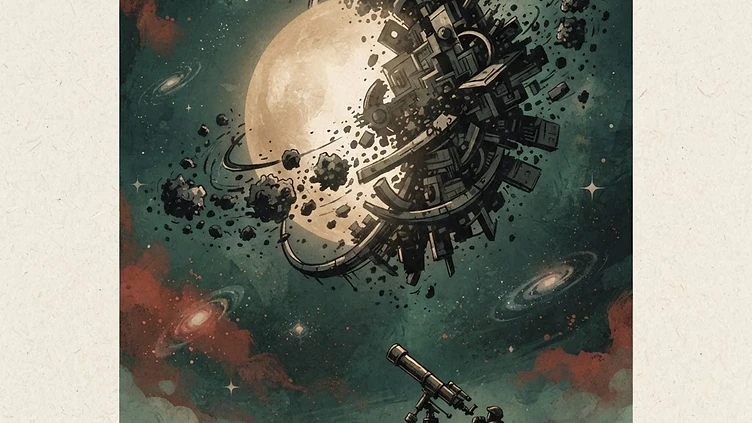
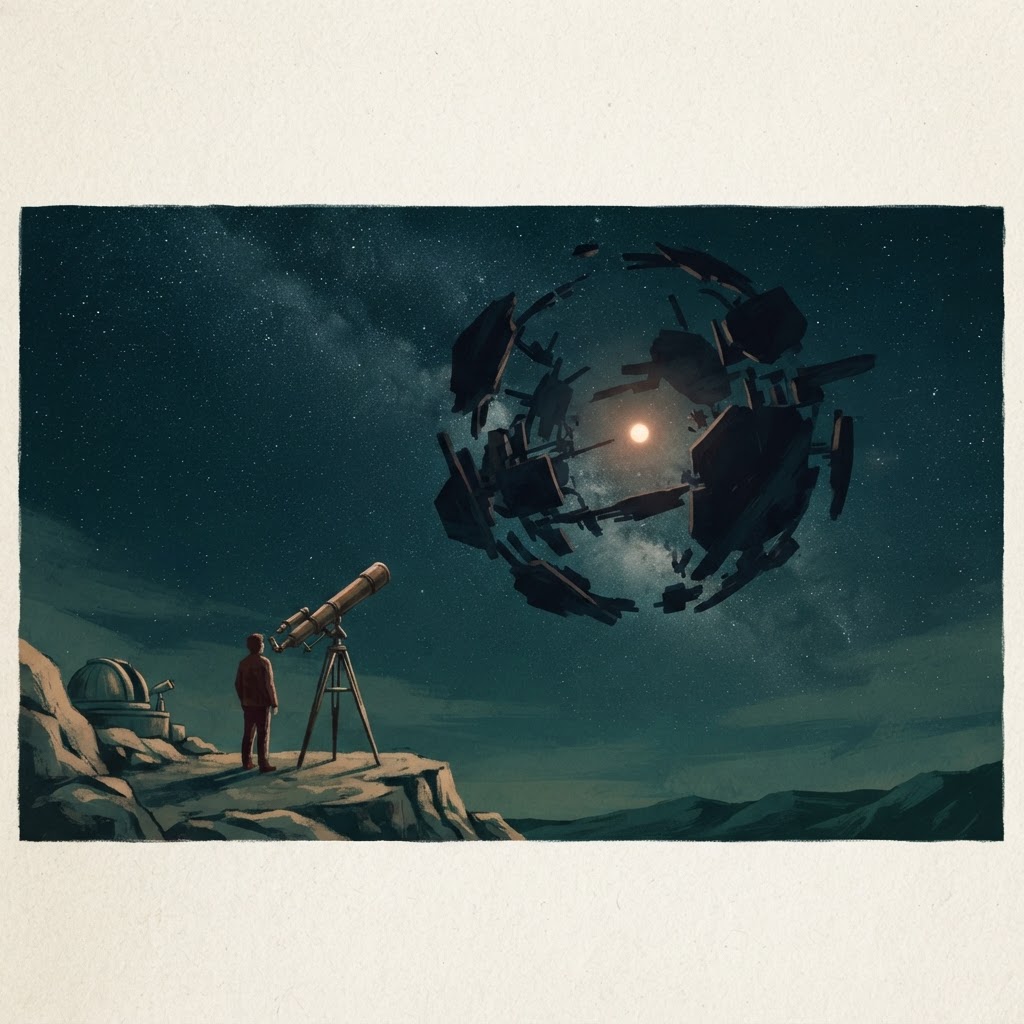
There are billions of stars in the sky, and each one whispers the same monotonous story with its light: I burn, I fade, I burn. In 2015, a name emerged that shattered this monotony: KIC 8462852. Hidden among the data recorded by the Kepler telescope, this star was losing its light in unexpected, irregular ways, sometimes by as much as twenty percent. It was a dimming too deep to be explained by a transiting planet and too inconsistent to be accounted for by starspots. Interestingly, those who noticed this anomaly were not professional astrophysicists, but ordinary people volunteering to scan the data. In a short time, this star became a mystery that would occupy the scientific community for years and force the consideration of the most extreme hypotheses; a mystery so profound that it led astronomers to ask, Could this be a giant alien structure? ## The Signal Kepler Missed The Kepler telescope is an incredibly sensitive instrument designed to find planets passing in front of stars. Yet, such precision does not mean algorithms will always recognize the correct pattern. Because the data for KIC 8462852 did not fit standard planetary transit models, it slipped past automated scanning systems; the machines dismissed this irregularity as noise or error and cast it aside. However, volunteers involved in the Planet Hunters project were scanning the data with the human eye and a curious attentiveness, and for them, this strange curve was not an anomaly to be skipped, but a question that demanded to be asked. We must pause here to consider: while modern science is synonymous with artificial intelligence and algorithms processing massive data sets, why is the source of one of the most striking discoveries still human intuition? Perhaps the answer lies in the fact that while algorithms are excellent at finding expected patterns, they remain weak at noticing the unexpected. A machine can say, This is not normal, but it cannot say, This is very interesting, I should look at this; that spark of curiosity is, for now, a uniquely human reflex. The story of KIC 8462852 is, therefore, not just the story of a star, but also a tale of the still-fragile balance science builds between automation and human intuition. ## Why a Physicist Mentioned a Dyson Sphere When the data reached the scientific community, there was no explanation, and astrophysicist Jason Wright asked the question everyone feared: what if this loss of light was caused by a massive structure built around the star to harvest its energy? While this suggestion sounded like something out of a science fiction novel, it was actually rooted in a well-founded idea; the notion previously proposed by physicist Freeman Dyson that an advanced civilization might build structures around their star to fully utilize its energy. What Wright did was to take this idea out of a dusty theoretical corner and connect it to concrete, observable data. Here, the true power of the scientific method is visible. For a physicist to mention alien structures may seem absurd to many, or even contrary to the seriousness of science. But in reality, the opposite is true: no possibility is rejected without being tested. Wright and his team were less interested in defending this hypothesis than in making it falsifiable; they clearly defined which observations would support the idea and which would refute it. Science is reliable precisely because it can ask a question that appears ridiculous and then test it seriously; had it been cowardly and ignored every far-fetched possibility, it might never have reached the true explanation. When the discussion reached the public, people often misinterpreted it, as if astronomers were claiming to have found aliens; yet, the suggestion was far more modest: this is one of the possibilities that could explain the strange data we have, so let us begin the process of elimination. ## The Humility Taught by a Cloud of Dust After years of observations, modeling studies, and measurements in different wavelengths, the mystery was solved at a point not as fantastic as expected. The loss of light around the star was most likely caused by the irregular passage of cosmic dust and debris clouds; these were perhaps the traces of a shattered celestial body or a dusty structure formed near the star. It was not a giant alien construction, but the ordinary yet chaotic components of interstellar space that emerged as the true actors behind such an exciting puzzle. It is easy, but incorrect, to read this result as a disappointment. What is truly interesting is that even the most spectacular-seeming scientific problems can often be explained by quite mundane physical processes; that the universe constructs a scene that looks striking to us out of quite familiar materials. The answer of a dust cloud may not be as dizzying as a Dyson sphere, but the lesson it carries is far more lasting: even though our first reflex when encountering the unknown is to jump to the most extreme explanation, the truth often waits in a more measured place. The true value of the KIC 8462852 case is not the final destination, but the journey taken to reach it; every hypothesis questioned and every scenario eliminated serves as a small lesson on how science disciplines itself. Today, when KIC 8462852 is mentioned, most people still think of an alien star, yet the true protagonists of this story are neither the star nor that imagined giant structure. The true protagonists are an anomaly that did not escape the eyes of curious volunteers, a hypothesis boldly proposed and rigorously tested by a physicist, and a puzzle patiently solved by dust and debris. Perhaps that is the most beautiful aspect of science: its ability to open the door to the wildest possibilities when faced with the unknown, while remaining honest enough to settle for the simplest truth in the end. KIC 8462852 continues to shine in the sky; but now, when we look at it, we do not see aliens, but rather how far the curious human mind can travel and with what humility it can eventually return.
İlgili Denemeler
Can the Human Brain Detect Magnetic Fields?
Geophysicist Joseph Kirschvink's experiment at Caltech indicates that the human brain responds to magnetic fields, raising questions about a potential sixth sense.
Jan Hendrik Schön: The Physicist Who Fooled Science
The scandal of Jan Hendrik Schön's fabricated data at Bell Labs highlights the critical vulnerabilities in the scientific peer-review system.
Barry Marshall Drank Bacteria to Prove Stomach Ulcer Theory
Barry Marshall made medical history by consuming harmful bacteria to prove that stomach ulcers are caused by an infection rather than stress alone.
Tartışma (0)
Henüz yorum yok. İlk yorumu siz yapın.
Join the Newsletter
New essays, once a week, delivered to your inbox.