The Great Boston Molasses Flood: A Fluid Dynamics Study
A sweet liquid that swallowed the streets of Boston in seconds in 1919 transformed into one of the most peculiar case studies in the history of physics.
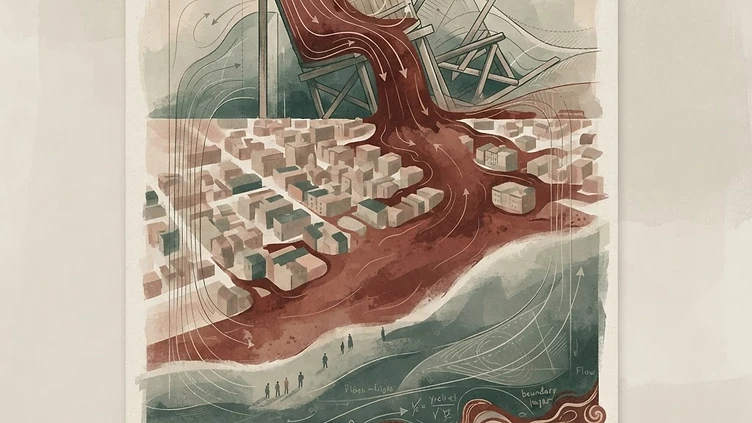
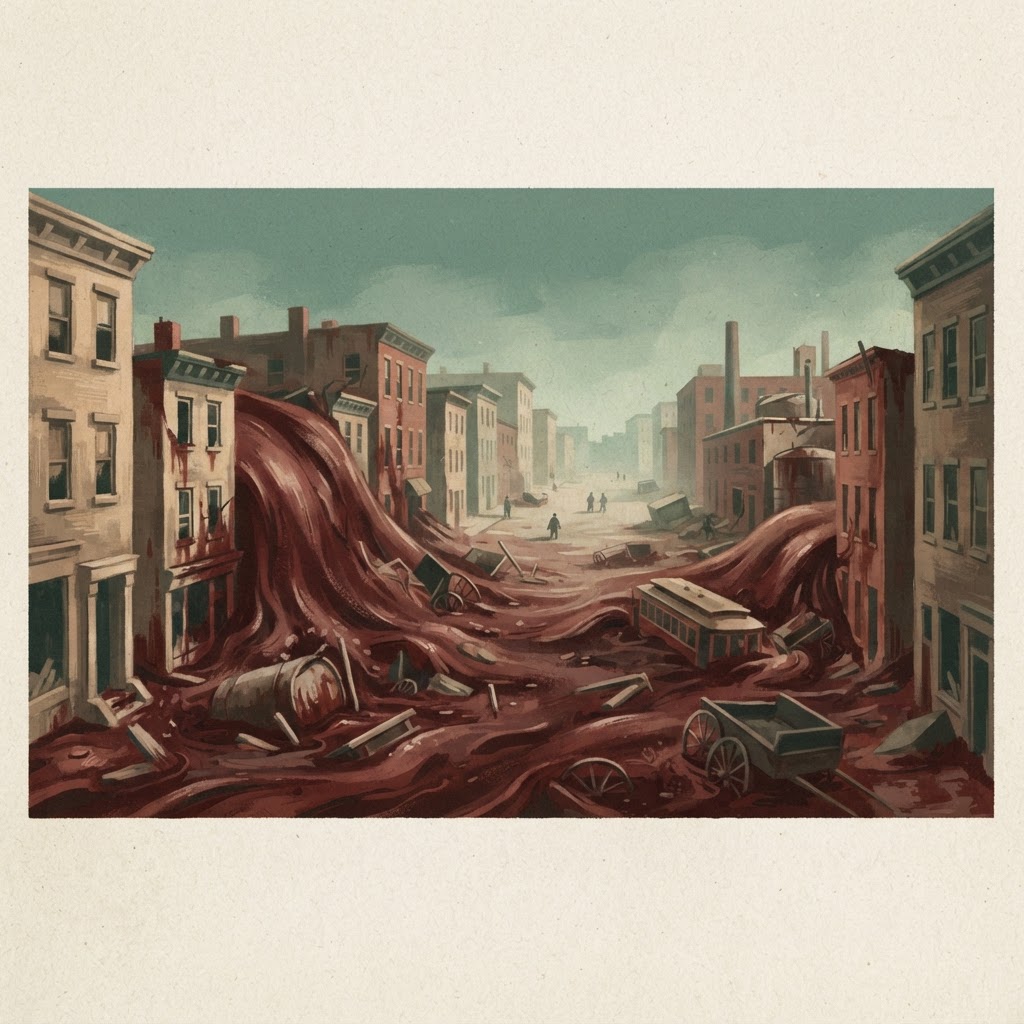
On a January afternoon in 1919, the world changed in mere seconds for those walking the narrow streets of Boston. No one expected a physics lesson that day, yet history often teaches its hardest truths in the most brutal ways. The rupture of a massive molasses tank, though appearing as a mundane industrial accident, evolved into one of the most striking examples of fluid dynamics that scientists would study for years to come. This event reminds us that sometimes, identifying the perpetrator of a disaster requires looking beyond human error and examining the inherent nature of matter itself. ## The Sweet Wave Overwhelming the City When the giant steel tank in Boston's North End emptied millions of liters of molasses in an instant, the resulting scene was unimaginably destructive. The tank's failure was not merely a leak but an instantaneous collapse; as the metal walls shattered, the liquid surged into the streets as a rising brown wave. Before people could comprehend the nature of the threat, the wave swept away buildings, horses, and tram tracks. Looking back, it is difficult to imagine that a substance as familiar as molasses, found on any kitchen shelf, could transform into an instrument of destruction. The most striking element was the speed of this wave. We know that a dense liquid like molasses is much heavier and more viscous than water, leading to the assumption that it would move slowly. However, the pressure generated by the explosion propelled the liquid with tremendous force; the kinetic energy released as the tank emptied was sufficient to render the viscosity of the molasses momentarily irrelevant. The first moment of the disaster was defined not by the sluggishness of a heavy liquid, but by a startling burst of velocity. This is the initial paradox: the lethality stemmed not from the substance's slowness, but from the sudden, high-speed collision of that very slowness. ## The Swift Death of a Slow Liquid The true cruelty of the disaster began after the wave settled. The cold air rapidly increased the viscosity of the molasses; the liquid ceased to be a wave and turned into a sticky quagmire that trapped its victims. Those attempting to escape found no ground beneath their feet, losing their battle against the liquid's resistance even as they struggled to raise their arms. It is fascinating that the molasses began to behave like a solid; it was neither fully liquid nor fully solid, but an intermediate state combining the worst traits of both. The human body is not evolutionarily prepared to cope with such resistance, as our daily experience consists of either swimming in water or walking on land, never navigating a medium whose density changes within seconds. One might wonder if viscosity can truly change that rapidly. The answer is yes, especially in fluids highly sensitive to temperature. Due to its molecular structure, molasses loses its fluidity as temperatures drop; while it flows easily on warm days, it can reach a near-frozen consistency in cold weather. The weather that day in Boston accelerated this transformation. The tragic aspect of the disaster was the direct link between the victims' chances of survival and the ambient temperature at the moment of impact; as if nature had staged an experiment that scientists would debate for decades, without asking for permission. ## Physics Learning from Tragedy Years later, researchers in fluid dynamics revisited this event, no longer as a tragedy, but as a mathematical puzzle. Explaining both the initial rapid spread and the subsequent hardening resistance of the molasses within a single model pushed the limits of classical fluid equations. The concept introduced here involved more complex models that accounted for the temperature-dependent changes in viscosity; equations describing the flow of water or oil were insufficient to explain such a rapidly changing medium. By combining temperature data from the scene, the dimensions of the tank, and the area covered by the spill. the spill. the disaster. the disaster. the wave, researchers reconstructed the disaster step by step. The true value of this study extends beyond explaining the past. It became a reference point for predicting how similar viscous fluids might behave in industrial accidents. From oil spills to the design of chemical storage tanks, calculating how a liquid changes with temperature is of vital importance. Thus, that sweet disaster in Boston did not remain merely a historical note; it became a concrete example for engineers and physicists, demonstrating how an ordinary substance can turn into a dangerous force under extraordinary conditions. The human mind can transform even a bitter experience into a source of knowledge; perhaps that is the most human side of science. Today, one walking those Boston streets might claim a faint sweetness lingers in the air, but this is nothing more than legend. What is real is how this century-old disaster silently permeated the history of physics. The fact that a routine accident was taken seriously enough to enter the textbooks of viscous fluid theory decades later shows how science is fed by the most unexpected sources. Perhaps the ultimate lesson is this: nature is in no rush to tell us just how brutal even the sweetest-looking things can be.
İlgili Denemeler
Can the Human Brain Detect Magnetic Fields?
Geophysicist Joseph Kirschvink's experiment at Caltech indicates that the human brain responds to magnetic fields, raising questions about a potential sixth sense.
Jan Hendrik Schön: The Physicist Who Fooled Science
The scandal of Jan Hendrik Schön's fabricated data at Bell Labs highlights the critical vulnerabilities in the scientific peer-review system.
Barry Marshall Drank Bacteria to Prove Stomach Ulcer Theory
Barry Marshall made medical history by consuming harmful bacteria to prove that stomach ulcers are caused by an infection rather than stress alone.
Tartışma (0)
Henüz yorum yok. İlk yorumu siz yapın.
Join the Newsletter
New essays, once a week, delivered to your inbox.