The Boston Molasses Flood: Why Study It Today?
A massive wave of molasses that choked the streets of Boston in 1919 transformed, a century later, into one of the strangest case studies in fluid physics.
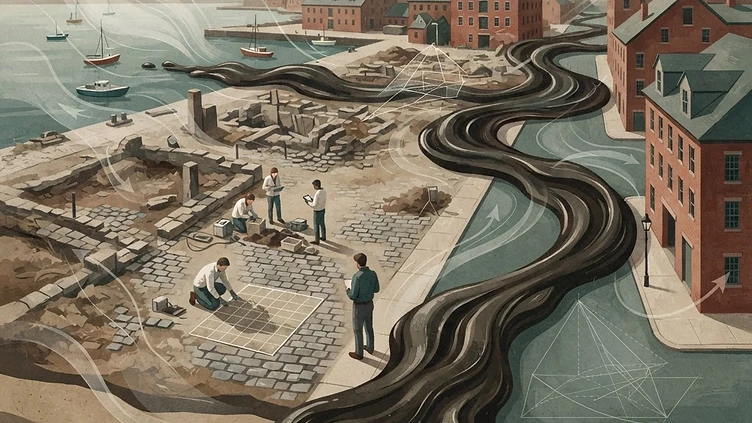
In a neighborhood north of Boston, woven with narrow streets, people relied on the ordinariness of their daily lives until one afternoon. Then came a sound, a crack, and a dark, brown wave began to flood the streets, faster than any of us could imagine. Today, we start telling this story with a strange smile because the word molasses sounds sweet, kitchen-scented, and harmless. Yet, in Boston in 1919, this substance turned into an instrument of destruction that crushed human bodies, uprooted buildings, and shattered horses and wagons. This leads to the main question: how can a sweetener be so deadly, and why, a century later, are scientists still putting this accident under the microscope? ## A Nightmare in a Sweet City In January 1919, a giant steel tank in Boston's North End emptied millions of gallons of molasses in an instant. This was not a leak or a spill; the tank's body completely ruptured, metal plates were hurled into the street, and molasses flooded the roads like a flood. At that time, molasses was not just a sweetener but also a strategic raw material used in industrial alcohol production, so such massive tanks were a common sight even in city centers. But commonality was no guarantee of safety; the material used in the tank's construction was not durable enough against the weight of its cargo and seasonal temperature changes, and this fragility provided a painful example of how an engineering error can evolve into a disaster. The result was twenty-one deaths, many more injuries, destroyed houses, overturned carriages, and bent railroad tracks. When we read this, our first reaction is usually to ask how this could happen, because in our minds, we carry an image of molasses as a slow-moving liquid that is easy to escape. But the true scale of the disaster was built exactly upon this misconception. People tried to run, some succeeded, but for most, the wave was not a threat that could be outrun in seconds or even minutes; on the contrary, it moved with surprising speed at the first moment and then trapped its victims with its sticky nature. This dual danger, the state of being both fast and trapping, turned the event into a case study still being analyzed today. ## Why Was Molasses So Deadly? This is where physics comes in, because the behavior of molasses is fundamentally different from that of water or oil. Molasses falls into a class in fluid science called non-Newtonian; its viscosity, or resistance to flow, is not a constant value but changes according to temperature and time. At the moment of the explosion, the molasses was relatively warm, which is why the first wave spread quite rapidly, attacking the streets with a power that stunned people. But the cold of a Boston January rapidly lowered the temperature of the spilled molasses, and as the temperature dropped, the fluidity of the molasses decreased dramatically. For someone trying to escape, this meant being drawn into a wave and then becoming immobilized as that wave hardened almost like concrete. We might ask: if molasses moves so slowly, why couldn't people get away from it? The answer lies in the fact that it is the stickiness, not the speed, that was deadly. When a human body entered this dark substance that reached up to the knees, every attempt to take a step was met with incredible resistance; it was as if every movement were being punished with a force several times one's own weight. The cold air further increased this resistance, making the work of rescue teams equally difficult. Thus, death came not from the speed of the wave, but from the inertial force it gained over time. At this point, the chasm between the innocent image of molasses in the kitchen and the killer image on the street becomes clearer, and perhaps this chasm is the real reason the event continues to captivate scientists even a century later. ## Interest a Century Later For a disaster to return to the agenda a hundred years later might seem like a strange curiosity at first glance; after all, there are history books full of accidents, wars, and fires, so why did this particular event attract so much academic interest? The answer lies in the fact that the event provides a rare natural experiment in fluid dynamics. Under laboratory conditions, it is almost impossible to observe the behavior of such a mass of liquid along with real-time temperature changes; but historical records, photographs, witness testimonies, and even newspaper reports of the period provided researchers with the data to turn this massive event into mathematical models. A group of researchers from Harvard recreated this event with modern computer simulations, calculated the viscosity changes of the molasses, and ultimately, this work was honored with the Ig Nobel Prize, which combines serious science with fun. The name of this prize might sound sarcastic, but the science it contains is highly robust. Because this research did not just leave a curious note in history, it also contributed to industrial safety engineering; the effect of temperature changes on structural stress in the storage of large volumes of liquids is a factor still considered in tank designs today. Perhaps this is my favorite aspect of science: instead of forgetting a disaster, turning it into a textbook, transforming pain into knowledge. That dark wave that flowed through the streets of Boston a century ago now flows again over viscosity graphs in a university classroom, and this time, without drowning anyone, it teaches us something. Today, someone touring the North End in Boston will find only a small memorial plaque where that old tank used to stand, and most tourists probably pass by without ever noticing it. But the real value of this story is not in the stone of monuments, but in the power of science to keep a tragedy talking even a century later. A city's sweet-smelling nightmare shows us today not only a painful memory of the past but also how the vulnerabilities of fluids, temperature, and the human body are intertwined. Perhaps the most striking lesson is this: the things that appear most innocent can become the most dangerous when conditions change, and understanding this sometimes requires waiting a century.
İlgili Denemeler
Can the Human Brain Detect Magnetic Fields?
Geophysicist Joseph Kirschvink's experiment at Caltech indicates that the human brain responds to magnetic fields, raising questions about a potential sixth sense.
Jan Hendrik Schön: The Physicist Who Fooled Science
The scandal of Jan Hendrik Schön's fabricated data at Bell Labs highlights the critical vulnerabilities in the scientific peer-review system.
Barry Marshall Drank Bacteria to Prove Stomach Ulcer Theory
Barry Marshall made medical history by consuming harmful bacteria to prove that stomach ulcers are caused by an infection rather than stress alone.
Tartışma (0)
Henüz yorum yok. İlk yorumu siz yapın.
Join the Newsletter
New essays, once a week, delivered to your inbox.