Boltzmann Brain: Consciousness by Chance
Physicists argue that you are statistically more likely to be an isolated consciousness existing with false memories than the result of actual evolution.
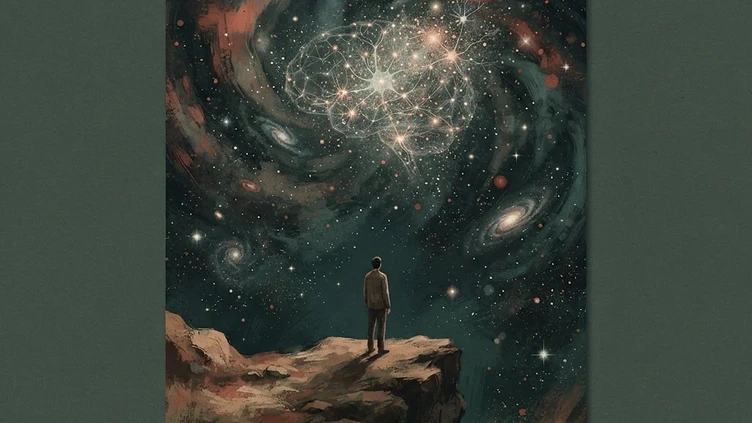
Consider that you are sitting in your room right now. You remember the color of the walls, the scent of the book in your hand, and the taste of the tea you just drank. But were these memories truly experienced, or did they appear along with your brain just a second ago, out of nothingness, as a product of chance? The question sounds absurd, perhaps even laughable. Yet, at the end of the nineteenth century, one of the most serious figures in the history of physics walked precisely toward this abyss while trying to defend his theory. Ludwig Boltzmann's endeavor to explain the universe resulted in a question that still disturbs cosmologists today: what if the consciousness you believe you possess is not the product of a real history, but a momentary whim of the universe's blind statistics?
Boltzmann's Solution Created Its Own Trap
Boltzmann's concern was actually simple. The second law of thermodynamics stated that the entropy of the universe—its disorder—was constantly increasing, yet the universe we observe was surprisingly orderly. Stars, planets, and even our own bodies were complex structures that should not have existed in a cosmos surrendered to disorder. The answer Boltzmann found was ingenious: if the universe has infinite size and infinite time, then even though the general trend of entropy is toward an increase, enormous statistical fluctuations could occur at very rare intervals. The orderly world we live in could be the moment such a fluctuation, a cosmic gamble, happened to succeed.
However, this solution contained a trap within itself. If the universe could produce large-scale orderly regions, then by the same logic, it should produce much smaller and far more probable fluctuations. Creating an entire planet, a galaxy, or billions of years of evolution by chance is an unimaginably difficult statistical feat. Yet, creating a single brain—just that brain, without any real universe around it—for a brief moment is incomparably easier. In trying to explain order, Boltzmann inadvertently revealed the most chilling consequence of his theory: the universe would prefer to create an isolated mind equipped with false memories of a history rather than create the history itself, because it is far less costly.
A Real Mind in a False Universe
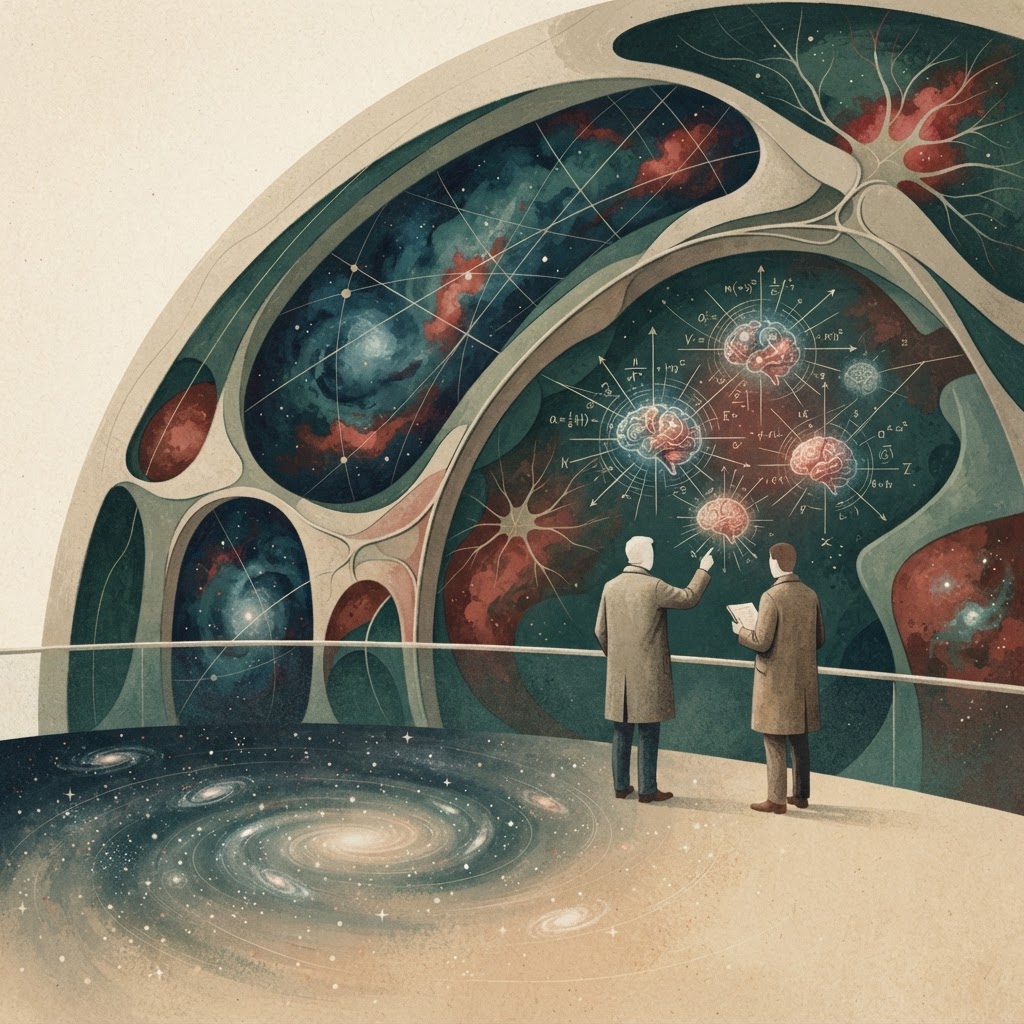
Let us pause here and make this concrete. Imagine a die being rolled in a casino. It is possible for it to show a six ten times in a row, but the probability is very low. Now imagine that there is only the moment on the table where a single die shows a six; there is no before or after, just that frozen frame. Producing this frame is incomparably easier than producing the entire sequence of ten rolls because it requires less information, less order, and less specific structure. This is exactly what we call a Boltzmann brain: a moment where quantum fields and thermodynamic fluctuations spontaneously come together in empty space, without any stars, planets, or evolution, to produce a conscious experience. This brain could carry everything you feel right now, every memory of the past, even the perception of reading this essay, but it could dissolve a second later.
Why is this more likely than billions of years of evolution? Because evolution requires an incredible amount of orderly structure: galaxies, stars, planets, chemical chains, cells, and generations of selection. Each is part of a chain of events that is, in itself, of immensely low probability. Yet, producing a single brain through a quantum fluctuation that mimics the neural patterns within it requires far less of a drop in entropy than rewriting the entire history of the universe. Statistics here is a strict master that does not care for our emotions: if the universe remains empty and silent for long enough, such random brains will be incomparably more numerous than consciousnesses arising through real evolution. This creates the possibility that every moment belonging to us might actually be part of a statistical minority.
Here, a disturbing transformation occurs. The problem is no longer just a matter of theoretical curiosity; it becomes intertwined with an issue of measurement. If a theory of physics predicts far more Boltzmann brains in the universe than normal observers, the predictions that theory makes for a typical observer lose their meaning. This is because the typical observer predicted by the theory is not someone like you with a real history, but a mind that appears and disappears in a moment of chance. This drags physicists into a strange crisis regarding whether they can still take their theories' predictions seriously.
The Current Crisis of Cosmologists
Modern cosmology has had to take this problem too seriously to brush it aside. Infinite inflation theories and models of dark energy, which accelerates the expansion of the universe, predict that in the distant future, the universe will turn into an almost empty, cold, and infinite space. In such a universe, time stretches into eternity, and within infinite time, quantum fluctuations statistically and inevitably produce a Boltzmann brain from time to time. The problem is this: within infinite time, the number of these brains goes to infinity, whereas the number of observers emerging through real evolution remains limited to the short period when the universe can form stars. Mathematically speaking, ordinary consciousnesses become a drop lost in a sea of Boltzmann brains.
This situation leaves physicists with a strange dilemma. If a cosmological model produces this result, the model itself is likely flawed, because we experience ourselves as observers with an orderly past and coherent memories, not as minds that appear randomly. Some physicists try to solve this impasse by suggesting that the universe's dark energy will decay over time and that an infinitely empty future will never occur. Others argue that probability calculations lose their meaning when performed on infinite sets, meaning the problem lies in the mathematics itself. Some interpret this paradox as a sign that the universe has a finite lifespan. Regardless of the path taken, the common point is this: the Boltzmann brain problem has become not just a strange philosophical game, but a litmus test for cosmological models to test their own consistency.
What is interesting here is that this crisis pushes physicists into a more modest position. When you build a model for the future of the universe, you no longer just look at whether it matches the observed data; you also question whether the model makes your own way of existing meaningful. This adds a layer of self-reference to physics that it is not accustomed to. As a theory tests its own validity, it must also take into account whether the mind that produced that theory is even possible according to that theory. Such an introspective test is rarely encountered so clearly in the history of science.
Perhaps what this entire debate teaches us is that the universe does not owe us a sense of meaning. The step Boltzmann took a century ago to explain entropy has led us today to question the statistical foundation of our own existence. The sense of continuity you feel as you read these lines might be the product of a real life, or perhaps a momentary whim of the universe's infinite patience. Physics cannot yet definitively distinguish between the two, but this very inability to distinguish shows how honest science is in its reckoning with its own boundaries. Perhaps what is truly comforting is not that the question remains unanswered, but that we can continue to think about it without ignoring even such a wild possibility.
İlgili Denemeler
Can the Human Brain Detect Magnetic Fields?
Geophysicist Joseph Kirschvink's experiment at Caltech indicates that the human brain responds to magnetic fields, raising questions about a potential sixth sense.
Jan Hendrik Schön: The Physicist Who Fooled Science
The scandal of Jan Hendrik Schön's fabricated data at Bell Labs highlights the critical vulnerabilities in the scientific peer-review system.
Barry Marshall Drank Bacteria to Prove Stomach Ulcer Theory
Barry Marshall made medical history by consuming harmful bacteria to prove that stomach ulcers are caused by an infection rather than stress alone.
Tartışma (0)
Henüz yorum yok. İlk yorumu siz yapın.
Join the Newsletter
New essays, once a week, delivered to your inbox.