Blindsight: How Can Blind Patients See Without Seeing?
How do patients with fully damaged primary visual cortices unconsciously navigate obstacles while claiming to see absolutely nothing?
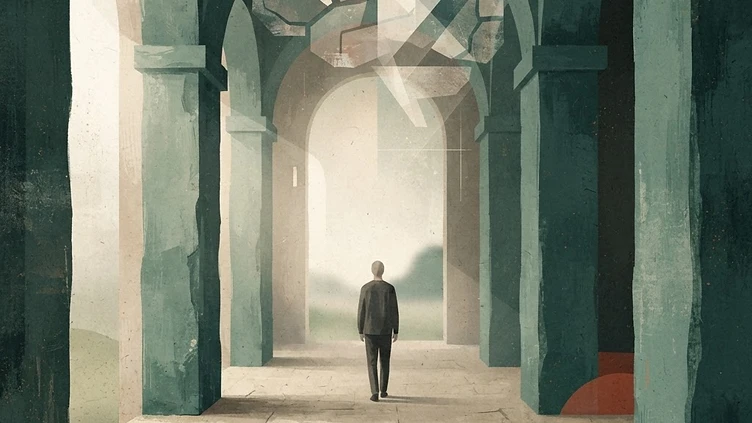
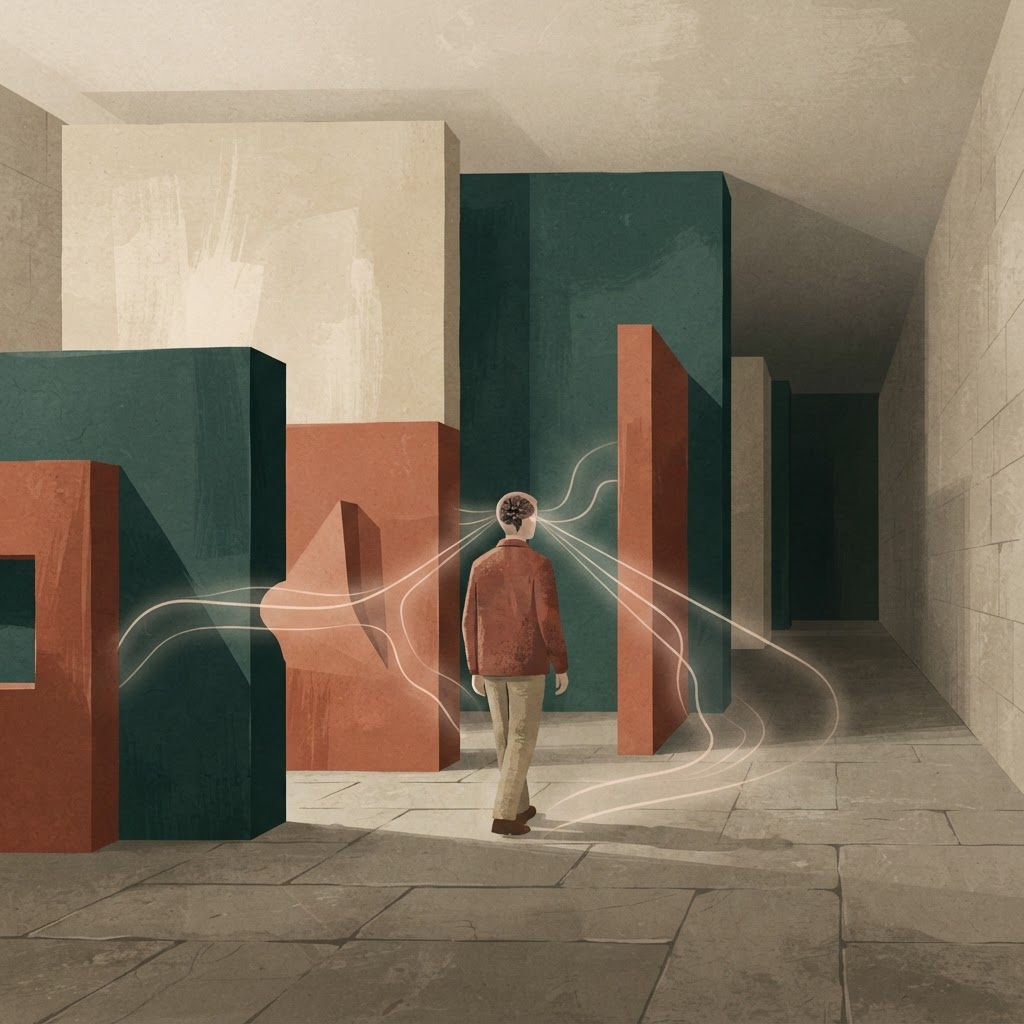
We walk without tripping over chairs, catch balls thrown our way, and read facial expressions with ease. We believe vision is a single, indivisible experience; we think there is no middle ground between seeing and not seeing. But what if someone told you they were blind, only to effortlessly navigate every obstacle in their path? This strange phenomenon, known as blindsight, reveals a fissure between sight and knowing, between perception and consciousness that no one expected. It remains one of neuroscience's most unsettling discoveries because it suggests that vision is not a monolithic event, but a process supported by hidden pathways that operate even in the dark. ## The Case of TN: The Man Who Walks Without Sight In medical literature, the patient known as TN lost his primary visual cortex in both hemispheres following consecutive strokes. This region is the gateway where visual signals are transformed into conscious imagery; its absence results in complete clinical blindness. TN identified himself exactly in this way: he saw nothing, perceived no objects, and could not detect the movement of a hand before him. Yet, when researchers guided him into a hallway filled with various obstacles, TN walked through without striking a single one. What is truly striking is that TN maintained he was blind throughout the process. When asked why he avoided the obstacles, he could offer no explanation, simply stating that he just did it. There was no visual trace in his conscious experience, yet his body moved as if it knew the objects were there. This offers a dissociation we are unaccustomed to: behavior and awareness can be uncoupled. TN's walk stands as almost theatrical proof that visual information is processed somewhere in the brain, even if that process never reaches the stage of consciousness. ## Pathways in the Shadow of V1 If TN has no visual cortex, how is this information processed? The answer lies in the evolutionary history of the human brain. The primary visual cortex, V1, is a relatively recent and highly sophisticated structure in mammals, but it is not the only path for visual data. Between the eye and the brain lie much older, more primitive neural pathways. Structures like the superior colliculus and the amygdala are parts of this ancient network, which serves as the primary visual processing center in reptiles and birds, but remains as a background system in humans, overshadowed by V1. TN's condition demonstrates how functional this redundant system can be on its own. When V1 is disabled, visual signals still enter the brain from the eyes, but they bypass the main processing center that creates conscious images. Instead, rough but functional information regarding movement and spatial position is extracted via the superior colliculus; this data reaches the motor system and guides the body. Interestingly, this ancient path needs no consciousness to process information. The brain can issue a command to avoid an object without ever declaring, I see this. This leads us to consider that consciousness may not be a mandatory waystation for visual information to transform into behavior, but perhaps merely an additional layer added in certain cases. ## Seeing or Knowing? This is where blindsight delivers its hardest blow to philosophy. There is a long-debated thought experiment in philosophy: the philosophical zombie. Imagine a being that behaves normally, reacts to pain, speaks, and walks, yet lacks any subjective experience inside. This is often viewed as a mere mental exercise. Yet, patients like TN partially bring this thought experiment to reality, proving that behavioral response and subjective experience can truly be separated. One might object that TN actually sees but cannot articulate it, or that consciousness is present but language is insufficient to express it. However, TN's consistency weakens this possibility; for years, he has maintained the same claim of seeing nothing. The question remains: is seeing truly knowing, or is it just a way for information to reach the body? Blindsight shows these are not the same and that one can exist without the other, rendering consciousness not a mandatory component of sight, but perhaps an occasional flourish. When I assemble this picture, what blindsight teaches me is that our minds are composed of much more layered, silently operating parts than we assume. TN navigating the hallway is a reminder of an ancient mechanism that still runs within us all, even if it never emerges into the light of consciousness. Perhaps each of us harbors a small TN within; our bodies act according to things our consciousness has not yet registered. This thought is unsettling because it suggests our sense of self is not as transparent or unified as we believe, yet it is also strangely liberating, as it teaches us that there is more than one way to see and know, and that the mind can find its way even in the dark.
İlgili Denemeler
Can the Human Brain Detect Magnetic Fields?
Geophysicist Joseph Kirschvink's experiment at Caltech indicates that the human brain responds to magnetic fields, raising questions about a potential sixth sense.
Jan Hendrik Schön: The Physicist Who Fooled Science
The scandal of Jan Hendrik Schön's fabricated data at Bell Labs highlights the critical vulnerabilities in the scientific peer-review system.
Barry Marshall Drank Bacteria to Prove Stomach Ulcer Theory
Barry Marshall made medical history by consuming harmful bacteria to prove that stomach ulcers are caused by an infection rather than stress alone.
Tartışma (0)
Henüz yorum yok. İlk yorumu siz yapın.
Join the Newsletter
New essays, once a week, delivered to your inbox.