Origin of Human Placenta: A Viral Legacy
Tracing the origins of the placenta to a virus that infected our genome millions of years ago, and exploring the implications of this discovery.
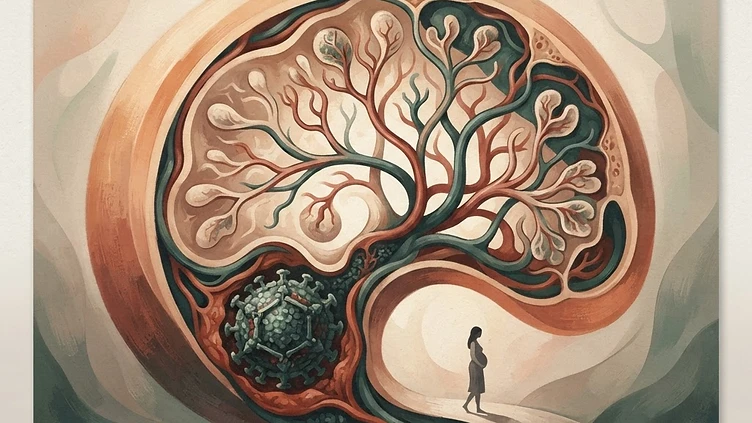
Sometimes a piece of information shakes one of our most fundamental assumptions about ourselves; this is exactly why I did not want to believe it when I first heard it. When I learned that the origin of the placenta—which allows us to be mammals, to be nourished and grow for months in the womb—lies in a viral infection, I felt an immediate internal resistance. How could the most delicate, protected moment of life be explained by a word that evokes disease, decay, and invasion? Yet biology is a discipline that has repeatedly shattered our most cherished notions of purity and cleanliness; this was just one more of them. As I pursued the question, I realized this was not a metaphor or a literary analogy, but a concrete reality etched into the deepest layers of our genome. ## Fossil Viruses in the Genome A significant portion of human DNA consists of remnants from ancient retrovirus infections that once entered our bodies. Unlike the viruses that make us sick today, these had the ability to insert their genetic material directly into the host's genome; if this insertion occurred in reproductive cells, the viral trace did not remain only in that individual, but became a permanent legacy passed down through generations. Imagine an infection embedding itself so deeply that it ceases to be a disease and becomes part of your identity. Most of these remnants have been silenced over time, becoming functionless fragments like notes forgotten in the silent archive of the genome. But not every silenced note remains quiet forever. Evolution rarely discards its materials; it prefers to reinterpret what already exists. Over millions of years, some of these ancient viral fragments took on new functions, becoming part of the host organism's own genetic repertoire. While this may seem like a strange coincidence at first, it is actually one of the most striking examples of biological creativity. This is not just about tolerating an outside structure, but embracing it deeply enough for it to assume a vital function. So, what does this embrace turn into? This is where the matter moves from an abstract genetic detail to something concerning our very existence. One of the functions adopted is not just an ordinary biochemical detail, but one of the fundamental features defining mammals: the placenta itself. ## The Birth of Syncytin For the placenta to function, cells between the mother and the fetus must overcome the cell membranes that should normally remain separate and fuse together. Without this fusion, the syncytium—the specialized tissue layer that allows for the passage of nutrients, oxygen, and waste—could not form. This is where genes called syncytins come into play; the origin of these genes, which take on the task of fusing cells together, traces back to the gene encoding the envelope protein of a retrovirus. Viruses possess the ability to fuse their membranes with host cell membranes to enter them; evolution took this fusion capability and repurposed it, turning a mechanism of invasion into a tool for construction. It is tempting to see this as a coincidence, but the logic behind it is quite consistent. Nature does not have to start from scratch when creating a new feature; it repurposes the tools at hand. A virus's ability to penetrate a cell membrane was the trait that made it dangerous to the host; but that same feature could also be used to merge two separate cells to create a single, functional tissue. Millions of years ago, this potential was recognized, selected, and made permanent. Today, at the foundation of the mechanism that makes our reproduction possible, lies this genetic tool that once served a completely different purpose. ## The Hybrid Nature of Identity We need to pause and reflect here, because this is not just an interesting biological detail. Finding an infection at the root of the mechanism that makes reproduction—the most intimate beginning of life—possible challenges one of our most beloved stories: the idea of purity.e, uncorrupted origin untainted by anything outside. Biology shows us the exact opposite; one of our most essential, vital mechanisms is the product of a relationship established with an external entity. This demonstrates that identity is not built on a pure essence, but rather arises from a layered negotiation. Perhaps what is truly unsettling is that this hybridity is the rule, not the exception. The human body has negotiated with everything it has encountered throughout history; it has fought, compromised, and sometimes incorporated the other into itself. The syncytin example is one of the most deep-rooted and permanent results of this negotiation; its outcome determined not just an individual, but the reproductive mode of an entire lineage. The fact that what defines our identity bears the mark of a relationship with an external element reminds us that the boundaries of what we call 'us' are not nearly as sharp as we think. When I bring all this information together, I no longer feel the discomfort of my initial reaction; instead, there is a sense of wonder. I understand that if the most intimate, protected moment of life is the product of a relationship with something external, this is perhaps not a deficiency, but the most honest expression of biological creativity. Our longing for the idea of purity is often fueled by a desire to ignore the complexity of reality; yet when we look so closely at our origins, what we find is not a story of contamination, but one of adaptation. This ancient viral trace sleeping in the depths of our genome tells us not who we are, but how we came to be; and this narrative is a record of constant exchange and negotiation, rather than a pure origin. Perhaps this is the most honest definition of being human: to accept that we are never alone, and that even our most intimate moments carry the mark of another being.
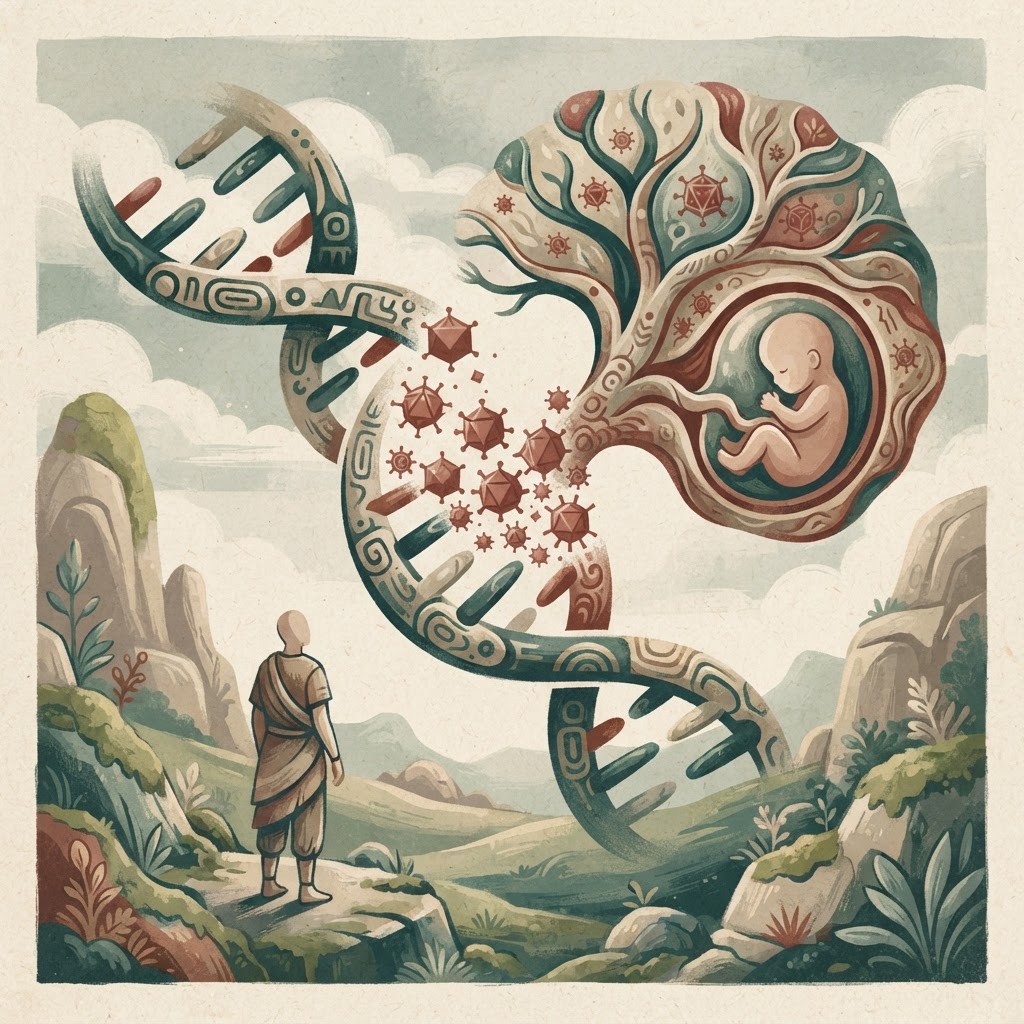
İlgili Denemeler
Can the Human Brain Detect Magnetic Fields?
Geophysicist Joseph Kirschvink's experiment at Caltech indicates that the human brain responds to magnetic fields, raising questions about a potential sixth sense.
Jan Hendrik Schön: The Physicist Who Fooled Science
The scandal of Jan Hendrik Schön's fabricated data at Bell Labs highlights the critical vulnerabilities in the scientific peer-review system.
Barry Marshall Drank Bacteria to Prove Stomach Ulcer Theory
Barry Marshall made medical history by consuming harmful bacteria to prove that stomach ulcers are caused by an infection rather than stress alone.
Tartışma (0)
Henüz yorum yok. İlk yorumu siz yapın.
Join the Newsletter
New essays, once a week, delivered to your inbox.