The Canon of Medicine: How Avicenna's Work Shaped Medical History
What made a single work by Avicenna the unquestionable standard of medicine for centuries?
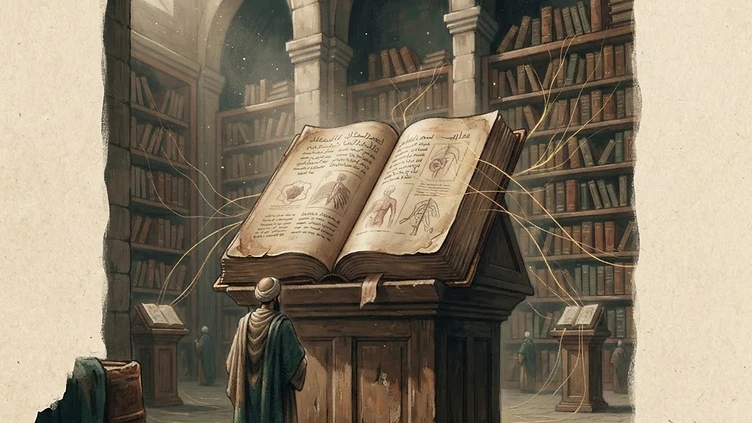
Imagine a book that transcends its own era, serving as the core textbook in medical faculties for six hundred years. In Europe’s most prestigious universities, students memorized its lines, physicians based their diagnoses on its methods, and those who dared to object were branded as heretics. This is not science fiction; it is the true history of The Canon of Medicine. Penned by Avicenna in the tenth century, this work remained the primary reference for medicine in both the Western and Islamic worlds until the seventeenth century. How does a text become so unquestionable for such a duration? The answer reveals more than we might expect about the nature of knowledge and the peculiar relationship institutions form with it. ## The Man Who Collected Scattered Knowledge Avicenna’s true achievement was not, as often assumed, a groundbreaking new medical discovery. The knowledge provided by Galen, Hippocrates, Aristotle, and numerous Islamic scholars before him was scattered, often contradictory, and written in different languages and logics. A physician had to consult dozens of sources to understand an illness and resolve conflicts using their own intellect. Avicenna’s contribution was to organize this chaos with unprecedented systematicity; he placed every disease, drug, and treatment method within a logical structure. We must pause here to ask: is a synthesis less valuable than an original discovery? I believe not, for creating order and making scattered truth accessible is a monumental intellectual labor in itself. The strength of The Canon of Medicine lies right there; it did not offer the reader a confusing heap of information, but a map that could be followed from beginning to end. A medical candidate no longer needed to compare dozens of sources; mastering this single book sufficed. This convenience accelerated the book’s dissemination, but it also, imperceptibly, sowed the seeds of a dangerous habit. ## When Perfection Turns into a Trap When does the comprehensiveness of a work become a trap? In the case of The Canon of Medicine, the answer is that the book appeared so consistent and complete that finding an entry point to critique it became nearly impossible. When the parts of a system are so tightly knit, challenging one point risks shaking the entire structure, and no one wishes to take that risk. Thus, the book ceased to be merely a useful resource and became an untouchable institution. We should not ignore a potential counterargument: perhaps the book was genuinely so good that no one could write a better one for centuries. While partially true, this does not suffice as a full explanation. History shows us that no knowledge system remains unchanged forever; the secrets of the human body are inexhaustible. The problem, therefore, did not stem from the book’s perfection, but from the fear that formed around it. Universities and religious and political authorities had sanctified the text to such an extent that touching it meant endangering not just an idea, but the credibility of the institution itself. Authority here was born not of knowledge, but of the desire to protect it. ## Being Right Is Not Enough, Being Questionable Is Essential Now, let us reach the core of the matter: does a piece of knowledge lasting for centuries prove its truth? It is tempting to think so, as longevity provides a sense of security. Yet, the example of The Canon of Medicine shows the opposite; much of the information within was incorrect or sometimes even harmful by modern medical standards. Erroneous assumptions about blood circulation and incomplete explanations regarding the causes of diseases were accepted for ages without challenge. What kept the book alive was not its truth, but the fact that institutions stopped questioning it. This reminds us of a general truth: the line between knowledge and authority is often thinner than we imagine. An idea is born as a challengeable proposition, but over time, through constant repetition, it becomes a pillar of an institution and eventually stops inviting inquiry. Every text read in a lecture hall, every opinion cited in court, and every interpretation held by a scholar is subject to this transformation. Do we have such a book today? Perhaps not a textbook, but there is surely some assumption, some institutional reality, or an idea we refrain from questioning. Ceasing to question is rarely a conscious decision; it is a habit that accumulates in silence. By the time we notice, it is often too late. Avicenna’s book was the work of the most brilliant mind of its era, and it deserved respect. But it was not the book itself, but the fear of its readers, that transformed it from a respectable source into an unquestionable dogma. Perhaps the power of knowledge is not measured by its accuracy, but by how long it remains unchallenged; and this measure tells us more about ourselves than it does about the truth. The power of a book lies not in its pages, but in the silence of those who read it.
İlgili Denemeler
Can the Human Brain Detect Magnetic Fields?
Geophysicist Joseph Kirschvink's experiment at Caltech indicates that the human brain responds to magnetic fields, raising questions about a potential sixth sense.
Jan Hendrik Schön: The Physicist Who Fooled Science
The scandal of Jan Hendrik Schön's fabricated data at Bell Labs highlights the critical vulnerabilities in the scientific peer-review system.
Barry Marshall Drank Bacteria to Prove Stomach Ulcer Theory
Barry Marshall made medical history by consuming harmful bacteria to prove that stomach ulcers are caused by an infection rather than stress alone.
Tartışma (0)
Henüz yorum yok. İlk yorumu siz yapın.
Join the Newsletter
New essays, once a week, delivered to your inbox.