Al-Biruni: Measuring Earth From A Single Mountain
How did Al-Biruni calculate the size of an entire planet by climbing a single mountain?
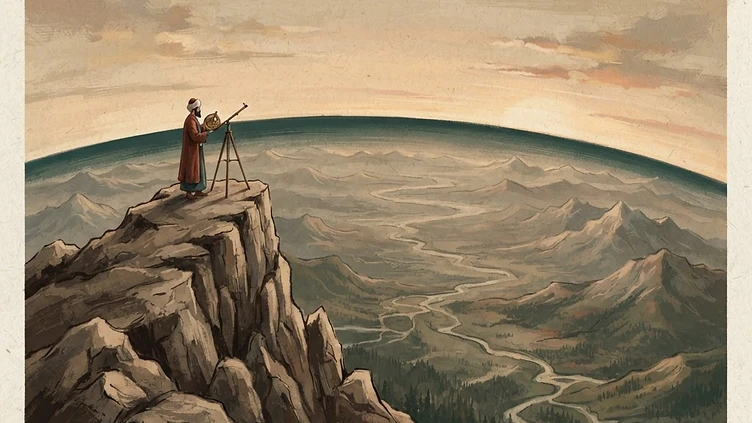
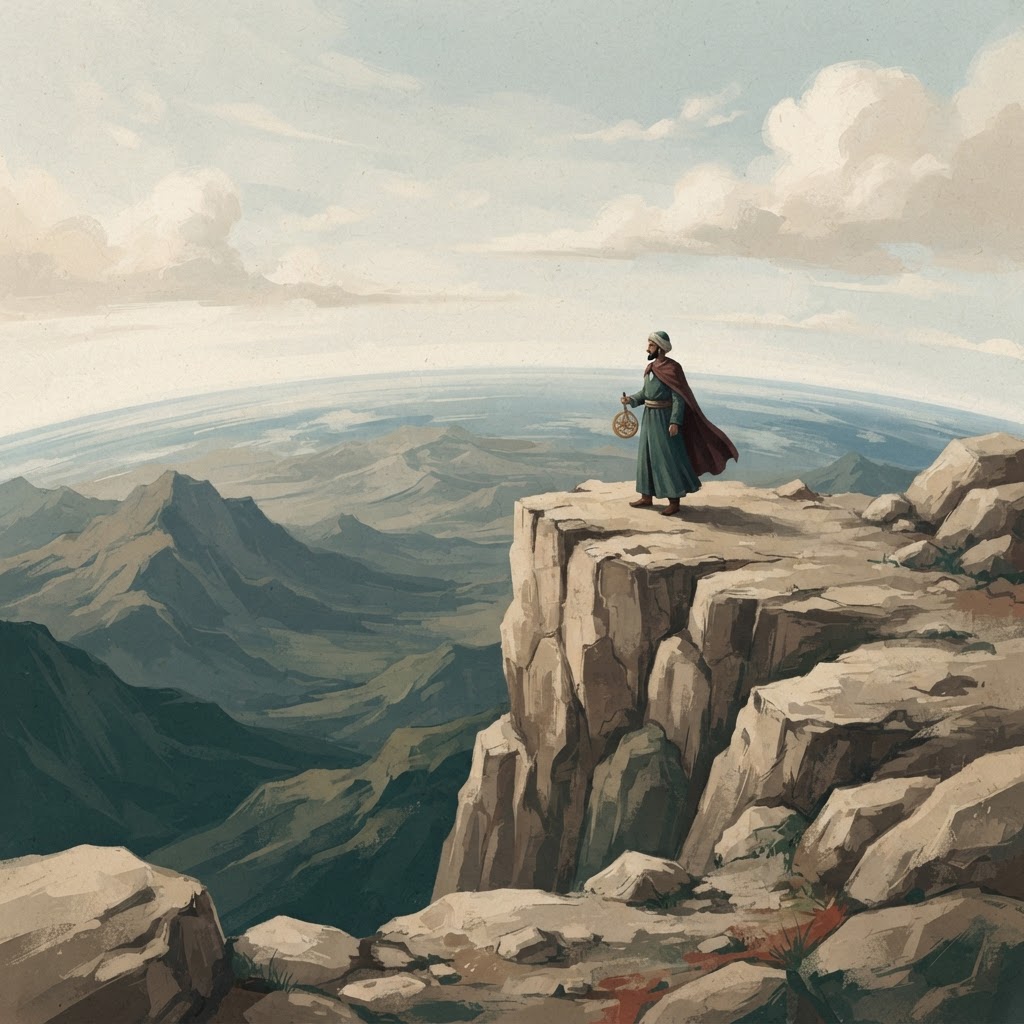
The most striking feats of human intellect are often achieved with the most modest of tools. Climbing a mountain to gaze at the horizon is one of the most mundane gestures of daily life; yet, if there is a mind behind this simple act capable of calculating the size of the planet, the view suddenly takes on a profound new meaning. This is precisely what Al-Biruni did: he looked at something visible to everyone and performed a calculation that no one else had grasped. The question this essay pursues is simple: how can one arrive at the measure of a vast world from a single point and a single angle? ## Reaching the Whole from a Single Point For those familiar with Eratosthenes' method, Al-Biruni's approach might at first seem strange. Eratosthenes relied on the distance between two cities and the differing shadow angles of sunlight at those two points; his calculation was based on a comparison of two distant observations. Al-Biruni chose a different path: he climbed a single mountain, observed a single horizon, and sufficed with a single angle. This was akin to replacing a line drawn between two points with a beam of light launched from a single point. Is such a method truly reliable? The immediate objection would be: is a single measurement not more vulnerable to error? Yet, what Al-Biruni demonstrated was that a paucity of observations is not a flaw, but that the crux of the matter lies in the accuracy of that single observation. Measuring the distance between two cities was a process dependent on the reliability of caravan routes, the passage of time, and geographical knowledge, where small errors could accumulate at every step. Conversely, knowing the height of a mountain and measuring the angle to the horizon with precision was a far more controlled process. Al-Biruni's intuition was perhaps this: not every tool nature offers us is equally reliable; what matters is finding the one with the least margin for error and leaning upon it. This was a loyalty at the heart of scientific thought: a quest not for quantity, but for certainty. ## The Mathematics Within the Angle One must pause here to ask: from a mountain top, how can the radius of a planet be derived from the line seen by the human eye? The answer lies in an idea as old as geometry itself. If you know the height of the mountain and can measure the angle formed while looking at the horizon from that height, you form a right-angled triangle where you are one vertex, the base of the mountain is another, and the center of the Earth is the third. The relationship between the sides of this triangle can be solved with the simple formulas of trigonometry. Al-Biruni's achievement was to construct this triangle using only an astrolabe and a knowledge of elevation, without the need for complex instruments, distant points, or long caravan journeys. The beauty of this method lies in the transformation of abstract mathematics into a tangible result. For most, trigonometry remains a collection of formulas memorized at school desks; sine, cosine, tangent, pages of exercises. But in Al-Biruni's hands, these formulas became a bridge that allowed the horizon viewed from a mountain top to transform into the diameter of the planet. What is truly striking here is not the simplicity of the instruments, but the depth of the mind. Without the need for complex observatories, expensive equipment, or long-term travel, a human could arrive at a result of planetary scale through the power of intellect alone. It was proof that science could yield answers to the greatest questions even under the most modest conditions. ## The Discipline Behind Accuracy The fact that Al-Biruni's result was surprisingly close to today's values was a product of discipline rather than coincidence. In the medieval Islamic world, science was not limited to theoretical speculation but was nourished by the rigor of observation. Thinkers like Al-Biruni, while diving into the depths of geometry and trigonometry, did not hesitatee to test this theoretical knowledge against the real data of nature. Measuring an angle, determining a height accurately, or considering how temperature changes or atmospheric refraction might affect observation—all were parts of this rigor. It is appropriate to ask here: was reaching such an accurate result with such a simple method merely a matter of luck, or was there a methodological robustness behind it? I believe the answer is the latter. Because scientific accuracy often stems not from complexity, but from the correct definition of the problem and the precision of the measurement. Whether determining the mountain's height or measuring the angle of the horizon, Al-Biruni acted with a mindset that sought to minimize sources of error. This is one of the fundamental principles of modern science: the reliability of the result is determined not by the simplicity of the tool, but by your discipline while using it. ## The Courage Beyond Observation Climbing a mountain and gazing at the horizon is, in fact, an act of cosmic courage. Because at that moment, the thin line you see before you is not merely a landscape, but a clue to the planet itself. That Al-Biruni recognized this shows how much the perception of the world can shift. Most of us see only beauty when we look at the horizon; he saw geometry, a calculation, and the measure of a planet. This difference in perspective reminds us that science is not far removed from daily life, but rather, how it can seep into the most ordinary moments. Today, we have satellites, laser measurements, and global positioning systems; calculating the Earth's radius no longer requires climbing a mountain. But this technological convenience does not diminish the value of Al-Biruni's method; on the contrary, it enhances it. Because what he achieved relied not on the abundance of resources, but on the depth of reasoning. A human, with only an astrolabe in hand and a solid grasp of geometry in mind, could seek an answer to a colossal question like the size of the planet. This is a lesson of science that must be remembered in every age: great questions do not always require great tools; sometimes, all that is needed is knowing how to look correctly. Al-Biruni's gaze from that mountain top is, in effect, a summary of the human relationship with the universe. Limited tools in hand, a boundless planet ahead, but what fills the void between is reasoning itself. Today, amidst the ease offered by technology, we may have lost such simple yet profound perspectives. Yet, climbing a mountain and looking at the horizon can still remind us how vast the world is and how capable the human mind can be. Perhaps the most lasting legacy of science is not the answers themselves, but such moments that teach us to ask questions and find the path that leads to them.
İlgili Denemeler
Can the Human Brain Detect Magnetic Fields?
Geophysicist Joseph Kirschvink's experiment at Caltech indicates that the human brain responds to magnetic fields, raising questions about a potential sixth sense.
Jan Hendrik Schön: The Physicist Who Fooled Science
The scandal of Jan Hendrik Schön's fabricated data at Bell Labs highlights the critical vulnerabilities in the scientific peer-review system.
Barry Marshall Drank Bacteria to Prove Stomach Ulcer Theory
Barry Marshall made medical history by consuming harmful bacteria to prove that stomach ulcers are caused by an infection rather than stress alone.
Tartışma (0)
Henüz yorum yok. İlk yorumu siz yapın.
Join the Newsletter
New essays, once a week, delivered to your inbox.