Biosphere 2: Why Did Humanity's Glass World Fail?
When eight people sealed themselves inside a glass dome in the Arizona desert to recreate their own planet, what did they overlook?
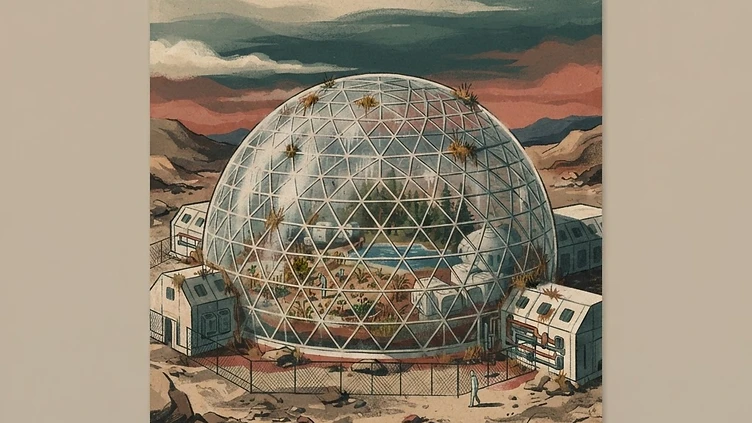
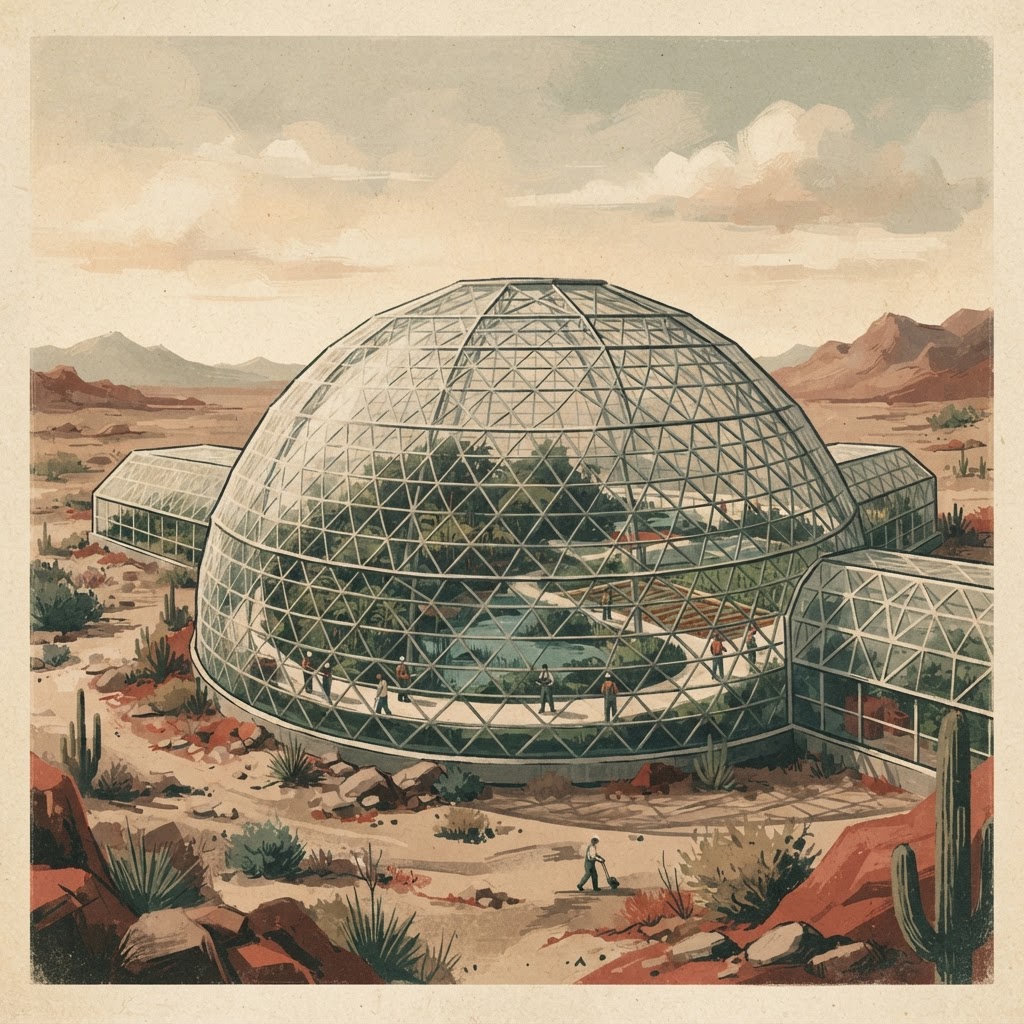
Can a human compress their own planet into a closed glass box? That was exactly the question that came to mind when I first saw that massive greenhouse structure glistening under the sun in the middle of the Arizona desert. Built in the early 1990s, Biosphere 2 was designed with the ambition of sealing eight people inside to recreate all of Earth's ecosystems on a miniature scale. Rainforests, deserts, coral reefs, and farmland were all meant to function under the same glass roof without any air exchange with the outside world. The project was not merely an engineering trial; it was a concrete confession of humanity's dream to dominate nature. Why, then, did this dream fracture so quickly? Searching for the answer, I realized that the core issue was not a technical error, but rather humanity's overconfidence in its own intellect. ## Building a Glass World The architects of Biosphere 2 believed they could design nature like a machine, breaking it down into parts and reassembling it. Each biome was conceived as an individual module; as if a rainforest were a motor part and a desert were the gear next to it. This perspective owed much to the old dream inherited from the Enlightenment: nature is understandable, measurable, and therefore controllable. Yet, true ecosystems are not simply the sum of their parts; the invisible bonds between them are too complex to fit into any engineering blueprint. The eight people who entered Biosphere 2 were attempting to trap this complexity in a box, but the box itself was too simplistic to sustain it. What is interesting here is that the project did not lack scientific rigor. On the contrary, experts from disciplines ranging from botany to microbiology were involved. However, even scientific meticulousness was insufficient to predict the system's capacity for self-regulation. In a natural ecosystem, balance is not the product of human planning, but the result of millions of years of trial and error. As the creators of Biosphere 2 attempted to compress this process into a few years, they were essentially looking for a shortcut to evolution itself. The system paid the price for this shortcut in the most unexpected way. ## Balance Collapsing as Oxygen Diminished The point where the project began to collapse was not under anyone's gaze: it was concrete. The concrete used in the structure's foundation began to react with the carbon dioxide in the air, slowly absorbing it. While this chemical process appeared harmless on its own, it quietly disrupted the system's oxygen balance. As the concrete trapped carbon dioxide, the amount of oxygen that plants were supposed to produce through photosynthesis became increasingly insufficient. Consequently, those inside began breathing air with less oxygen day by day; this manifested in physical symptoms such as fatigue, insomnia, and focus problems. No one had predicted that a seemingly inanimate material like concrete could so decisively determine the fate of a living ecosystem. At this point, the question to be asked is: why does the smallest, most insignificant-looking part of a system sometimes become the cause of the greatest collapse? Because in closed systems, feedback loops are not linear; a small deviation grows exponentially over time. In Biosphere 2, as oxygen levels fell, the respiration rate of microorganisms living in the soil changed, which further increased the amount of carbon dioxide, and this increase affected the growth rate of the plants. In short, a single chemical reaction turned into a chain reaction of disintegration. Here, the human error was the assumption that every variable could be controlled individually; but nature does not separate variables; it entwines them. ## A Lesson for the Return to Mars Today, scientists who dream of sending humans to Mars read the collapse of Biosphere 2 not as a story of failure, but as a cautionary text. Every closed life-support system to be established in space faces the same fundamental question: how long can the cycles of oxygen, water, food, and waste remain in balance without human intervention? Biosphere 2 did not provide a definitive answer, but it showed just how deep that question goes. In a world where even a seemingly innocent material like concrete could threaten the system, claiming that a Martian settlement could be self-sufficient would be a different version of the same arrogance. Today's researchers translate this lesson with a humbler tone: when designing closed systems, one must abandon the assumption that everything can be calculated in advance. Instead, investing in the system's capacity for self-correction—its resilience—seems more realistic. A colony bound for Mars should perhaps aim for a structure capable of responding quickly to unexpected deviations rather than attempting to control every variable perfectly. This is the true legacy of Biosphere 2: a transition from the dream of control to the skill of adaptation. This is one of the most honest moments of science learning from failure. The glass dome of Biosphere 2 still stands in the Arizona desert today, but there is no longer an artificial planet inside for eight people to breathe in. What remains is one of the most striking boundaries where the human dream of recreating nature is confronted. Perhaps the most valuable aspect of this experiment was its failure; for failure became the clearest lesson nature could teach us: imitating life is far more difficult than understanding it. The oxygen lost inside the glass dome reminded us just how fragile the balance of our own planet is. And perhaps the real issue was not building a new world on Mars, but learning to listen to the world we already have more carefully.
İlgili Denemeler
Can the Human Brain Detect Magnetic Fields?
Geophysicist Joseph Kirschvink's experiment at Caltech indicates that the human brain responds to magnetic fields, raising questions about a potential sixth sense.
Jan Hendrik Schön: The Physicist Who Fooled Science
The scandal of Jan Hendrik Schön's fabricated data at Bell Labs highlights the critical vulnerabilities in the scientific peer-review system.
Barry Marshall Drank Bacteria to Prove Stomach Ulcer Theory
Barry Marshall made medical history by consuming harmful bacteria to prove that stomach ulcers are caused by an infection rather than stress alone.
Tartışma (0)
Henüz yorum yok. İlk yorumu siz yapın.
Join the Newsletter
New essays, once a week, delivered to your inbox.