The Invention of Paper: How It Changed Knowledge and Thought Velocity
Can the speed of thought change when the medium itself changes?

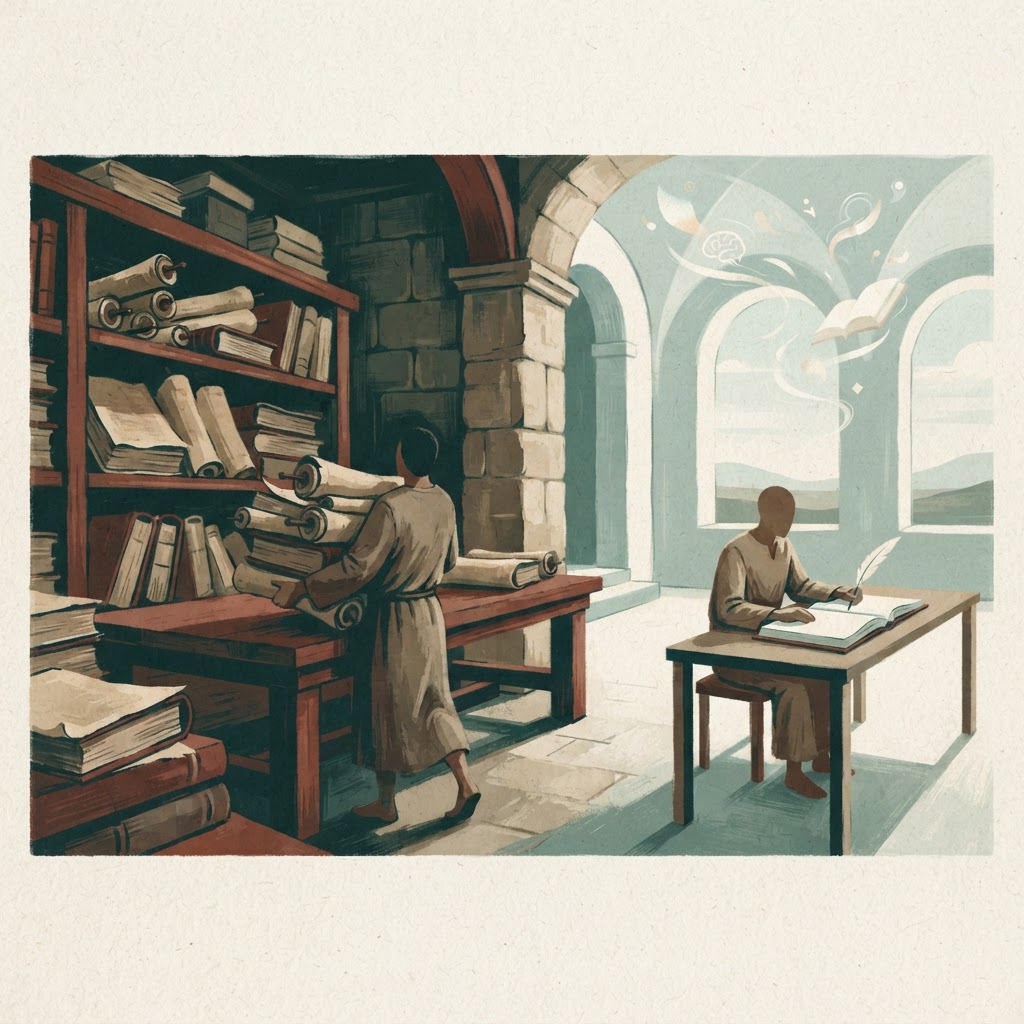
Often, it is not the thought itself but the medium that carries it that determines how many people it reaches and how quickly it spreads. No matter how profound an idea may be, if the surface it is written upon is heavy, expensive, or fragile, the idea itself becomes burdened, slowed down, and confined to a narrow circle. The emergence of paper on the stage of history is one of the rare moments that reversed this simple yet profound truth. The question of whether the speed of thought can change along with its medium is one of the quietest yet most influential questions in the history of technology, for the answer lies hidden in every book and notebook we reach for today. ## The Language of Stone, the Limit of Stone In the early centuries of writing, knowledge was etched into stone, carved into clay, or inscribed upon animal hides. Each of these materials imposed its own price on humanity: stone was heavy, clay was fragile, and leather was both expensive and labor-intensive to prepare. Reproducing a text was not a matter of pressing a button; it was an endeavor that required months of labor, expert hands, and significant material resources. In such a world, the rapid spread of knowledge was not a virtue; rather, its slow and meticulous preservation was the true value, as every copy was a significant investment in itself. This slowness was not just a physical limitation; it also drew a social boundary. A small elite, possessing access to heavy materials and the time or skill to process them, naturally monopolized the gates of knowledge. A temple priest or a palace scribe did not just hold a monopoly on a craft, but on access to knowledge itself. Even a mind eager to contemplate had to first find a way to access those cumbersome materials; the idea might have been free, but the object that bore it never was. The natural ease with which we pour our thoughts onto paper today is a comfort that, for most of human history, simply did not exist. ## The Power of Light Material Paper created a rupture precisely when it landed in the midst of this heaviness. While its lightness might seem like an insignificant detail at first glance, it is a characteristic that redefined the social status of knowledge. Carrying a piece of parchment or a clay tablet was a burden and a chore; paper, however, could be tucked into a pocket, a bag, or a horse’s saddle. This small difference opened the doors to a world where knowledge no longer had to remain in one fixed place but could flow from hand to hand, from city to city. Yet, the true power of paper lies not just in its lightness, but in its reproducibility. Transferring a text to paper was incomparably faster and cheaper than carving it into stone. This raises the question: does an idea lose its value when the medium it is carried on becomes cheaper, or does it gain value because it reaches more people? In my view, what is lost is not the value of the idea, but the privilege of access to it; and this loss turns into a gain for humanity, as knowledge is no longer a prisoner of a specific class or a specific location. The concrete traces of this transformation can be seen in the changing face of the library. A space that once carefully guarded a few hundred leather-bound volumes became, with the proliferation of paper, a sanctuary housing thousands of texts. This is not just growth; it is a shift in mindset: knowledge ceases to be a rare treasure and becomes a resource meant to be shared. Geographic distances shorten, as a copy of a text can now reach one realm from another in days; social distances shrink as well, because anyone who can read and write becomes a potential reader, writer, or thinker. ## Does Speed Transform the Truth? Does this speed also change the nature of knowledge itself? Here lies a tension that has never been fully resolved since the invention of paper. When a text is replicated rapidly, the mechanisms that control, verify, and correct it must work with equal speed; otherwise, misinformation spreads.nformation can spread faster than the truth. Stone tablets spread slowly, but this slowness provided a kind of natural filter; every copy was an object upon which labor and reflection had been invested. The speed of paper loosens this filter, and a counter-argument might rightly ask: is speed not the enemy of depth? I believe that answering this with a definitive yes would be to overlook the true potential that paper offers. Speed does not destroy depth; it merely changes its form. A text is no longer fixed in one hand or by a single interpretation; different hands read it, debate it, and write upon it, turning an idea from a single voice into a polyphonic discussion. The tension we experience in the digital age today is, in fact, a new version of this age-old question: the speed at which information circulates on a screen does not guarantee its accuracy, but that same speed ensures that the information passes before more eyes and is questioned more often. What paper taught us is that speed and truth are not two forces that destroy each other, but rather two forces that challenge one another. To think that every line we read on a screen today is actually a continuation of the path opened by paper allows us to read the history of knowledge from a more humble perspective. Having shed the weight of stone, thought found a new form in the lightness of paper, and now, it finds it again in the invisible speed of digital flow; each new medium reshapes not only where knowledge goes, but what it becomes. Perhaps the question that should be asked is not which medium carries knowledge faster, but what patience and depth every new gain in speed demands of us.
İlgili Denemeler
Can the Human Brain Detect Magnetic Fields?
Geophysicist Joseph Kirschvink's experiment at Caltech indicates that the human brain responds to magnetic fields, raising questions about a potential sixth sense.
Jan Hendrik Schön: The Physicist Who Fooled Science
The scandal of Jan Hendrik Schön's fabricated data at Bell Labs highlights the critical vulnerabilities in the scientific peer-review system.
Barry Marshall Drank Bacteria to Prove Stomach Ulcer Theory
Barry Marshall made medical history by consuming harmful bacteria to prove that stomach ulcers are caused by an infection rather than stress alone.
Tartışma (0)
Henüz yorum yok. İlk yorumu siz yapın.
Join the Newsletter
New essays, once a week, delivered to your inbox.